
Design Rules for the Best Small Bathroom Tile Combination
Intro — Why Bathroom Tile Combination Matters in a Small Bathroom
Bathroom tile combination is one of those design decisions that feel surprisingly overwhelming—especially in small bathrooms. A space that’s only a few square meters suddenly carries a lot of pressure: every tile, every grout line, every color choice feels permanent.
Not to mention, the bathroom is one of the most expensive parts of the apartments per square meter to build.

This article is not about trends or copying the latest bathroom inspiration you’ve seen online. It’s a decision-making guide—a system you can follow to choose tiles with confidence, even in very small bathrooms.
TL;DR
Designing a small bathroom tile combination doesn’t have to be overwhelming.
Follow these 10 rules: avoid uniformity, coordinate all surfaces, choose light and harmonious colors, mix tile sizes intentionally, tile strategically, keep patterns simple, plan grout placement, visualize digitally, see samples in real life, and ask a professional when needed.
These steps help even the tiniest bathrooms feel larger, cohesive, and stylish.
I’m currently renovating my own mini studio apartment, and progress is slow—in the good way. We’re still at the bathroom stage, which gave me the opportunity to rethink many things I thought I already knew.
After a lot of research, I (re)discovered a few universal rules that work consistently when it comes to small bathroom tile combinations.
In my professional work, I usually design larger-scale buildings with more generous bathrooms—or industrial spaces where functionality often overrides visual finesse.
Designing our own compact bathroom, however, made the topic far more nuanced and, honestly, much more interesting. When space is limited, tile size, color, grout, and placement don’t just decorate the room—they actively change its proportions.
The good news? This is not a matter of taste alone. There are clear rules that help small bathrooms feel calmer, more balanced, and visually larger.
Below, I’ll walk you through these rules step by step—paired with visual examples—so you can design your bathroom with clarity instead of confusion.
1. The Core Rule: Avoid Uniformity
General principle
Avoid using the same tile everywhere—on walls and floors. This means not the same size, not the same color, and not the same pattern. Subtle variation creates depth and prevents a small bathroom from feeling flat or boxed in.
When it comes to bathroom tile combinations, one rule stands above all others—especially in small spaces: avoid uniformity. Using the exact same tile everywhere may feel “safe,” but in reality, it often makes a small bathroom feel flat, boxed in, and visually smaller than it already is.
This principle is not limited to bathrooms; it’s a universal design truth. Spaces need contrast to create depth. In a small bathroom, that contrast becomes even more important.
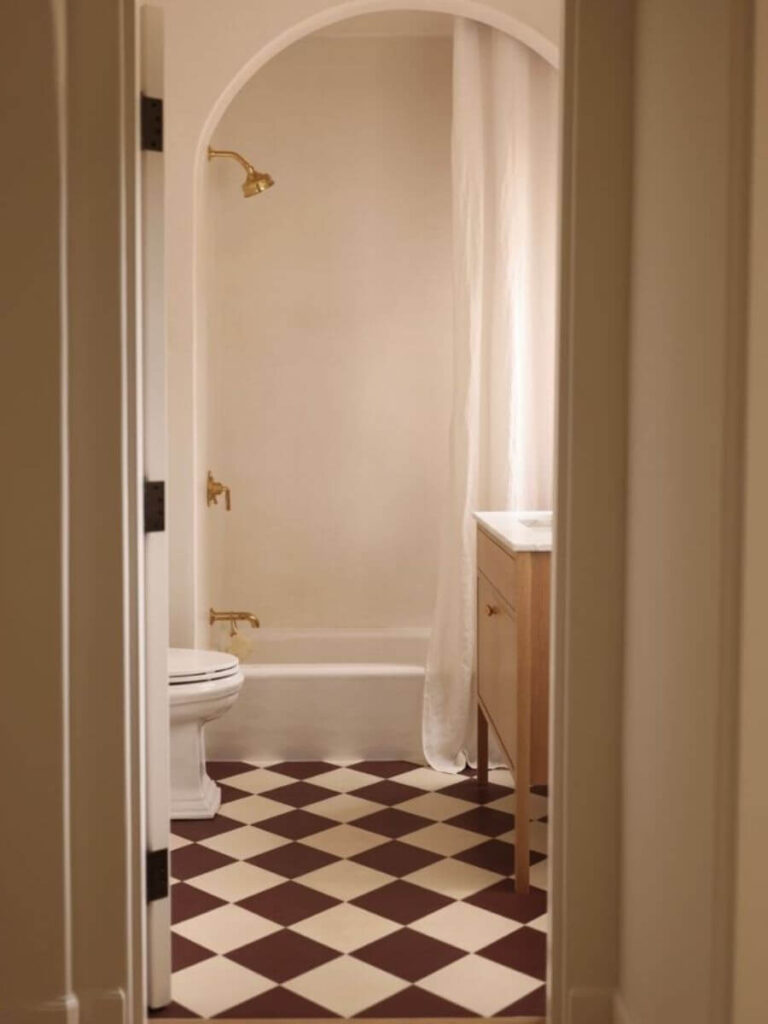
How to create hierarchy in your bathroom:
Avoid using:
- the same tile size on all walls and floors
- the same color across every surface
- the same pattern repeating without pause
Instead, aim for subtle variation.
- For example, pairing smaller wall tiles with larger floor tiles immediately creates hierarchy.
- Or using textured or patterned tiles below and calmer, more uniform surfaces above helps the eye rest.
- It is still possible to use the same tile on the floor and on parts of the wall, if you insist – in this case consider only using just on smaller wall surfaces. Keep larger surfaces just painted, or use different tiles there.

Beautiful deatails – black and white with a vivied blue. Found it here. Sophisticated small bathroom color ideas with earthy browns and terrazzo, an inspo for a luxe bathroom color palette. A beautiful project (3D visualisation) by Ewa Mróz on Behance
Luxury bathroom of Swedish turnkey project. Source
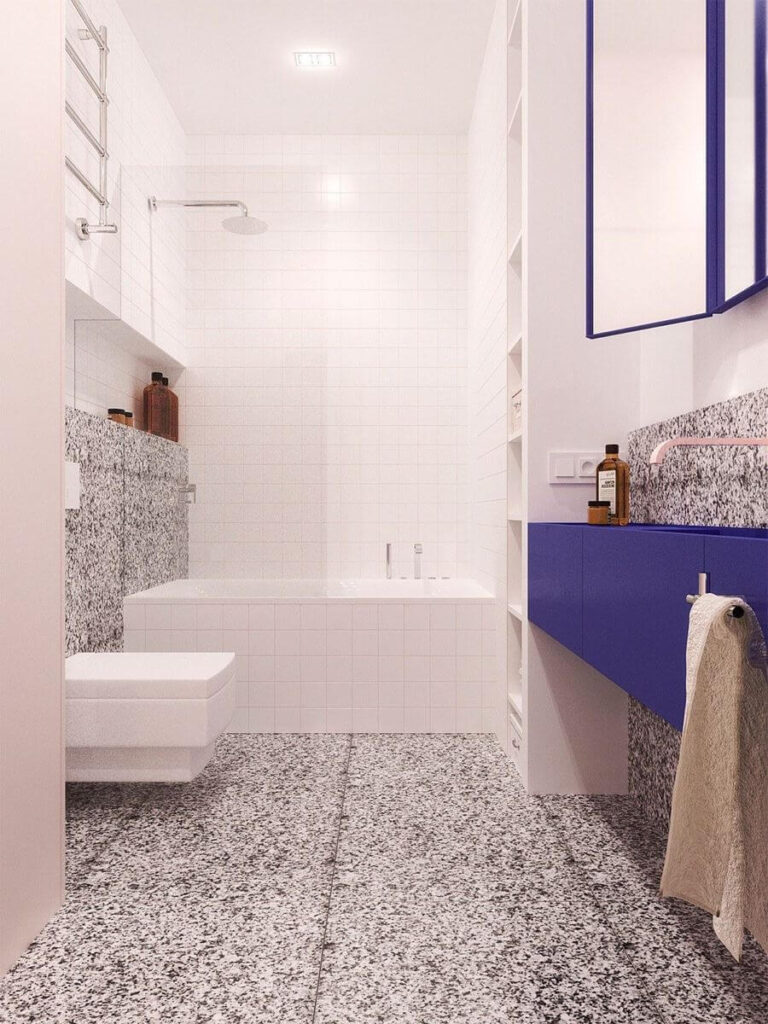
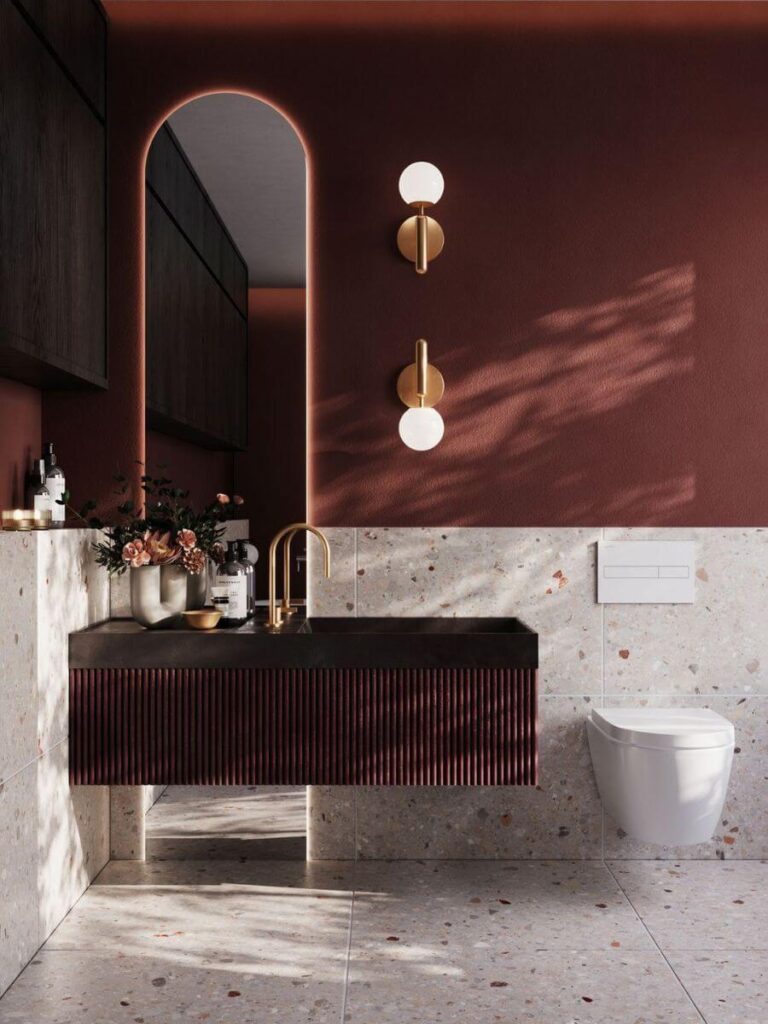
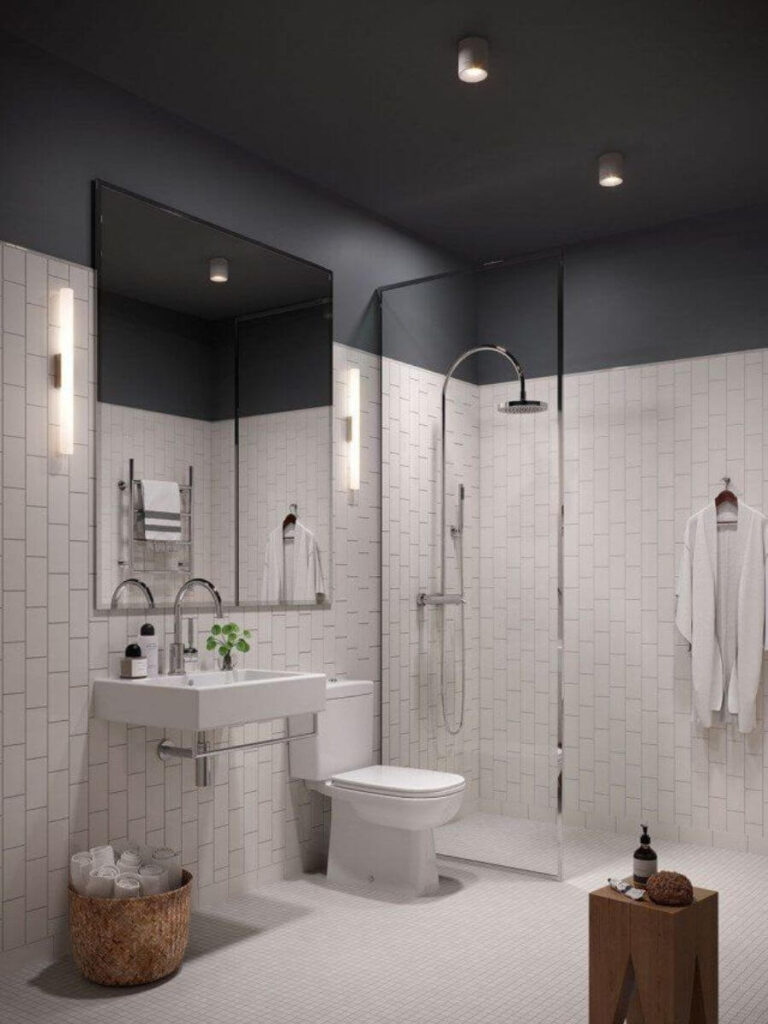
When working with small bathroom tiles ideas, it’s worth asking an extra question:
Do all walls really need tiles, and do they need to go all the way up?
Often, leaving parts of the wall painted—especially upper sections—visually expands the room. A larger, uninterrupted surface reads as more open than a fully tiled box.
If your floor uses a mosaic or a visually “noisy” pattern, balance it with calmer bathroom interior tiles on the walls, or even a smooth painted surface.
A strong floor paired with a quiet wall is a classic, well-working bathroom tile combination that brings harmony without boredom.
Uniformity simplifies decisions—but variation is what makes a small bathroom feel intentional, layered, and well designed. Take a look at the renovation of the small bathroom in our studio apartment!
2. Coordinate All Bathroom Surfaces
Big-picture planning
Tiles should work in harmony with other bathroom materials—vanity finishes, fixtures, mirrors, shower glass. A cohesive material palette makes every space well designed and harmonious.
A successful bathroom tile combination is never just about the tiles themselves. Tiles live in a system—and that system includes vanity finishes, faucets, mirrors, lighting, shower glass, and even wall paint.
When these elements are planned together, the result feels calm, intentional, and timeless.
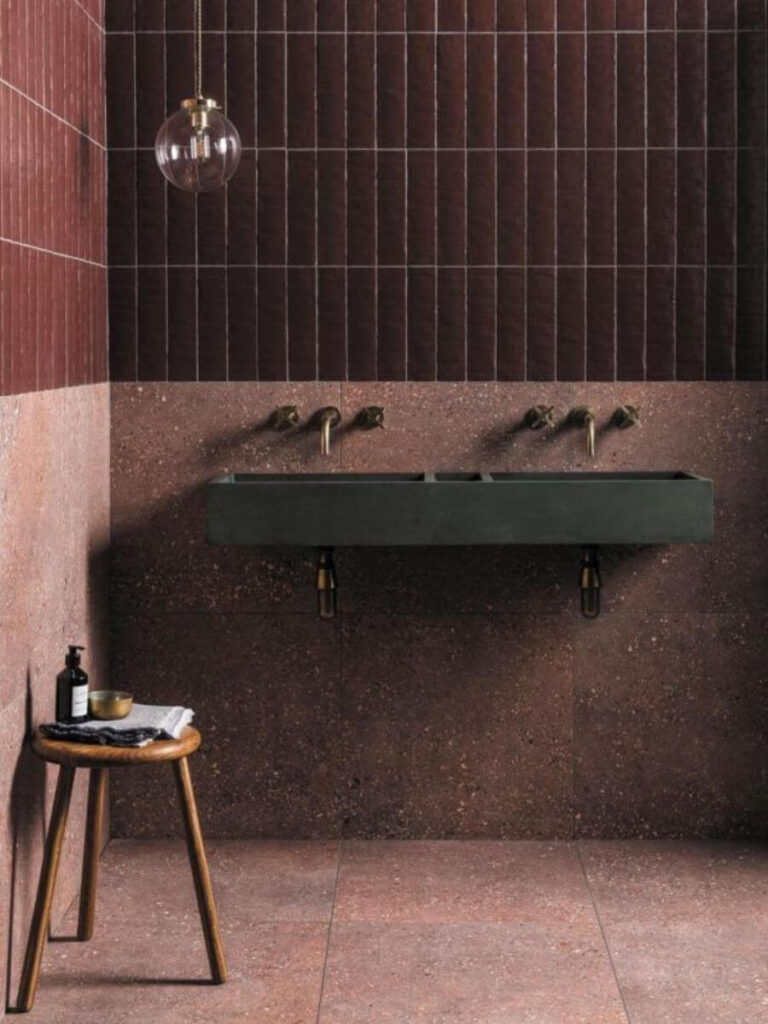
If you fall in love with a specific tile (which often happens), pause before committing and do a little research:
- What materials pair well with it—wood, stone, metal, concrete?
- Which colors enhance it rather than compete with it?
- Does it lean warm or cool in tone?
How to keep all surfaces coordinated?
For example, if you’re drawn to a green bathroom, ask yourself where that green belongs.
- Should it appear on the walls, the floor, the vanity, or just as an accent?
- Is it a cool, bluish green that feels crisp and architectural, or a warmer, earthy green that feels softer and more organic?
The same applies to texture. A clean, sharp tile with a glossy surface communicates something very different from a handmade ceramic with an uneven edge. Both can work beautifully in modern small bathrooms—but they create entirely different atmospheres.
A home in Milano, with a strong visual impact of deep blue – although I am not a fan of wooden floors or wood-like ceramics in the bathroom, this is just such a harmonious example for using mosaics in bathrooms. Also, if you were wondering how to match black and withe with other colors, this is a great example for dark colors! My trial AI visualisation for the concept of mixing patterns: the small space is divided into 3 section, each of it has different charcter, the color white connects them. A second example of combinig similar sizes of tiles and finishes: small mosaic on the wall, flooring and ceiling repeating narrow lines. Nice contrast in materials, colors and hues – found the photo here.


Zoom out even further and consider the bathroom as part of your home, not a separate world. In modern bathroom design, continuity matters.
When the bathroom door opens, the space should feel like a natural extension of the apartment—not a sudden stylistic detour. Matching tones, materials, or moods with the rest of the home helps the entire environment feel coherent and well thought through.
When every surface speaks the same design language, the bathroom feels calmer, and more refined—no matter its size.
Even if it is a tiny space, the focus will be on the appearance and harmony of the materials, rather than the size of the bathroom.
3. Color Strategy in Small Bathrooms
Surface color matters
- Lighter shades are generally preferable, as they reflect light and make the space feel more open.
- That said, small doesn’t mean boring—introducing one bold, soft, cheerful, or vibrant color can add character and personality without overwhelming the room. Even in bigger surfaces – like wall paint, floor tiles, or vanity finishes.
- When choosing colors, keep in mind color harmony – there are cooler and warmer tones, color intensity and saturation matters, as well as the “style” of each tile. (Color is a huge topic in itself, a good analogy for easy understanding is the seasonal-color-analysis method for humans)
Since we’ve already touched on surfaces and materials, it’s natural to talk about color next—because in small bathroom tiles, color choices shape the space just as much as layout or lighting.
Start with Light (for a Reason)
In most cases, lighter colors are your best allies in a very small bathroom design. Pale tiles reflect light, soften shadows, and help compact spaces feel calmer and more open—especially important if there’s no natural light.
Clean whites, soft greiges, warm creams, or light stone tones create a visual base that feels breathable rather than boxed in.
That doesn’t mean dark colors are forbidden—but they need intention.
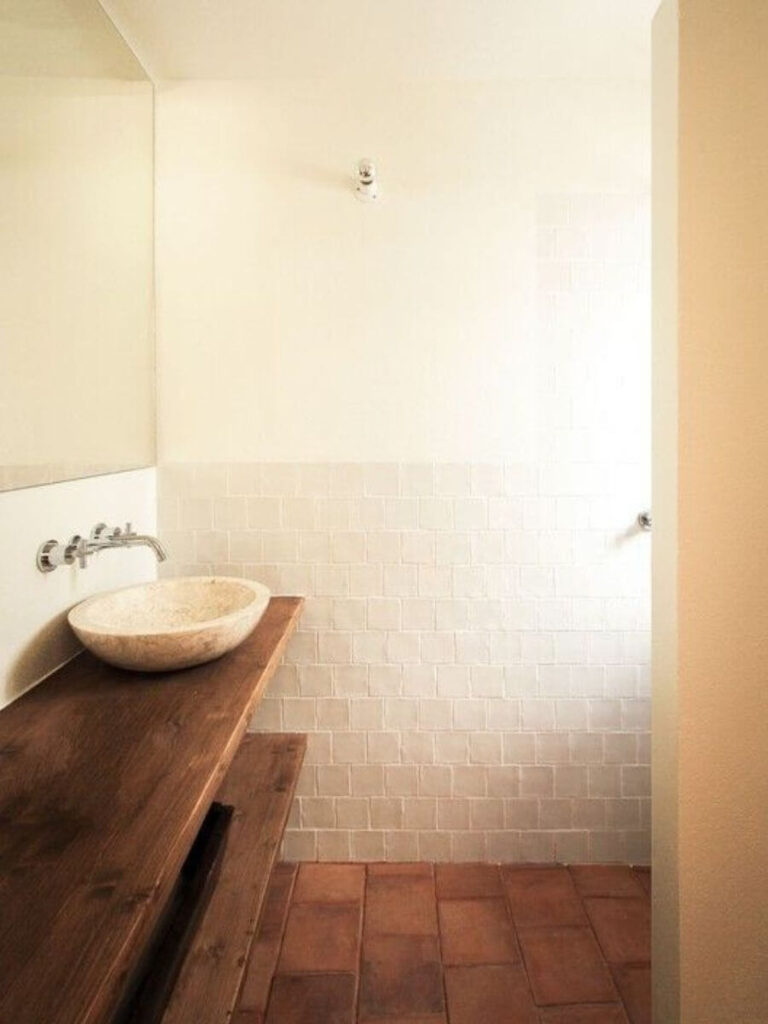
When Dark or Bold Colors Actually Work
Small doesn’t have to mean boring. One bold, cheerful, or vibrant color can add depth and personality without overwhelming the room—especially when used strategically:
- On one main surface (floor tiles, a feature wall, or a vanity finish)
- In bathrooms with limited use, like guest toilets or powder rooms
These spaces aren’t used for long daily routines, so darker tones can feel dramatic and elegant rather than heavy. In fact, they often strengthen the rule by showing that color works best when aligned with function.
The Hampstead Villa by anewday_interiordesign – everything in this bathroom is deep blue, but the different bathroom tile sizes andmaterial choices make a nice monochrom harmony. Other corner of The Hampstead Villa by anewday_interiordesign – same narrow mosaic-like bathroom tile on the wall, combined with wood. Mosaic floor with rustic subway tile ceramic on the wall. Dark and deep earthy tones add charachter and a perfect pairing for black and white mosaic pattern. Found it here.


Think in Color Harmony, Not Just “Nice Shades”
When choosing colors for bathroom interior tiles, think beyond light vs dark:
- Warm vs cool tones (beige vs grey, olive vs emerald)
- Saturation (muted, dusty tones vs crisp, intense colors)
- Surface style (glossy, matte, handmade, industrial)
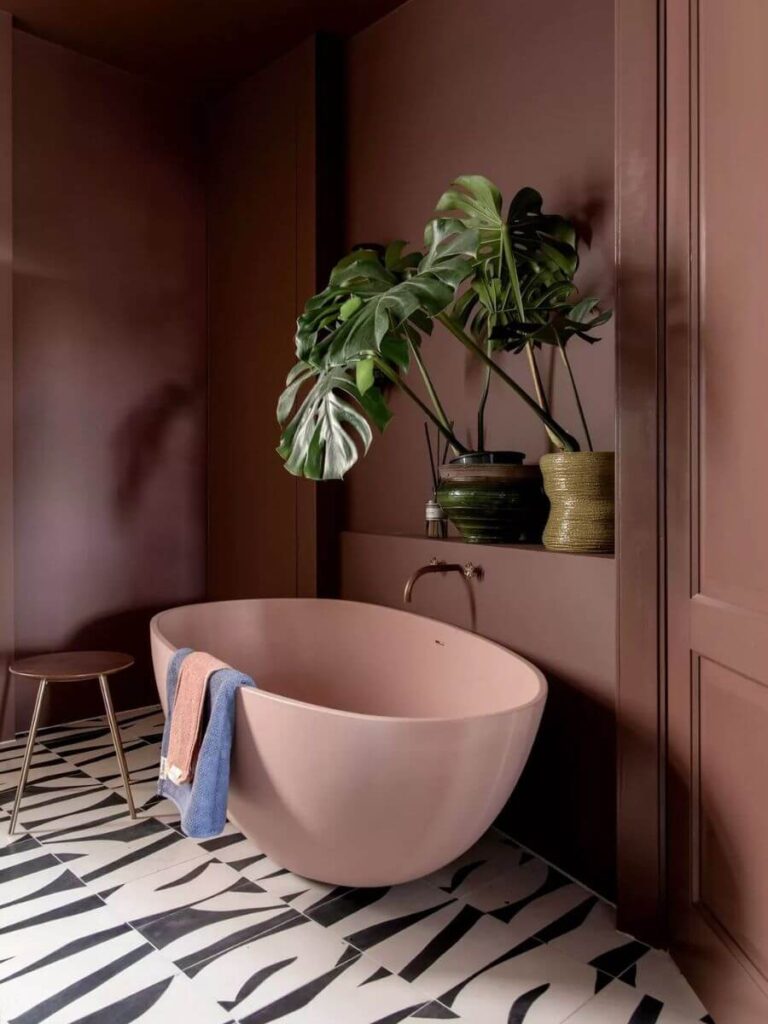
One of the simplest ways to understand color harmony is through the seasonal color analysis used for people. Just like fashion palettes, bathrooms also benefit from harmonious “seasons”—soft and warm, crisp and cool, earthy and deep.
You don’t need to apply it strictly, but it’s a surprisingly helpful guide when deciding what truly belongs together!
Define Your Design Goal First
Before choosing tile colors, ask:
What should this bathroom feel like—fresh, cozy, calm, playful, or dramatic?
Once that goal is clear, every color decision becomes easier. In small spaces especially, consistency beats experimentation.
These aren’t rigid rules—they’re tools. And when used consciously, color becomes one of the most powerful ways to visually expand and refine a small bathroom.

4. Rules for Choosing Tiles Sizes
Tile size fundamentals
Larger tiles often create a more seamless, homogeneous look with fewer grout lines, which helps visually expand a small bathroom.
Mosaics can create a visually uniform surface similar to large-format tiles, especially when patterns are subtle and colors are consistent. They work best when used intentionally, not everywhere.
A proven strategy is to use large-format tiles on the floor with smaller tiles on the walls—or the other way around. This contrast adds structure and keeps the space visually dynamic.
Rules for Choosing Tile Sizes in Small Bathrooms
Tile size is one of the most underestimated tools in small bathroom design. Yet it strongly influences how spacious, calm, or busy a bathroom feels—sometimes more than color itself.
When choosing the best tiles for bathroom projects, especially compact ones, scale matters.
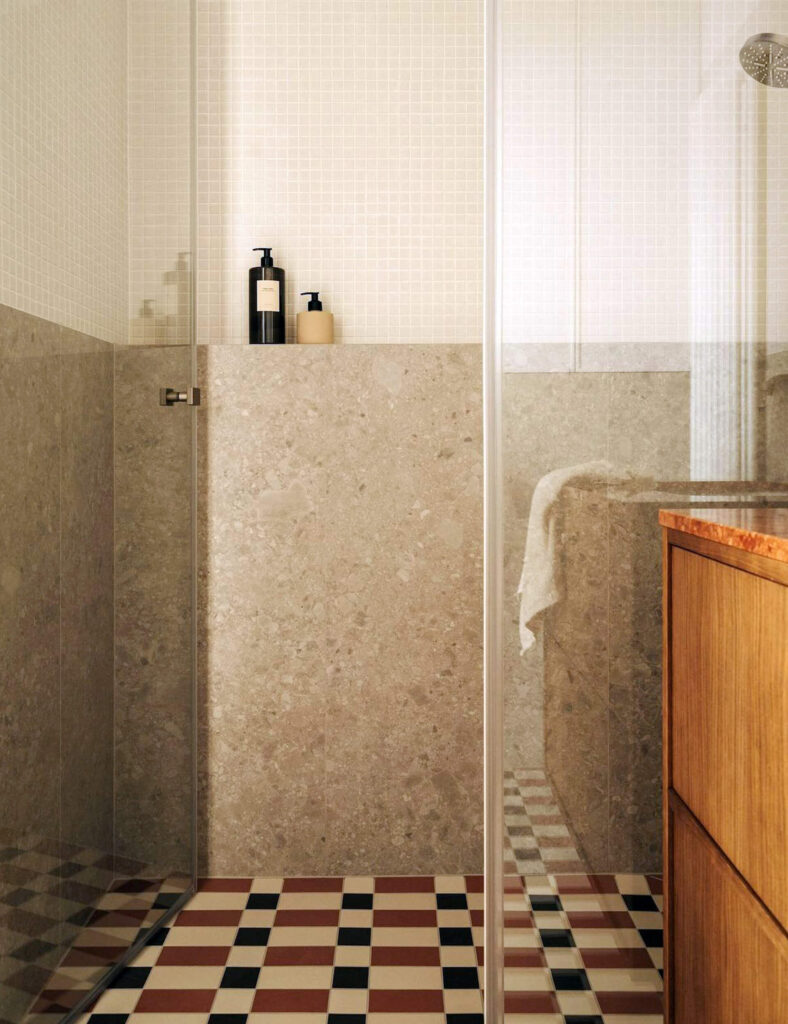
Larger Tiles = Fewer Interruptions
Large-format tiles create a more seamless, homogeneous surface because they reduce the number of grout lines. Fewer visual breaks mean the eye can travel more freely across the space, which makes a small bathroom feel larger and calmer.
This is why large tiles are often a smart choice for bathroom floor tile ideas in compact rooms.

In my own bathroom remodel, I was drawn to terrazzo. Real terrazzo would have been beautiful—but also unnecessary for a small studio apartment. Instead, I chose a gres tile with a terrazzo pattern, sized 66 × 66 cm (about 26 × 26 inches).
The result: very little grout on the floor, a calm visual base, and a surprisingly generous feeling of space.

When Mosaics Work (and When They Don’t)
Mosaics can also create visual unity—if the pattern is subtle and the color palette is restrained. They work best when used intentionally:
- As an accent wall
- In a shower niche or backsplash zone
- On the floor in shower niches
- On smaller surfaces where texture is desired
Using mosaic everywhere can quickly become visually noisy and harder to clean, especially on floors. Hygiene and maintenance matter just as much as aesthetics.
Found it on facebook: Shower Tile: Cloe 2.5×8 in White,
Styling: @brandidevers, Design/build: @mhousedevelopment @margaretrajic
Tile sizes and colors different, creating harmony.Contrasted mosaic flooring with simple white ceramic with white grout on the wall. Found it here. Found on this blog, a beautiful home with Scandinavain minimalist vibe. Perfect bathroom tile combination with mosaic floor and classic rectangle rustic ceramic wall tiles.


Mix Sizes to Create Structure
A proven strategy in wall tiles bathroom design is contrast:
- Large-format floor tiles + smaller wall tiles
- Or mosaic floors + larger, calmer wall tiles
One of my favorite timeless combinations is terrazzo flooring paired with classic subway tiles—a pairing you’ll recognize from early 20th-century subway stations. To make it feel modern, I matched the grout color of the subway tiles to one of the terrazzo tones. The contrast stayed playful, but the palette remained cohesive.
5. Tip for Wall Surfaces and Tiles
Tiling height & coverage
Tiling all the way up to the ceiling is not always necessary.
Strategic tiling—such as in the shower zone or behind the sink and toilet—can be more effective and visually lighter in a small bathroom.
Wall Tile Height: Where to Tile (and Where to Stop)
When planning bathroom tile combinations for small spaces, one of the most overlooked questions is not which tile to choose—but how far it should go. Tiling all the way up to the ceiling is common, but in many cases, it’s simply not necessary.
Found it here. Small black tiles on the wall, larger grey tiles on the floor. A nice blue bathroom – beautiful blue paired with wooden vanity and basic grey flooring – a tiny nostalgy from mid-century. Found it on pinterest, unfortunately no source. A project by Studio Bosko: Zander Rooftop. Richly textured apartment nestled among roofs of 19th century Berlin. As they beautifully describe their project: “Sharp architectural lines of the main bathroom are softened by the playfulness of hand painted JP Demeyer tiles, fluted oak joinery and a vintage Kartell magazine stand by Giotto Stoppino.”


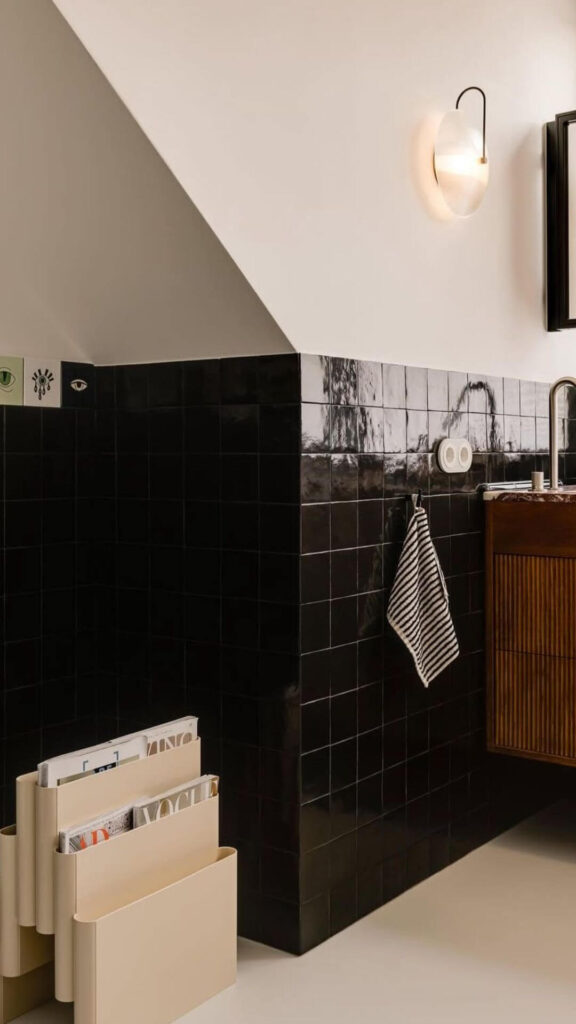
Full-Height Tiling: Useful, but Not Always Ideal
Wall tiles bathroom designs that run from floor to ceiling can feel clean, simple, and durable. Many people choose this option for hygiene reasons, assuming more tile means easier maintenance.
In reality, grout is the hardest part to clean—not painted walls.
There’s also an invisible factor few people consider: acoustics. A bathroom covered entirely in hard surfaces (ceramic, stone, porcelain) can feel rigid—or, more naturally phrased in English, harsh and echoing.
Sounds bounce, water feels louder, and the space can feel colder and less comfortable.
Strategic Tiling Creates Balance
Instead of tiling everything, consider tiling only where it’s truly needed:
- Inside the shower
- Behind the sink
- Around the toilet area
Above these zones, painted walls—or even washable, water-resistant wallpaper—can soften the atmosphere while still being practical.
This approach is especially effective for small bathroom tiles ideas, where visual breathing room matters. Leaving negative space allows the eye to rest and makes the room feel more harmonious.
Design + Perception
From a modern bathroom design perspective, mixing tiled and non-tiled surfaces creates contrast, warmth, and depth. Different textures and colors can subtly change how we perceive proportions—walls feel taller, ceilings lighter, and spaces more generous.
In the visualizations I’ll share from my own bathroom, you’ll see both versions: tiles to the ceiling, and tiles stopping lower with the upper walls painted like the ceiling. The difference in atmosphere is remarkable. And how it works in reality? Take a look here!
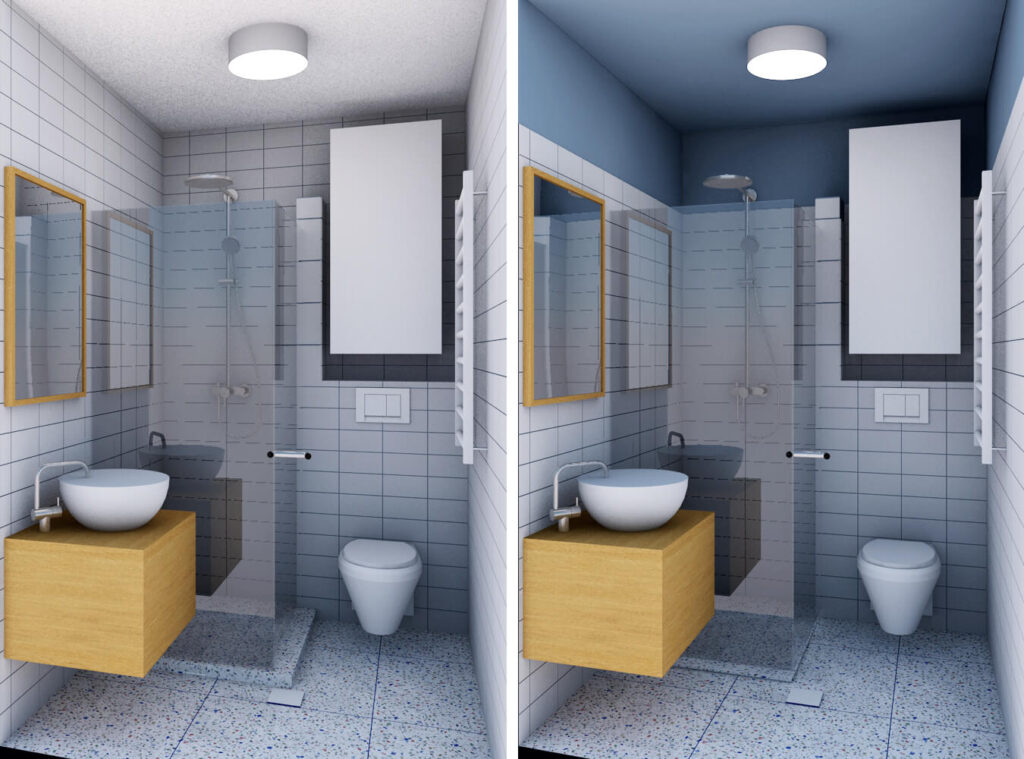
The takeaway is simple: tile where it works for you. More tile doesn’t automatically mean better design—thoughtful placement does.
6. A Key to Successful Bathroom Tile Combination: Pattern Simplicity
Pattern selection
Simpler, more uniform patterns work better with smaller tiles. Very bold or busy patterns can feel distracting and make the space appear smaller.
Why Simpler Patterns Work Better
In small bathroom tiles, bold or complex patterns tend to visually “shrink” the room. The eye has too many directions to follow, which creates noise instead of structure. This is why simplicity almost always wins in compact bathrooms.

A few reliable rules:
- Large tiles work best in clean, simple grids.
- Rectangular wall tiles look best in horizontal layouts, which visually widen the space.
- Smaller tiles (especially under ~10×20 cm) need extra care—too much variation can feel chaotic.
- Square tiles usually perform best in a classic, straight grid.
Subway tiles are a perfect example of how pattern changes perception—I’ve written an entire article about this because the difference between layouts is dramatic.
In small bathrooms, herringbone or highly decorative patterns often feel too intense unless used very selectively.
7. Understand How Grout Influences Space
Grout lines & direction
Grout lines define direction and emphasis. Highlighting horizontal lines can visually widen a bathroom, while vertical emphasis can make it feel taller—but also narrower.
Choosing a similar grout color for a tile can work well, but choosing a contrasty color can work well too – depends on the pattern and the tile size.
When choosing larger tiles for walls or floors, the positions of grout lines should be calculated as well – it is a good strategy, if the vertical grout lines are in symmetry axis of vanities (toilet and sink). This is true also for bigger bathrooms, half bathrooms.
Grout is often treated as a technical detail, but in reality, it plays a major role in a successful bathroom tile combination—especially in modern small bathrooms. Grout lines don’t just separate tiles; they create direction, rhythm, and visual emphasis.

‘s Japanese mosaics, this time in Denim color! Use that along with Castello terrazzo look tile in silver fox to get the look!
Direction Matters More Than You Think
The orientation of grout lines can subtly reshape how a bathroom feels:
- Horizontal grout lines visually widen the room, making narrow bathrooms feel more balanced.
- Vertical emphasis can increase the sense of height—but in very small bathrooms, it may also make the space feel slimmer.
This is particularly important when choosing bathroom interior tiles for walls, where layout decisions are immediately noticeable at eye level.
Grout Color: Blend or Contrast?
There is no universal rule—grout color must be chosen in relation to tile size and pattern:
- Larger tiles usually look best with grout that blends in, creating a calm, seamless surface.
- Smaller tiles can handle contrast better, where grout becomes part of the design rather than a distraction.
Both approaches can work beautifully—the key is intention.

Grout as a Design Tool
With large-format wall or bathroom floor tile ideas, grout placement should be planned, not left to chance.
A strong design strategy is aligning vertical grout lines with the symmetry axis of key elements like the sink or toilet.
This creates visual order and balance—a principle that applies not only in small bathrooms, but in larger and half bathrooms as well.
8. Visualize Your Bathroom Tile Combination Before Remodeling
Moodboard and Visualisation
It is hard to imagine the final result, even for architects. Creating a digital mood board, building in a free design program the bathroom helps a lot already, and more variations can be created and compared to each other.
For a successful bathroom tile combination, creating a mood board is an invaluable first step.
By creating a visual reference, you can feel confident about your decisions and understand how your chosen modern bathroom design will look in reality. It turns abstract ideas into a tangible plan, making the process of remodeling much smoother and more enjoyable.

Why Moodboards Matter
- They allow you to test colors, materials, and tile sizes without touching a single tile.
- You can experiment with different combinations of wall tiles, floor tiles, and finishes to see what works best together.
- Even in very small bathroom design, visualizing the layout helps prevent costly mistakes later.
Tools for Visualization
- Free design software or apps lets you mix, match, and compare variations easily.
- Digital mood boards are perfect for collecting tile inspiration and seeing how your choices interact with fixtures and furniture.
9. Get Samples, See in Real Life and Light
For the real look of each tile, visit a tile showroom, see materials in person, and collect samples. Real-life textures and colors often look very different from photos, and the light reflection is always different for each tile.
No photo can replace seeing and touching tiles in person. Even the best tiles for bathroom projects can look completely different under natural or artificial light. Texture, finish, and reflection change how the tile reads in your small space.

Why This Matters
- Photos can be misleading—colors may shift depending on your lighting.
- Feeling the texture and surface gives a realistic sense of quality and touch.
- Seeing samples in context with other bathroom interior tiles or finishes helps you coordinate materials and colors effectively.
Pro Tip
If you’ve found your dream tile, bring a sample with you when shopping for other elements like vanities or wall finishes. This ensures harmony across the space and avoids mismatched materials.
Even in wall tiles bathroom selections, small differences can impact the overall design.
Touch it, see it, and let your eyes guide you!
10. Ask a Professional When It Feels Overwhelming
Final safety net
Of course, every bathroom looks problematic at first – the pipes limit flexibility, often there is no window or just the room has a difficult shape. If the process feels confusing or stressful, consulting an interior designer or interior stylist can save time, money, and regret.
Why It Helps
- Experience matters: An interior designer or stylist knows how to optimize layouts, tile placement, and material combinations for modern bathroom design.
- Efficiency: Their guidance can prevent costly mistakes and reduce trial-and-error shopping.
- Peace of mind: You can move forward confidently, knowing your small bathroom will look cohesive and functional.
Even in small bathroom tiles projects, a bit of professional advice can make a big difference. Investing in expertise ensures your bathroom is beautiful, practical, and tailored to your space.
Summary — Designing a Bathroom Tile Combination with Confidence
Creating a bathroom tile combination that feels intentional, spacious, and harmonious is easier when you follow clear rules.
Small bathrooms benefit the most from a thoughtful approach—these guidelines turn overwhelm into clarity.
Here’s a quick recap of the 10 essential design rules for bathroom tile combination in modern small bathrooms:
10 Key Rules for Confident Small Bathroom Tile Design
- Avoid Uniformity: Don’t use the same tile on all surfaces; subtle variation creates depth.
- Coordinate Surfaces: Tiles should harmonize with vanity, fixtures, mirrors, and shower glass.
- Color Strategy: Light shades expand the space; add color for character.
- Tile Size Matters: Larger tiles create continuity; mosaics add texture and accents.
- Wall Coverage: Full-height tiling isn’t always necessary—strategic zones work better.
- Keep Patterns Simple: Busy patterns shrink space; choose subtle, uniform layouts.
- Grout Awareness: Horizontal lines widen, vertical lines add height; contrast or match thoughtfully.
- Moodboard First: Visualize digitally to explore options and prevent regrets.
- See Samples in Real Life: Lighting, texture, and color look different in person.
- Ask a Professional: When in doubt, expert advice saves time, money, and stress.
Small bathrooms benefit most from intentional design choices. Every tile, color, and grout decision contributes to atmosphere, comfort, and daily life enjoyment.
Your Turn: What’s your favorite small bathroom tile combo? Have you tried mixing patterns or colors successfully? Share your experiences and ideas in the comments—I’d love to hear them!
This approach ensures your small bathroom tiles project feels like a carefully crafted design, not an accident—and opens up endless possibilities for creativity and style.
Pin it for later!