The Rules for a Good Small Living Room Layout – Small Space Living
TL;DR
Designing a small living room layout feels hard because every decision matters — and most inspiration online ignores real life, real movement, and real homes.
This guide shows you how architects think about small living spaces:
- how to define purpose first
- plan circulation
- choose the right furniture scale
- create zones without walls
- and adapt layouts to different room shapes — from studio apartments to open kitchen–living rooms.
Instead of copying layouts that don’t fit your life, you’ll learn how to design a living room that actually works for your daily routines, even in very small spaces.
If your living room feels cramped, confusing, or never quite right — this article will help you understand why and show you what to do instead.
1. Why Small Living Room Layout Feels So Hard
Designing a small living space often feels overwhelming, even for experienced homeowners. Every choice is magnified when square meters are limited: the sofa you love might be too big, the coffee table in the way, or the room feeling cramped despite your best efforts.
Pinterest and social media can make it even harder. Stunning layouts and photos often don’t translate to real rooms—what works in a 50-square-meter studio won’t automatically work in your 25-square-meter apartment. But don’t worry! There are great solutions, that work only in small spaces.
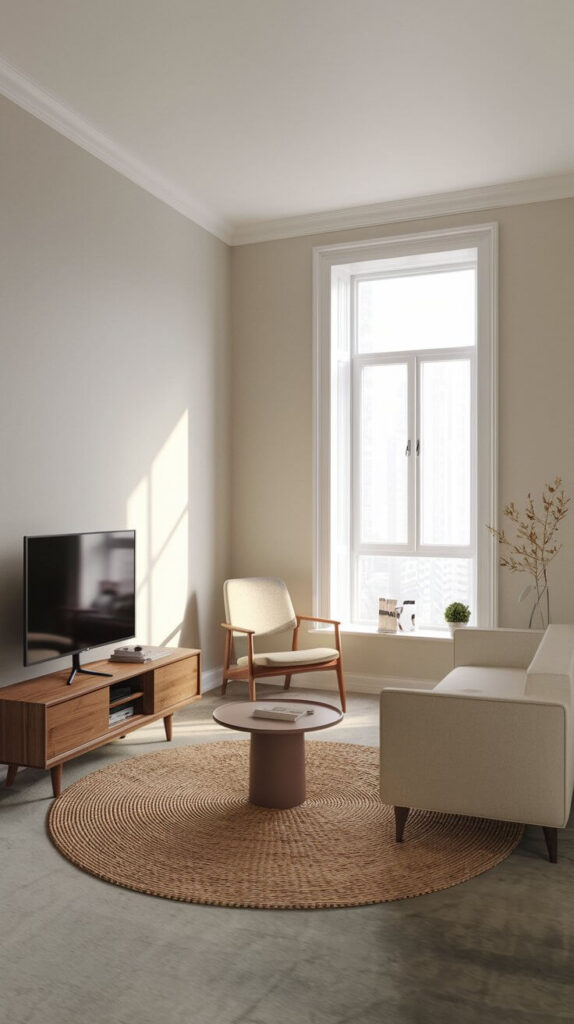
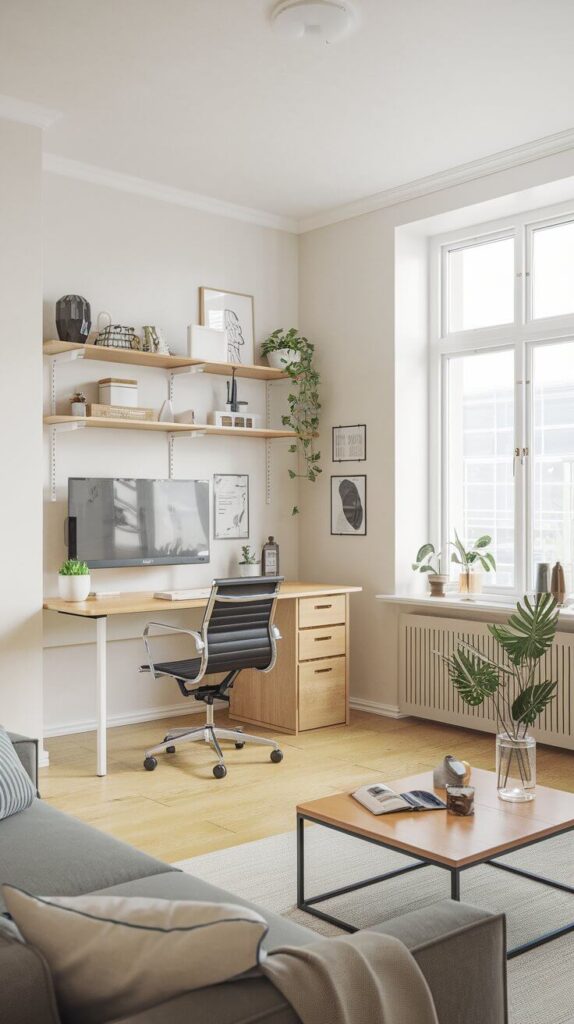
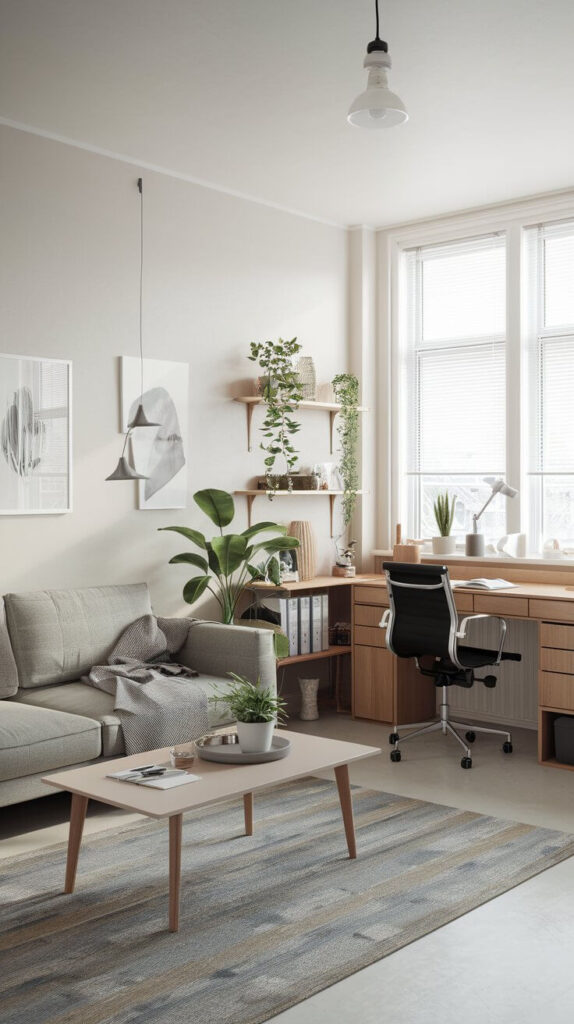
It’s easy to feel frustrated or stuck because these images don’t consider your lifestyle, circulation, or furniture needs.
Why moving, life changes, or new homes trigger layout confusion is simple: your living room isn’t just a room. It’s the heart of your home, a space where family life unfolds, social moments happen, and yes, it has a subtle status role in your home.
In small apartments, it often has to serve multiple functions at once—living, working, dining, playing for kids—and it still needs to feel comfortable and functional.
When a room is small, or opens directly into other spaces like the kitchen or hallway, it’s even trickier. Ideally, living rooms should not be mere corridors, but private, flexible zones where family members can be together without being cramped.
Thoughtful planning can prevent your living room from becoming just a pass-through, even if your apartment layout is challenging.
In short, a small apartment living room can work beautifully—but only when you approach it as a system: matching furniture, circulation, and lifestyle needs, rather than squeezing in pieces because they “look nice.”
Compact living isn’t about doing less; it’s about designing smarter.
2. What Is a Living Room — And Why Layout Matters So Much Today
The Living Room as a Mirror of Society
(Inspired by BBC Culture – The Evolution of the Modern Living Room)
The living room has never been just a room. From the very beginning, it reflected how we live, how we socialize, and what we want to show about ourselves.
Early living rooms were formal, almost ceremonial spaces — carefully arranged, often unused, designed more for guests than for everyday life. Furniture placement was about status, not comfort.
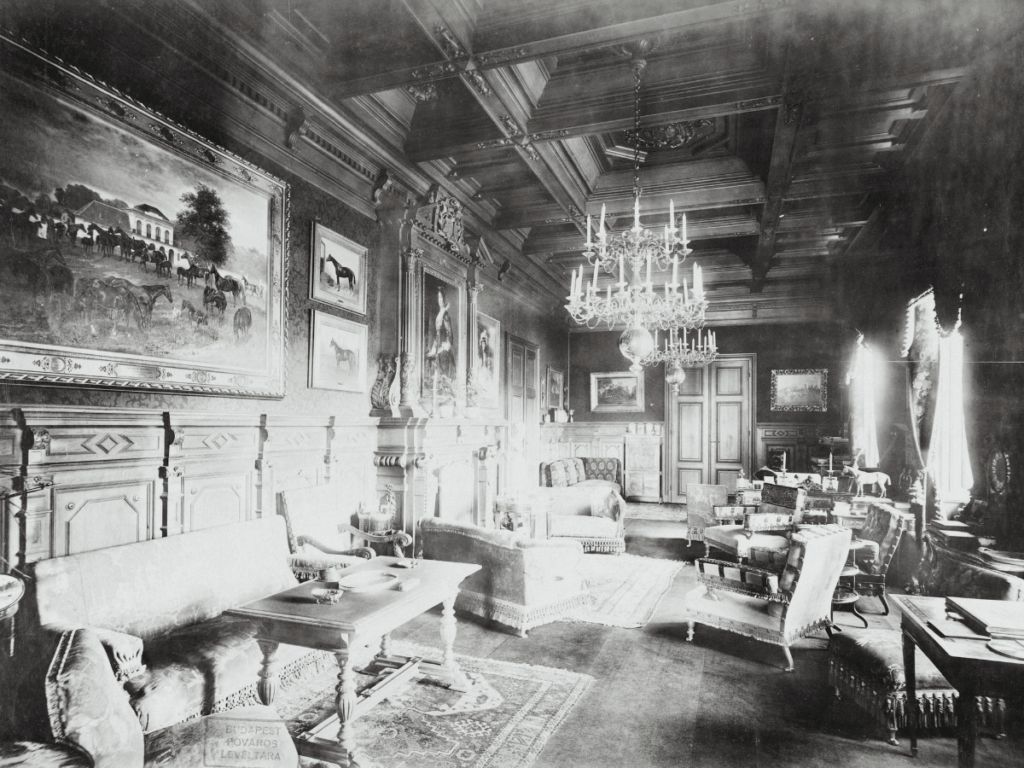
As homes became smaller and lifestyles more relaxed, the living room slowly transformed into a lived-in space. The small living room layout evolved to the needs of the era.
Sofas turned toward each other instead of the center of the room, chairs invited conversation, and comfort became just as important as appearance.
This shift is especially relevant today in small space living, where every square meter must work harder — not to impress, but to support real life.
In a small living room layout, this history reminds us of one important lesson: a room should serve the people living in it, not an outdated idea of how a home should look.
From “Best Room” to Everyday Life
(Inspired by BBC Magazine – A Social History of the Living Room)
For a long time, the living room was the “best room” — used only on special occasions, kept tidy and untouched most days. Daily life happened elsewhere.
But as working hours changed, family structures shifted, and homes became more compact, this separation slowly disappeared.
The living room moved closer to everyday life. It became a place for resting after work, for children to play, for shared evenings and quiet afternoons.
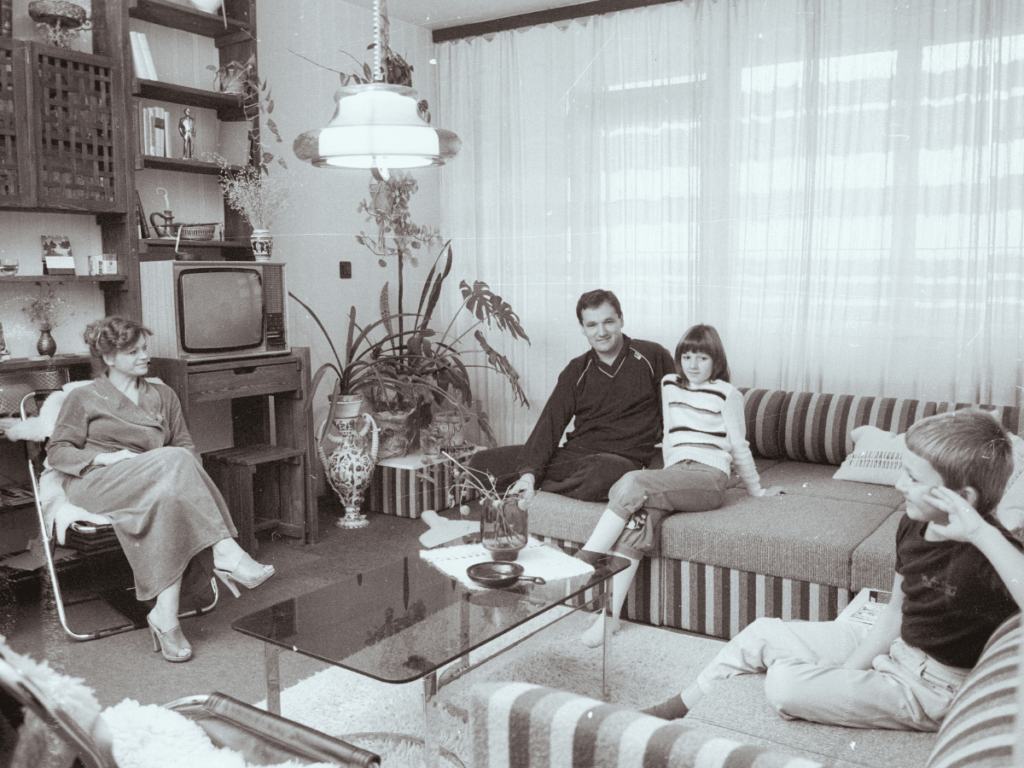
Television, books, music, later laptops — each new habit reshaped furniture arrangements and circulation within the room.
This evolution is especially visible in the studio apartment or a small living room layout, where there is no luxury of unused space.
The modern living room must support parallel activities — one person reading, another working, someone cooking nearby — all within one shared environment.
When the Kitchen Joined the Conversation
The idea of the family room — and later the open-plan living space — grew from a desire to be together, even while doing different things. As kitchens became less hidden and more social, they naturally merged with living and dining areas.
Cooking was no longer something done away from family life; it became part of it.
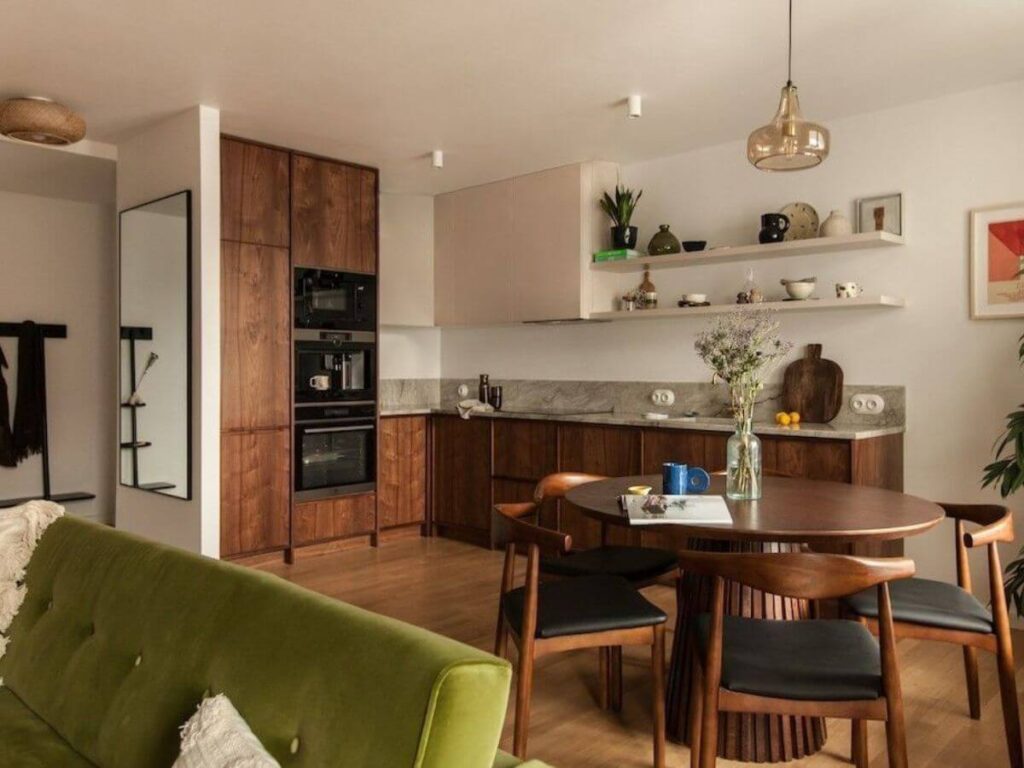
This change is especially important today, with working parents and busy schedules. The kitchen is no longer a background space — it is a hotspot of daily life.
In small homes, combining kitchen, dining, and living functions is often the smartest way to create a feeling of openness.
In a well-designed small living room layout, including small open kitchen and living room layouts, multifunctional spaces need clear zones — not walls, but subtle boundaries defined by furniture placement, circulation paths, and ambient lighting.
One window can be enough, if light — natural and artificial — is thoughtfully layered for cooking, reading, working, and resting.
Whether it’s a long rectangle living room layout, a square living room layout, or a tiny living room idea, these principles remain the same: every element should support how the space is used. The room must adapt to your lifestyle, not the other way around.
Keep reading to find out what works best for a long rectangle living room layout, a square living room layout or an open concept studio!
3. Start Here: Define Your Living Room’s Real Purpose
Before you move any furniture or study layout diagrams, pause and ask yourself: “What do you actually do in your living room?”
Too often, people copy Pinterest layouts or magazine spreads that look beautiful but don’t fit their lifestyle. In small apartment living rooms or a small open kitchen and living room, every square meter matters — so the first rule is clarity of purpose.
Think about how you really use the space:
- Relax + TV – Comfortable seating focused on entertainment.
- Work + Relax – A small desk or multipurpose table alongside cozy lounging.
- Social + Dining – Room for conversation, meals, and gatherings.
- Living room for playing, hobbies – Clever pieces, multifunctional furniture, and hidden storage.
- Open kitchen + living room – Zones for cooking, dining, and relaxing coexist without feeling cramped.
Even in the same room, the layout changes drastically depending on your goals. Visualizing your purpose first allows you to plan furniture, circulation, and lighting effectively.
For example, a long rectangle living room layout might suit a work + relax scenario, while a square living room layout may handle social + dining better. But this is not an universal truth, just an easy scheme.
Tip: Sketch or use simple diagrams to see your living room in multiple “modes.” This small step will save time, let you become clearer in what you want,, and make the next layout rules much easier to apply.
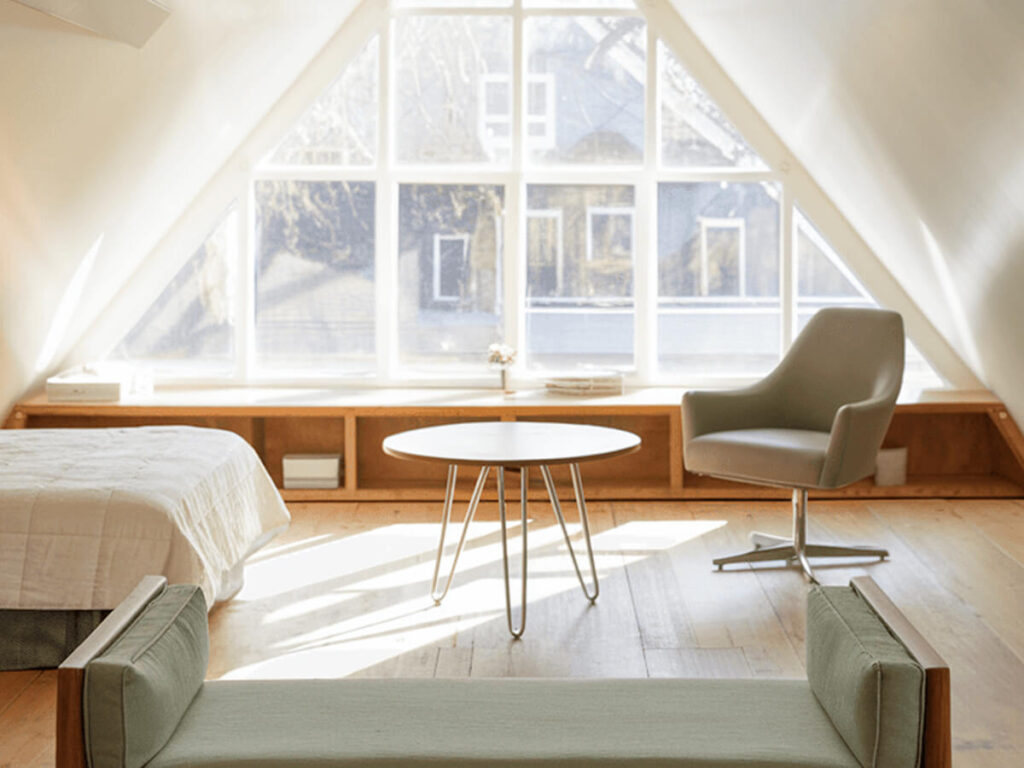
4. The 4 Core Layout Rules for Small Living Rooms
Once you know your family’s routines, how the room will be used, and the space’s physical dimensions, the next step is to establish the rules that make your living room functional, comfortable, and visually balanced.
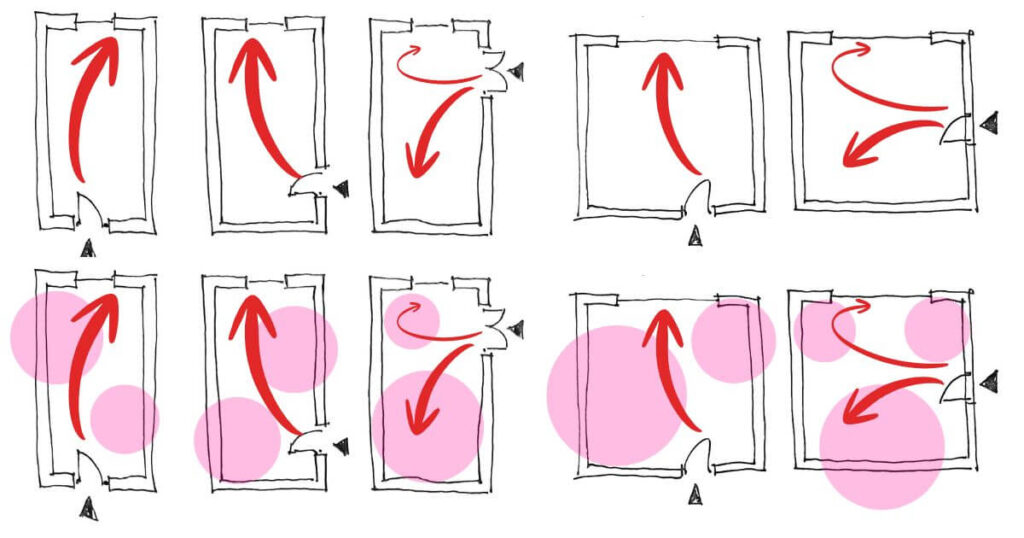
4.1 Circulation Comes First
The first rule in any compact living space is movement. Clear, logical circulation paths are the backbone of a successful small living room layout.
In small apartments, furniture is often pushed against walls to “open up” the center. On the surface, this seems sensible — but in reality, the middle of the room becomes a crossroad for multiple circulation paths, breaking the room into zones and making it feel chaotic rather than spacious.
How to create clear paths:
- Identify primary pathways first: where do you walk most frequently? From entry to sofa? From kitchen to dining?
- Consider doors and openings. Not all doors need equal access: bedrooms used rarely can have more visual or physical separation, while high-traffic doors should guide circulation naturally.
- Use furniture, rugs, or lighting subtly to define zones, so pathways don’t feel like empty voids cutting through your living space. A rug can anchor a conversation area, while the surrounding circulation path remains intuitive and uncluttered.
Common mistakes in small living rooms:
- Blocking natural flow by placing furniture against every wall.
- Allowing too many “floating” pathways in the center, creating wasted space.
- Ignoring how different activities intersect — a reading corner shouldn’t be in the path to the kitchen or bathroom.
When pathways are planned, the room feels intentional and compact, not like a series of obstacles. Circulation defines zones naturally, helping you organize multifunctional areas — from play corners and workstations to relaxation spots — even in a small apartment living room or studio apartment living room.
4.2 Furniture Quality Beats Furniture Quantity
In very small living rooms, it is easy to fill every corner with furniture. A sofa, a bulky armchair, extra side tables — it all seems necessary, but in reality, too small, oversized or too many furniture quickly overwhelms the space.
The first principle of smart layout: choose fewer, well-scaled pieces over many items. A compact sofa, paired with a small coffee table and a carefully placed delicate chair, can provide all the comfort you need without crowding the room.
In fact, the shape and proportion of each piece often matters more than its size.
Why less is more:
- Visual spaciousness: Leaving some empty floor and corner space allows the eye to perceive the room’s true dimensions. The room feels open rather than cramped.
- Functionality: Fewer pieces mean each one must earn its place — multifunctional furniture becomes essential. A sofa with hidden storage, a coffee table that doubles as a tray or bench, or a floating cabinet that doesn’t touch the floor can serve multiple needs without cluttering.
- Flexibility: Smaller furniture allows for easy rearrangement. Need a game night, a workout, or a family gathering? Compact pieces make the room adaptable.
Multi-functional furniture logic:
- Hidden storage is key. Ottoman with storage, benches with drawers, or modular seating can store toys, blankets, or work items.
- Floating furniture — pieces that are slightly raised from the floor — maintains visual flow and avoids a “heavily furnished” look.
- Convertible items like foldable desks, pull-out sofas, or nesting tables maximize usability without increasing footprint.
By focusing on scale over quantity, even a tiny living room can feel luxurious, functional, and uncluttered. This principle works for very small living room ideas or studio apartment living room layouts, and it sets the foundation for creating well-defined zones, which we’ll cover in the next section.
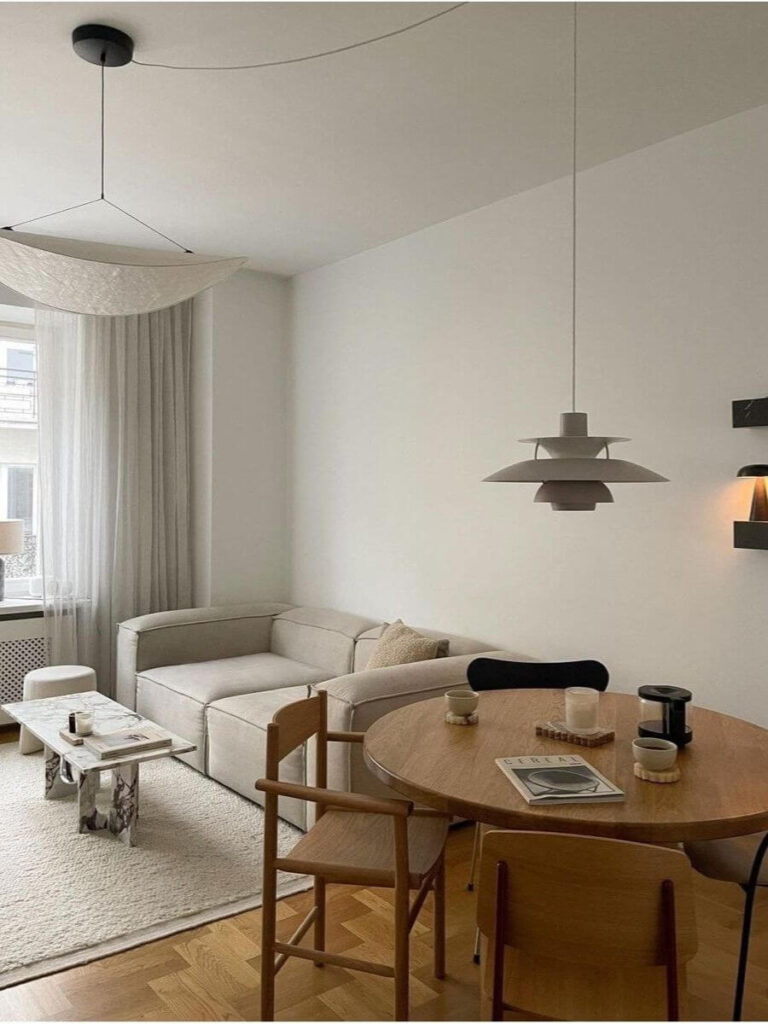
4.3 Zoning Without Walls
In small open kitchen and living room layouts, one of the biggest challenges is creating functional zones without relying on walls. Open spaces feel bright and airy, but without clear boundaries, activities overlap, and the room can feel chaotic. The solution? visual and functional zoning.
How to create zones without walls:
- Rugs define areas: A rug under the seating area or dining table visually separates the zones without cutting off light or flow.
- Lighting orientation: Pendant lamps or floor lamps can illuminate specific zones, signaling their purpose. Warm lighting over a reading corner, brighter lights near the kitchen, or layered ambient lighting can all help define areas.
- Furniture placement and orientation: The way sofas, chairs, or cabinets are positioned can create subtle boundaries. A sofa back can act as a divider between the living and dining area. A low cabinet can delineate the kitchen edge while providing storage.
- Decor and objects as visual barriers: A tall plant, a decorative screen, or even a freestanding shelf can create a sense of separation without enclosing space.
Special considerations for kitchen–living combos:
- Counters or kitchen islands are natural dividers, especially if proportioned for the room. Consider how often and what you cook — the zone should match your activity.
- Fireplaces can be both a divider and a connector, visually anchoring a seating area while keeping openness. Even in very small apartments, a carefully positioned fireplace or stove can define zones elegantly.
- Mobile solutions, such as screens, paravans, or lightweight partitions, allow flexibility. These are especially useful in studio apartment living rooms, where one space serves multiple functions.
In small space living, zoning without walls is not just aesthetic — it’s functional. Thoughtful furniture orientation, layered lighting, and visual cues (like smartly chosen living room paint color) create distinct areas, improve circulation, and allow multiple activities to coexist without feeling cramped.
4.4 Windows and Lighting Strategy
In small living room layouts, light can make or break the perception of space. A well-planned lighting strategy doesn’t just illuminate — it defines zones, emphasizes circulation, and visually enlarges the room.
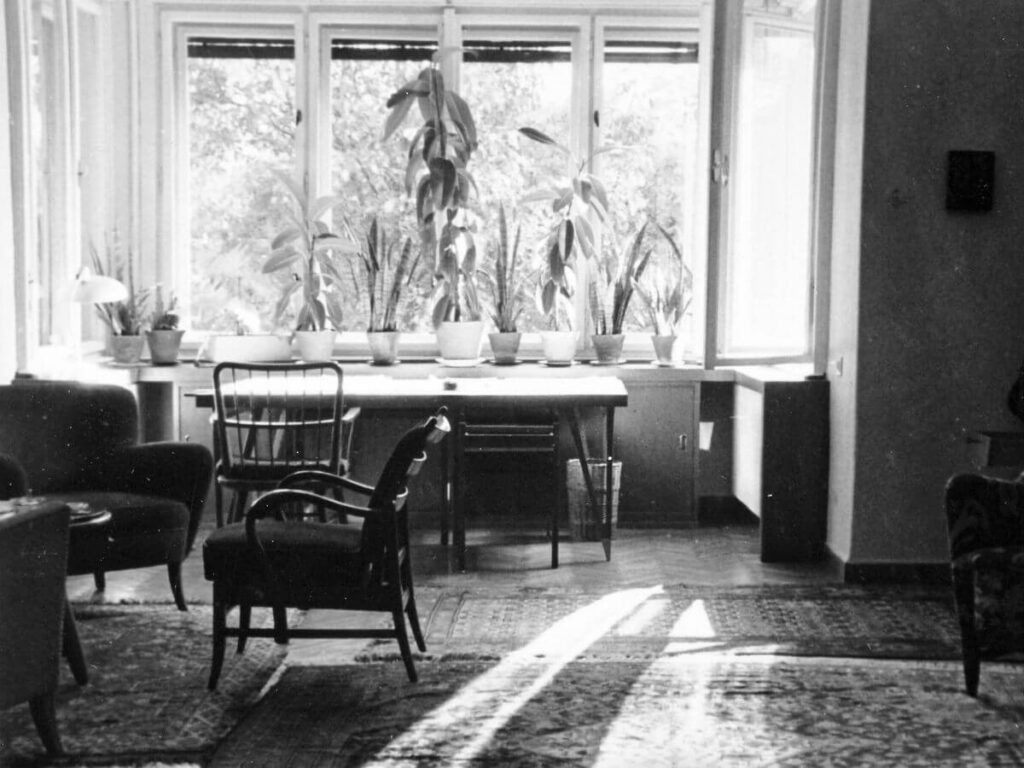
In small space living, every corner counts, so layering natural and artificial light is essential.
Why it matters:
Without careful lighting, even the best small apartment living room layout can feel cramped, dark, and disconnected.
Windows provide natural daylight, but in small homes or studio apartments, one window often has to serve multiple functions: reading, working, dining, and relaxing.
Strategic lighting solves this by highlighting zones, guiding movement, and creating depth.
Practical strategies:
- Maximize natural light
Keep window areas uncluttered. Use light, sheer curtains or blinds that can be fully pulled back. Reflective surfaces — mirrors, glossy cabinets, or light-colored walls — amplify daylight across the room. - Highlight circulation and boundaries: Lighting can subtly guide the eye along pathways, or it can signal functional zones without physical walls.
Layered lighting for multifunctional zones:
- Ambient lighting: Ceiling lights or flush-mount fixtures provide overall illumination.
- Task lighting: Floor lamps, table lamps, or under-cabinet kitchen lighting support reading, working, or cooking.
- Accent lighting: Highlight artwork, shelves, or architectural details to add depth and interest.
In tiny living room ideas and very small living room ideas, lighting is as much a design tool as furniture placement.
Thoughtful illumination expands perception, clarifies zones, and supports all the functions your small apartment living room needs to perform.
5. Layout Rules by Room Shape
Not all small living rooms fail for the same reason.
Very often, it’s not the size — it’s the shape.
A small living room layout behaves very differently if the room is long, square, or part of a studio apartment. Understanding the logic behind each geometry helps you understand the limits of the space – and the possibilities as well.
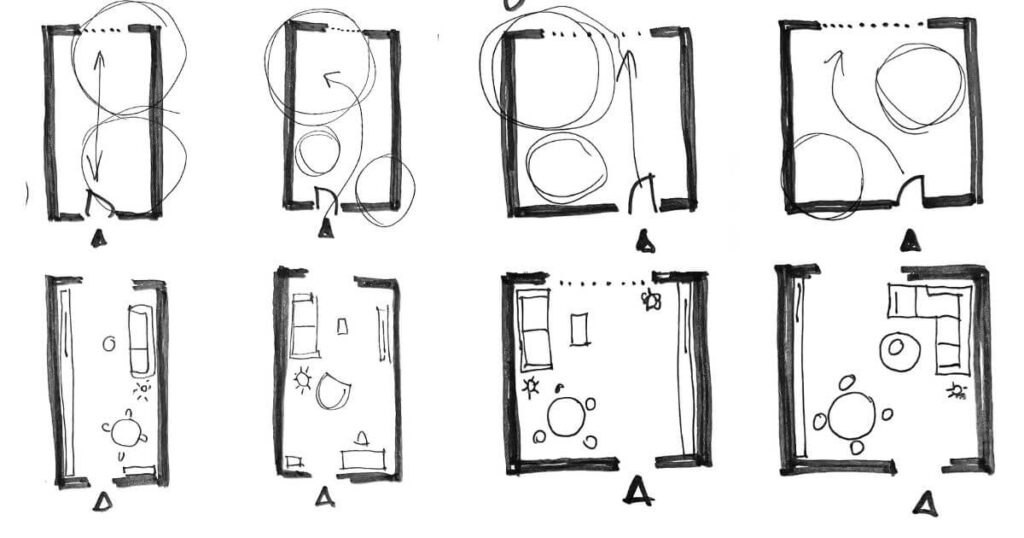
5.1 Long Rectangle Living Room Layout
Why this shape is tricky
Long, narrow rooms tend to become visual corridors. The most common mistake is pushing all furniture against the walls, which only emphasizes the “bowling alley” effect and leaves the center as a useless circulation zone.
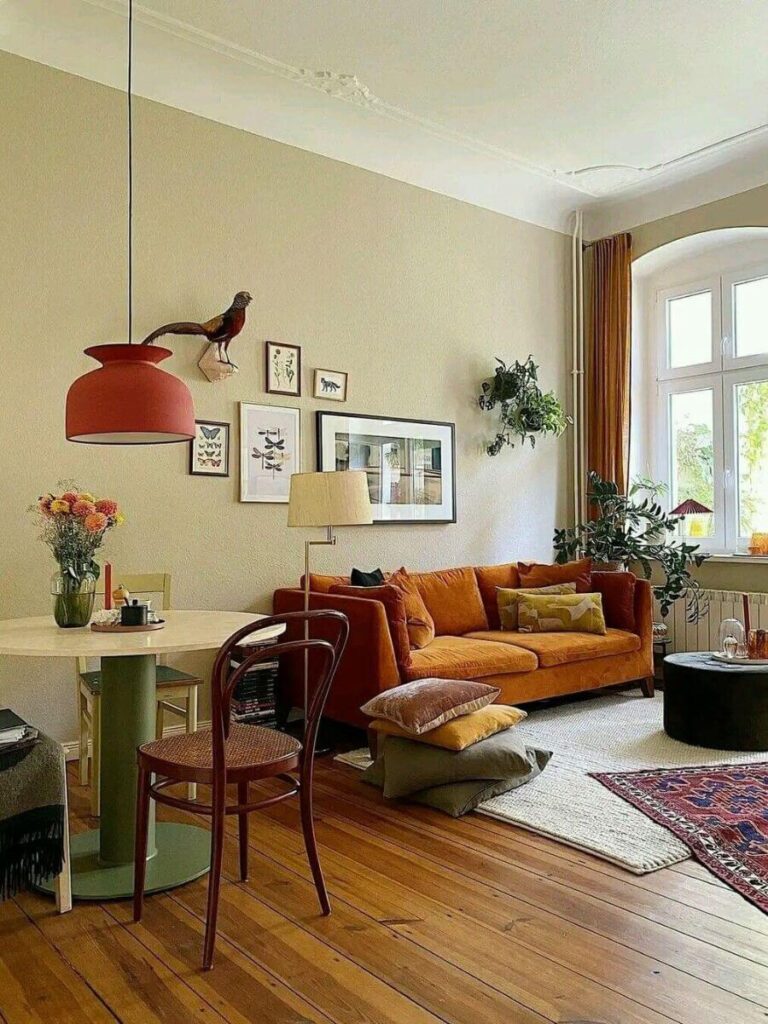
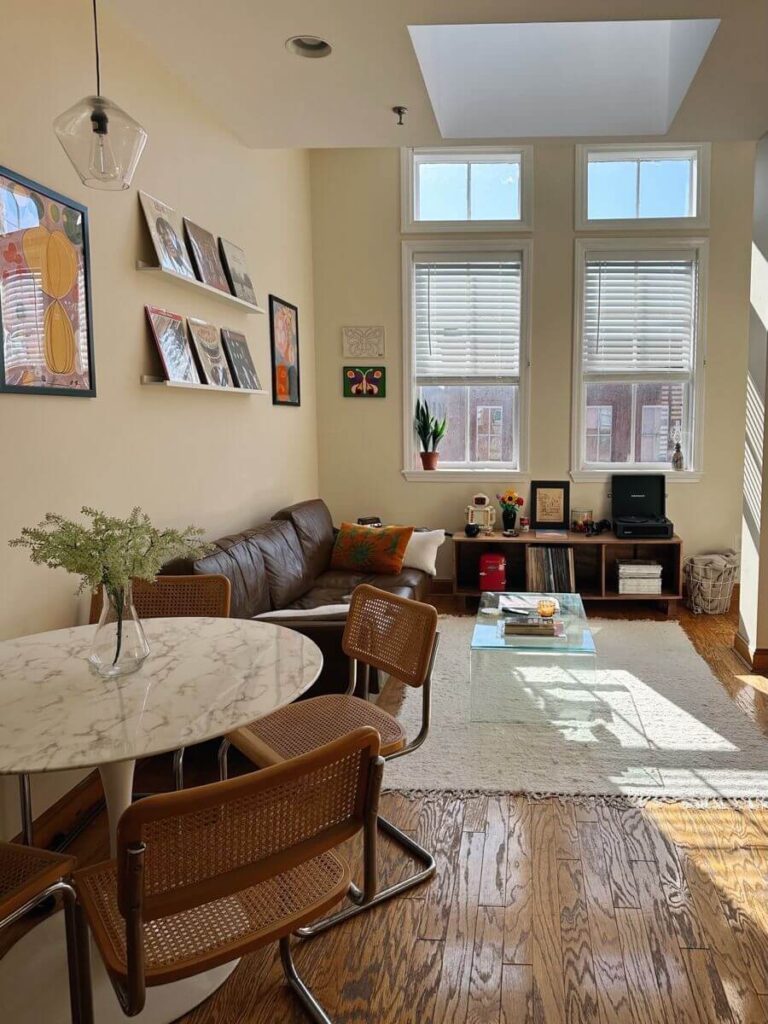
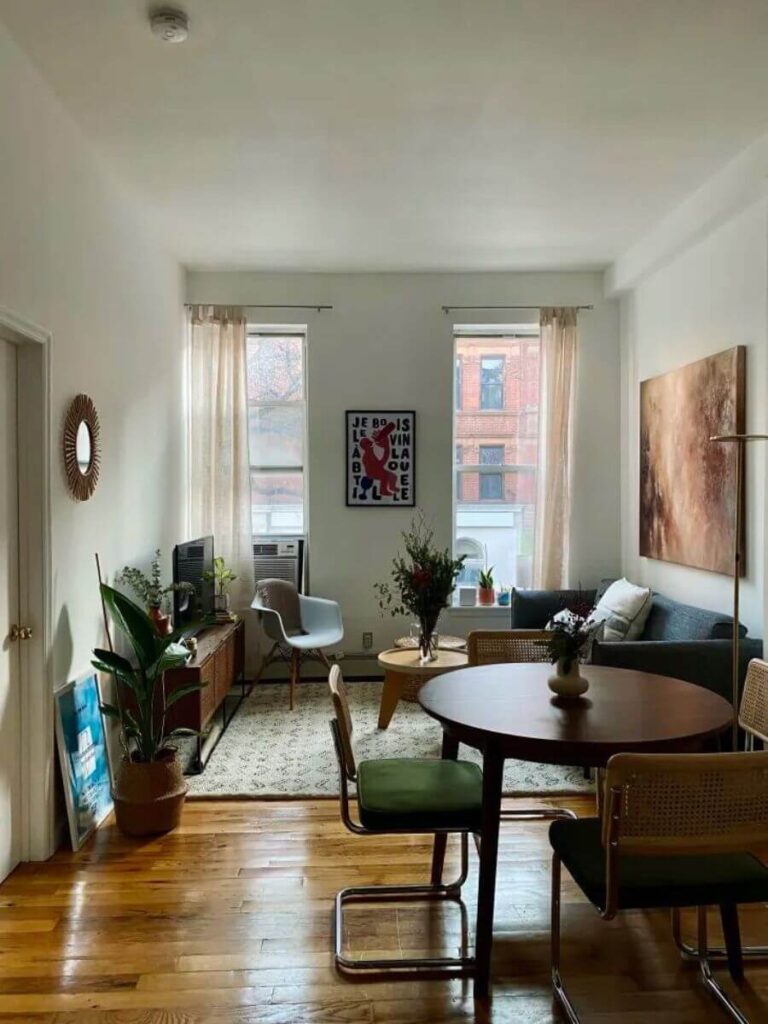
Some photo examples for the universal narrow living room solution:

Small narrow living room with dining. A good strategy is just to organize all sitting zones on one longer side of the room. With colors, carpets and materials there is huge variability – but it is important to leave some wall space open. Source: Pinterest, please help me find the project! Berlin interior with the same layout, similar furniture: dining, with circle tables, and living next to each other. Photo of fux_berlin Narrow living room layout, with a cirle dining table – found it on Pinterest, please help me find the project! Small, narrow living room with dining. Easiest and most secure ways to combine these functions in a small living room layout. Credit: Coralie Kwok, Brooklin.
What not to do
- Don’t align everything along the long walls
- Don’t place the TV at the far end if it forces all seating into a straight line
- Don’t treat the entire room as one single function
What works better
- Break the room into zones along its length, not its width
- Arrange functions next to each other, not around the perimeter
- Use rugs, lighting, or furniture orientation to shorten the space visually
Window logic matters
- If windows are on the long side → you’re lucky. Place active zones (sofa, desk, play area) where light is strongest.
- If windows are on the short side → assign lower-light functions (TV, storage) farther away and keep visual depth light and open. Or opposite way, if you prefer reading on the couch.
Example (imaginary room: 12 × 18 feet or 3,60 x 5,40 m):
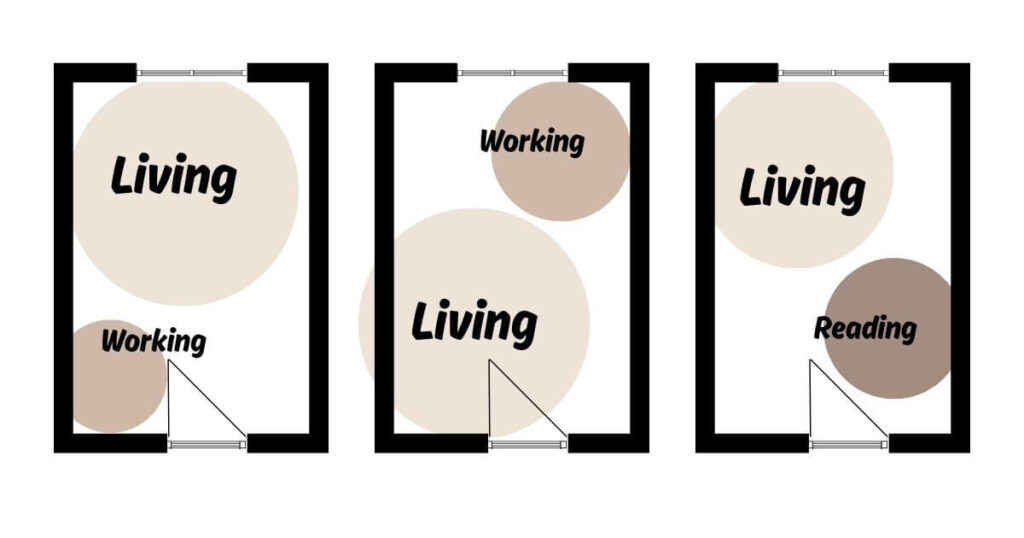
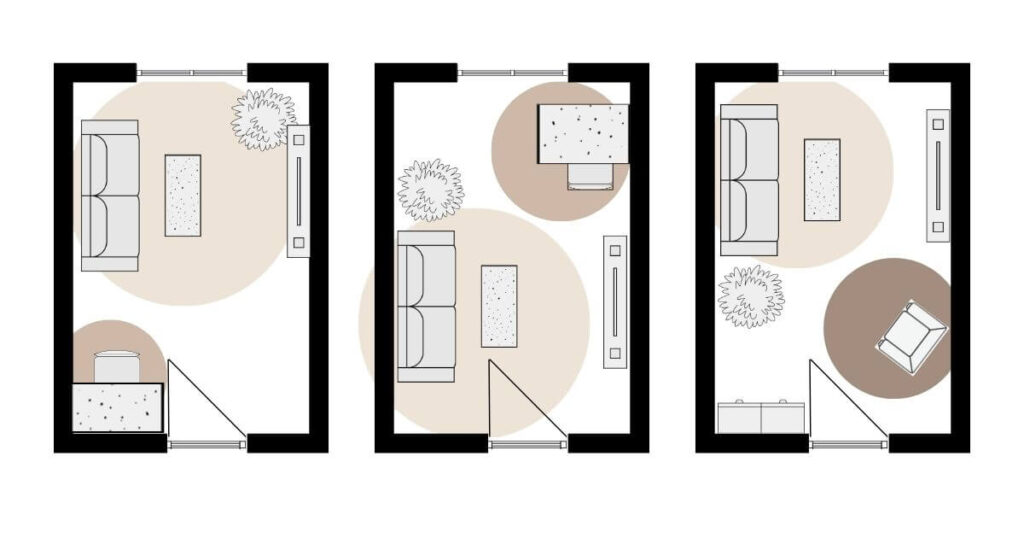
This approach turns a long rectangle living room layout into a sequence of usable spaces instead of one stretched problem.
5.2 Square Living Room Layout
Why square rooms feel awkward
Square rooms lack direction. Without a clear axis, furniture often “floats” randomly — creating visual chaos even in a small space.
Two strategies that work
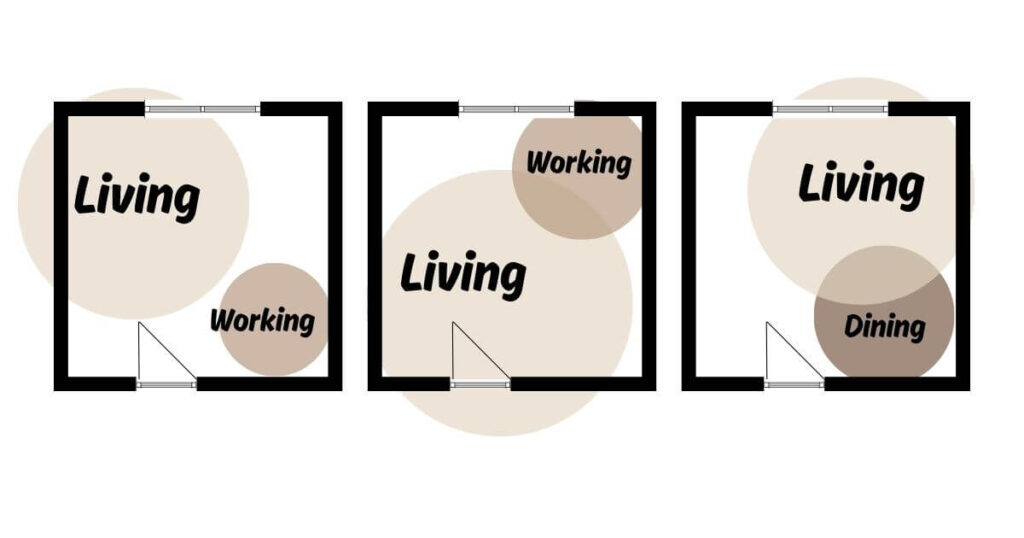
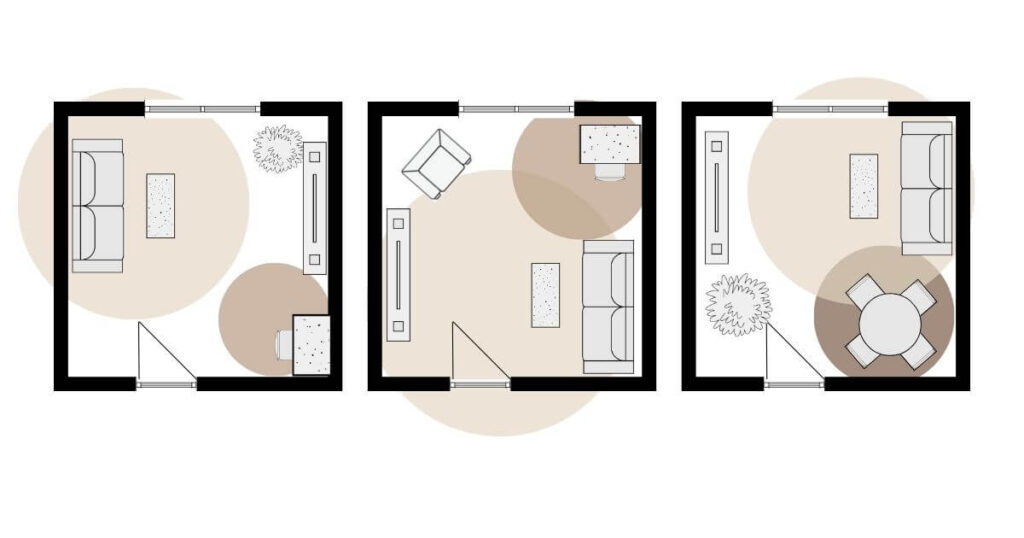
1. Controlled symmetry
- Central rug + sofa aligned with a main axis
- Balanced furniture on either side
- Works well for social or TV-focused layouts
2. Intentional asymmetry
- One strong anchor (sofa or camine wall)
- Secondary functions placed diagonally or peripherally
- Creates movement without confusion
What to avoid
- Furniture floating without visual connection
- Multiple small pieces with no hierarchy
- Treating all walls as equal
A successful square living room layout always has a clear focal point — not four competing ones.
5.3 Studio Apartment with Sleeping Area + Living Room Layout
Why this is the hardest version
In a studio apartment’s living room, the space must do everything:
living, sleeping, working, cooking — often within a few square meters.
The challenge isn’t fitting functions in.
It’s keeping them mentally separate.
I have a small studio apartment, where I made many experiments, what arrangements can work in a small studio apartment – it is just 16 square meters / 172 square feets – take a look at the 6 best versions!
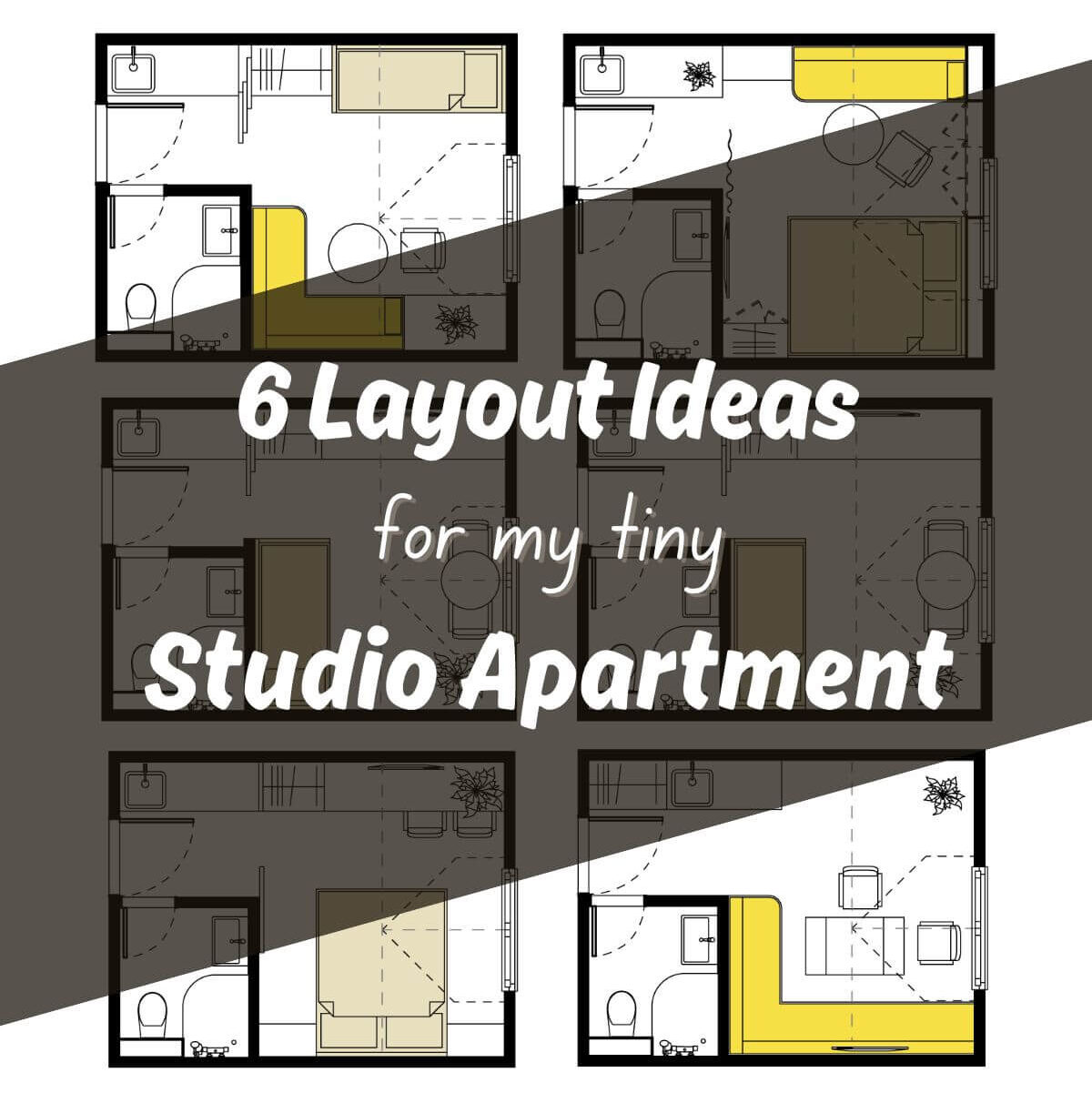
Key principles
- The living room becomes a connector, not a container
- Zones must be readable at a glance
- Storage must support flexibility, not lock the layout
What works best
- Furniture as soft dividers (sofa backs, shelves, cabinets)
- Lighting to signal function changes
- Multi-functional pieces that disappear when not needed
Hidden storages – my favorites, maybe they seem to occupy to much space at first, but in the end they disappear from the room.
6. Open Kitchen + Living Room: One Space, Two Logics
Open-plan spaces are popular for a reason: they create light, connection, and a sense of generosity — even in a small apartment living room.
But they often fail for one simple reason: the kitchen and the living room follow different rules.
Understanding this difference is the key to designing a small open kitchen and living room that feels organized instead of chaotic.
6.1 Why Kitchen Logic ≠ Living Room Logic
The kitchen is a task-driven space.
The living room is a people-driven space.
- The kitchen needs:
- clear work zones
- direct circulation
- strong, focused lighting
- clear work zones
- The living room needs:
- visual calm
- flexible seating
- layered, softer light
- visual calm
Problems arise when we try to design both with the same mindset — or worse, when one function dominates the other unintentionally.
In contemporary homes, the kitchen has changed dramatically. With longer working hours and less time spent together, the kitchen is no longer a hidden, secondary space.
Especially for working parents, it has become a family hotspot — a place for conversation, homework, shared meals, and everyday rituals.
This is why open-plan layouts work so well — but only when the zones are clearly defined.
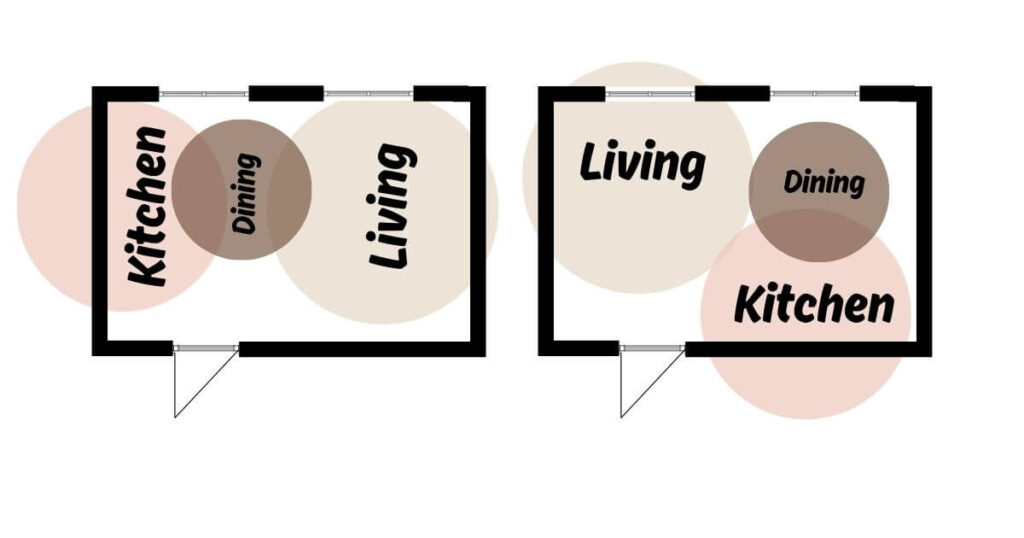
6.2 One Space, Clear Zones
In a well-designed small open kitchen and living room, zones are not separated by walls, but by logic.
The 3 strongest zoning tools are:
- Circulation – how people move through the space
- Usage hierarchy – which function matters most to your daily life
- Furniture orientation – what each zone faces
For example:
- Kitchen circulation should never cut through the main seating area
- Living room seating should not face the kitchen worktop directly unless it’s intentional
- Dining often works best as a “buffer zone” between cooking and relaxing
These invisible boundaries help the space feel organized without making it feel smaller.
6.3 Sightlines Matter More Than Square Meters
In a small apartment living room, what you see from each zone matters as much as where things are placed.
- From the sofa, the eye should rest on:
- a window
- a calm wall
- a focal point (art, shelf, fireplace, TV)
- a window
- From the kitchen, the view should support:
- connection with others
- awareness of the space
- daylight, if possible
- connection with others
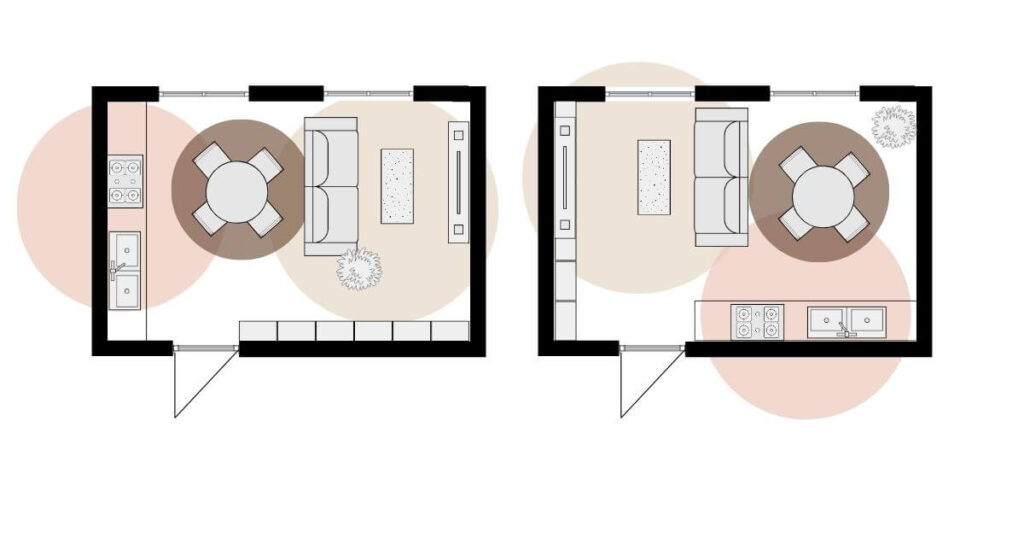
Align furniture so that sightlines support comfort, not distraction. A sofa back can be a perfect soft divider — it separates functions without blocking light or movement.
6.4 Lighting Follows Activities, Not Furniture
In multifunctional spaces, lighting must be planned around actions, not objects.
One window can be enough — if artificial lighting is layered correctly.
Each zone needs its own light logic:
- Kitchen: strong, task-focused lighting
- Dining: centered, warm, social lighting
- Living room: ambient, indirect, dimmable lights – in different position, serving as calm background.
This approach allows the space to transform throughout the day — from active mornings to calm evenings — without rearranging furniture.
7. Layout Mistakes That Make Small Living Rooms Feel Smaller
Even a well-decorated space can feel uncomfortable if the layout is wrong. These are the most common small living room layout mistakes — and the easiest ones to fix.
Oversized furniture
A sofa that dominates the room leaves no space for circulation or visual breathing. In tiny living room ideas, scale matters more than comfort marketing.
Too much furniture
More pieces don’t add more function. They reduce clarity. Fewer, well-chosen items make the room feel larger and calmer.
Everything pushed against the walls
This creates an empty center with no purpose and turns the room into a circulation crossroads. Furniture should define zones, not avoid the middle at all costs.
No visual hierarchy
When every piece competes for attention, the room feels chaotic. One clear focal point is enough. Think about solid and airy furniture as well – contrast and balance are important at the same time.
Ignoring lighting layers
Relying on a single ceiling light flattens the space. Even the best small living room layout fails without proper lighting.
Decorating before fixing the layout
Pillows, art, and accessories can’t compensate for a poor layout. Always solve the function first.
8. Test Your Layout Before You Commit
Before buying furniture or drilling holes, test your ideas. This step alone can save time, money, and frustration in any small living space.
Sketch it
A simple hand sketch helps you understand proportions, distances, and circulation.
Use digital tools
Basic floor-planning apps or even scaled grids allow quick experimentation without risk.
Think like an architect
Professionals never start with furniture shopping. They test multiple layout versions first — especially in compact living, where every decision matters.
If it doesn’t work on paper, it won’t work in real life. If this is the case, don’t worry, and don’t be shy to ask for help.
9. When to Ask for Help (and Why It Saves Money)
DIY works — until it doesn’t. Knowing when to ask for help is part of smart design.
Many interior designers and architects offer short consultations. Even 1–2 hours can:
- solve layout challenges
- prevent expensive furniture mistakes
- provide a clear furniture or zoning concept
Professionals have seen hundreds of small apartment living rooms and solved problems that feel unique — but rarely are.
Even designers ask other professionals for feedback. It’s not a weakness; it’s a shortcut.
If you feel stuck or uncertain, a small investment in advice can completely change the outcome — and often costs far less than replacing the wrong sofa.
10. Summary: a Good Small Living Room Layout Is a System
A successful small living room layout is never about copying a picture or following a single rule. There is no universal “best layout” — only layouts that are more or less aligned with the lives of the people using them.
The most functional spaces are not accidental. They are the result of patient observations and intentional decisions:
how people move through the room, how activities overlap, where visual focus is needed, and where calm is required.
Especially when working with very small living room ideas, layout becomes the silent structure that either supports daily life or constantly works against it.
Looking back at the history of the living room, one pattern is clear: the spaces adapted to real behavior, not idealized lifestyles. This is even more relevant today in small space living, where one room often needs to function as a place for rest, work, social life, and storage at the same time.
A good layout does not try to squeeze in more functions.
It prioritizes what matters most and organizes the space around that reality.
In a well-designed small living room, family members can be together without doing the same thing. One person can read, another can work, someone else can relax — all without the room feeling chaotic or constrained.
That is where good layout begins: not with furniture, but with life.
And after that, finding the best layout for your life, you can start with dressing up your small living room: paint colors, lighting strategy and of course – furniture.
A Thought to Take Forward
Before changing anything in your living room, ask yourself one simple question:
What do I actually need this space to support every day?
If you’d like to share:
- What is the biggest challenge in your small living room layout?
- Which part of the room never seems to work, no matter how you arrange it?
Leave a comment below — real homes raise the best questions, and your situation may help others facing the same layout problems.
Pin it for later!