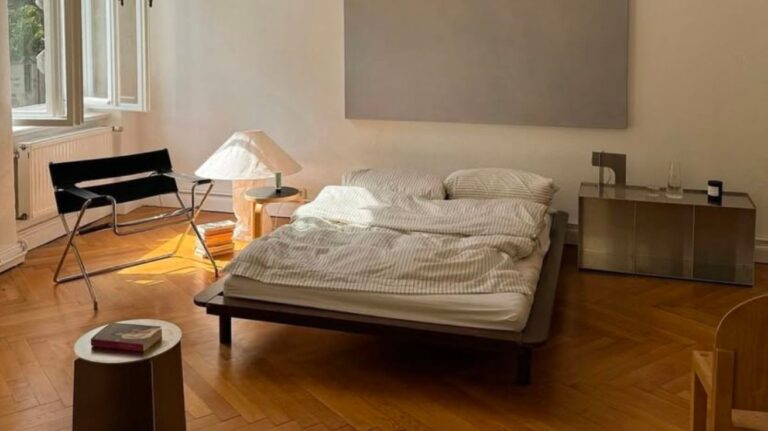
Open Plan Kitchen Living Room Tips That Will Make an Amazing Multiuse Space
This post contains affiliate links. If you buy through them, I may earn a small commission — at no extra cost to you. I only recommend products I’d genuinely specify as an architect.
Pinterest VS Reality
An open plan kitchen living room sounds like the dream.
More light, more connection, more space to breathe.
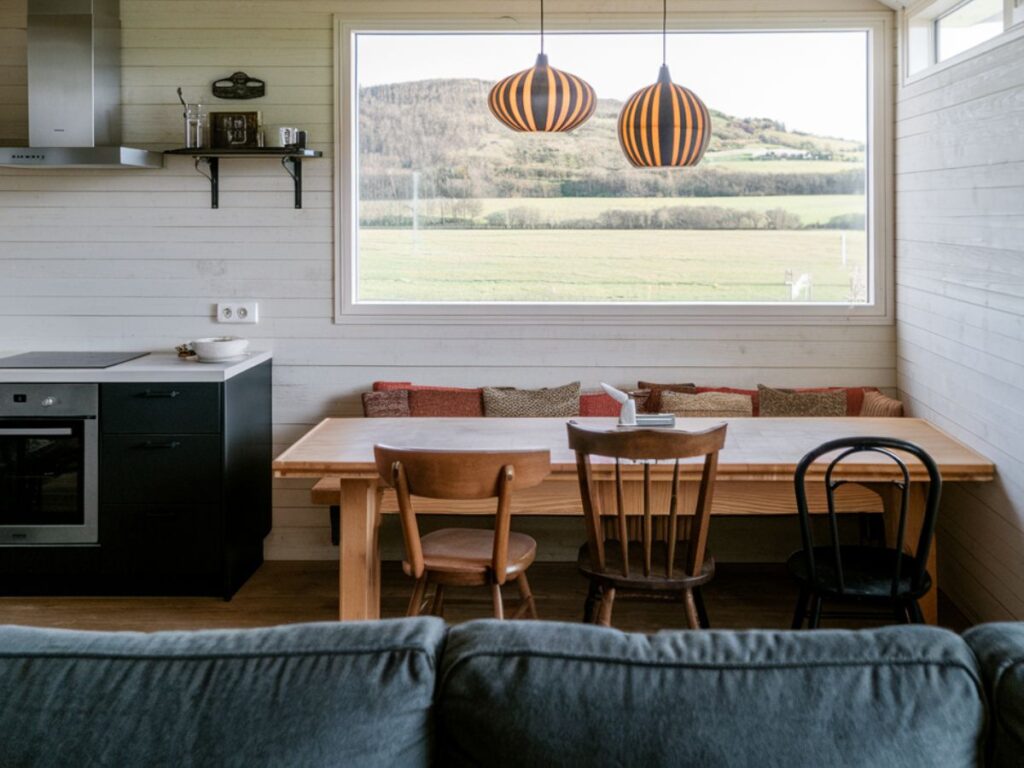
And then you actually live in one — or you start planning one — and something doesn’t add up. The dishwasher runs while you’re trying to watch a film. Cooking smells settle into the sofa cushions. The space feels enormous when empty and somehow cluttered the moment real life moves in.
You rearrange the furniture twice, repaint a wall, add more plants — and it still doesn’t feel quite right.
The truth is that an open plan kitchen and living room is one of the more spatially demanding situations in residential design. It asks a single room to do the work of several. It should be a kitchen, a dining area, a living room, and sometimes a workspace, all at once, all visible from every angle.
Without walls to contain the chaos of daily life, every design decision echoes across the whole space. A kitchen layout that doesn’t suit the way you actually cook, a sofa placed against the wrong wall, a lighting plan left to chance — any one of these can tip the space from genuinely comfortable into something that never quite settles.
The good news is that most of the problems that make an open concept kitchen living room feel uncomfortable come from a small set of identifiable mistakes. And they all have clear, considered solutions.
From choosing the kitchen layout that suits your daily routine to the zoning tools that give each area its own identity without building new walls, we’ll explore everything that makes this combination work beautifully.
Why an Open Plan Kitchen Living Room Is More Complex Than It Looks
When you remove the wall between a kitchen and a living room, you do not simply gain space. You gain responsibility for the whole picture. How the cooking zone relates to the relaxing zone, how one color reads next to another, and how the sounds and smells of daily life move through the air.
This is worth understanding before you fall in love with an open plan layout. Or before you try to fix one that isn’t working.

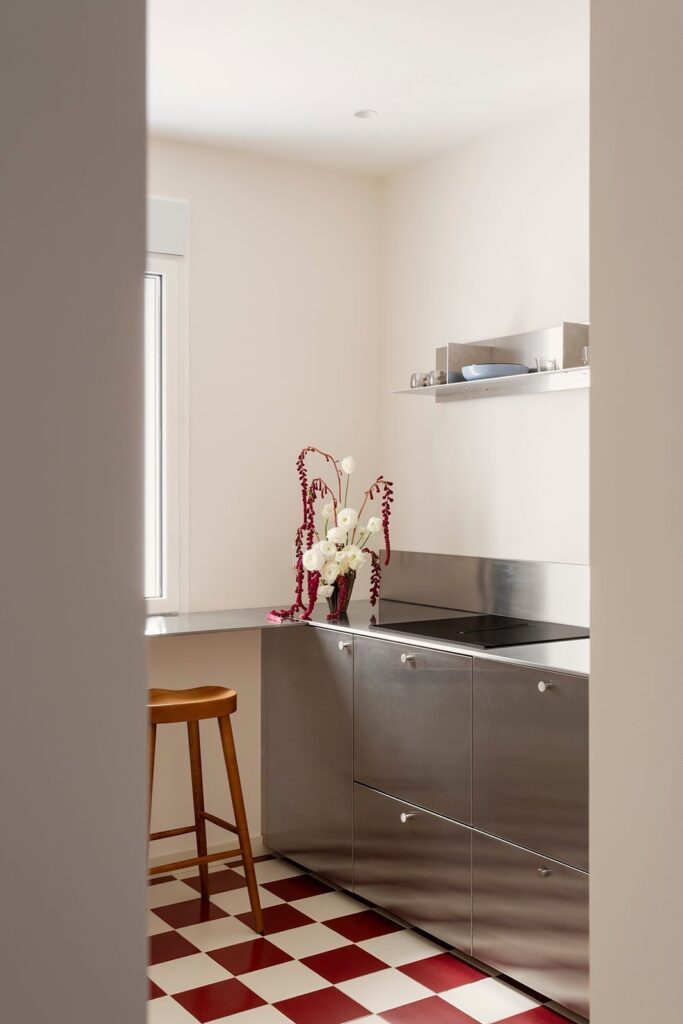
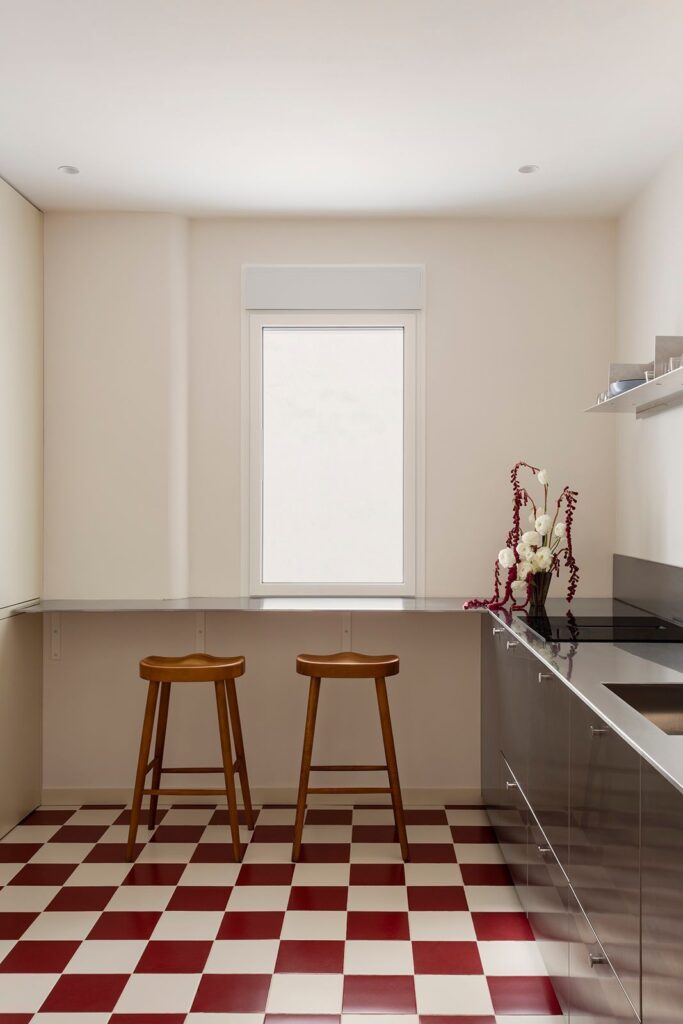
If you just have a nook – perfect for a tiny kitchen!
The kitchen of Casa Inari, design by Yeyé Estudio. SourceIn this house this is galley kitchen, connected by a tiny floating table.
The kitchen of Casa Inari, design by Yeyé Estudio. SourcePerfect if you have one side with full height cabinets – endless hidden storage, built in appliances.
The kitchen of Casa Inari, design by Yeyé Estudio. Source
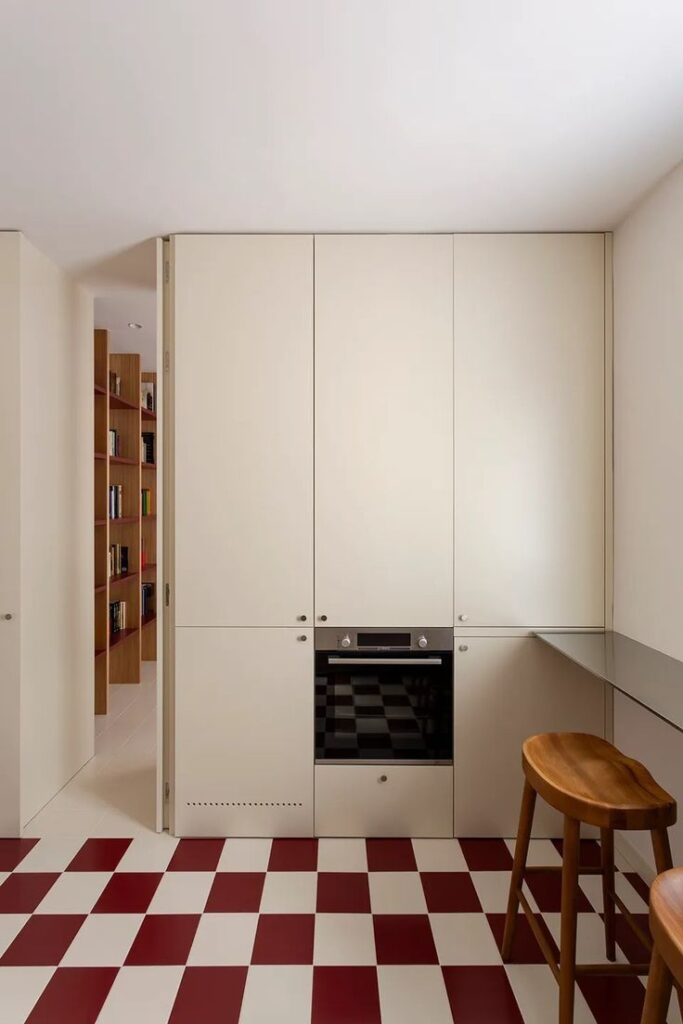
One space, many functions — and all of them visible at once
A kitchen is a working space. A living room is a resting space.
In a conventional layout, the wall between them does a quiet but important job: it contains the clutter, the activity, and the visual noise of cooking. Remove it, and everything is always on display.
A pile of dishes on the counter is visible from the sofa. The washing-up bowl features in every conversation. The practical and the personal share a single room, and finding balance between them requires deliberate design, not just decoration.
The open plan kitchen living room also multiplies the number of functions a single space has to support. These are preparing food, eating, working, relaxing, socialising, and often sleeping in smaller apartments.
Good small living room layout thinking is essential here. Identifying where each activity will actually happen, and making sure the furniture and space planning support that reality, not just a lifestyle ideal.
The hidden challenges: noise, smell, and visual clutter
These are the three elements that open plan living tends to underestimate.
Hard surfaces — stone countertops, tiled floors, glass splashbacks — reflect sound rather than absorbing it. And open kitchens amplify appliance noise and cooking sounds far more than a closed room ever would.
A running dishwasher, a range hood, the click of an induction hob — all of these carry into the living area and can make the space feel restless rather than calm.
Cooking smells present their own challenge. In a closed kitchen, the door contains them. In an open plan, they travel freely.
This is not necessarily a problem when you are slow-cooking something fragrant. But it is worth thinking about when the meal involves fish, strong spices, or anything that leaves a lingering trace. Ventilation, as we will discuss later, is not optional in this kind of layout.
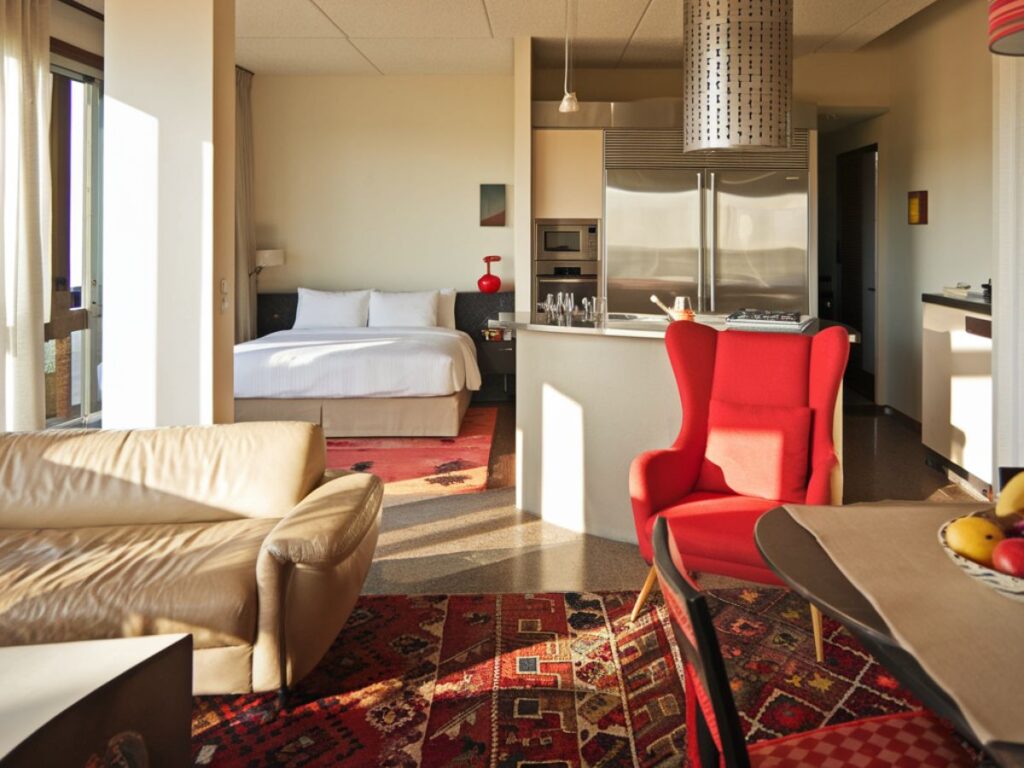
Why getting it right takes a different kind of planning
The reason open plan kitchen living rooms so often fall short is not for lack of beautiful things in them.
It is because they were planned as two separate spaces that happened to be joined together. Rather than as one coherent environment with distinct zones.
The solution is not more décor — it is more considered planning from the outset.
How to Choose the Right Kitchen Layout for Your Open Plan Space
The kitchen layout you choose will shape how the entire open plan area functions. It determines where the cooking activity is concentrated, how much visual weight the kitchen carries, and how the two zones relate to each other.
Knowing the differences between the main layout types is the starting point for making a decision that serves your actual life.
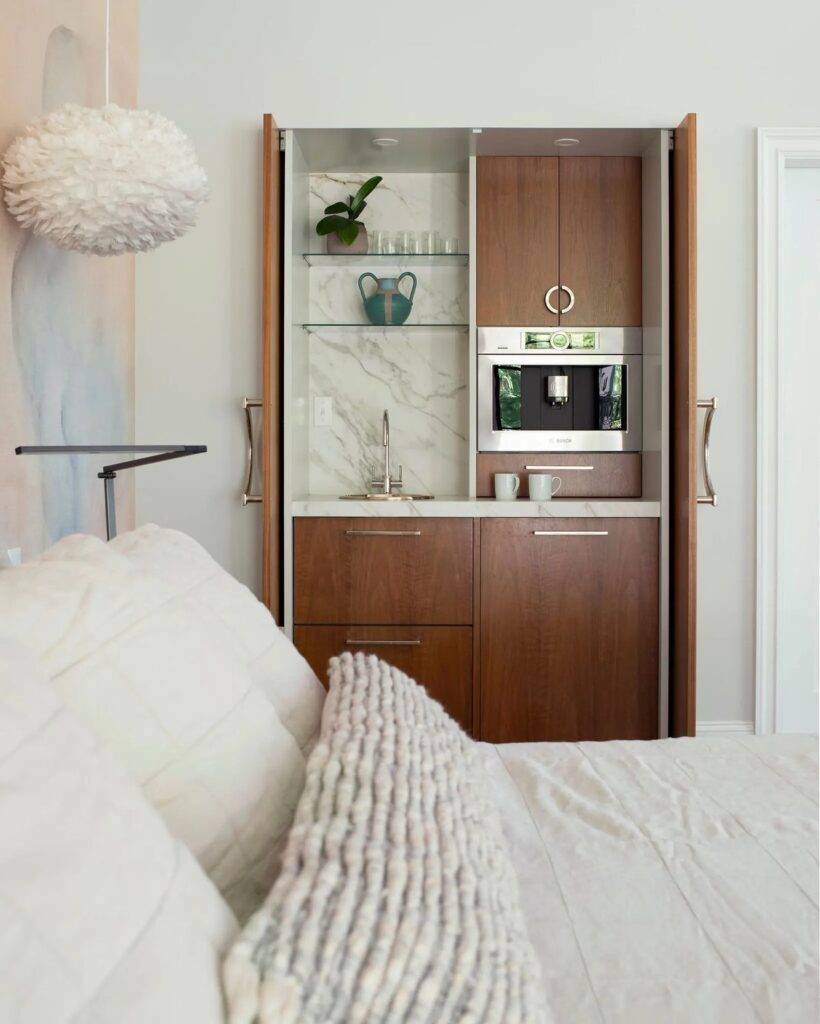
One-wall and galley: when contained efficiency works best
A one-wall kitchen arranges all appliances, cabinets, and counters along a single wall. It’s one of the most space-efficient solutions for small open plan apartments.
It keeps the kitchen visually compact and frees up the rest of the floor plan for living. The trade-off is counter space. A freestanding island or a small dining table with a prep-friendly surface solves this without major intervention.
A galley kitchen places two parallel runs of units facing each other, and for a single cook, nothing beats it for efficiency. It maximizes both storage and work surface without eating up floor space. Itkeeps the cooking zone clearly contained within the open plan.
Width is the critical variable here: leave at least 120 centimetres between the facing units to move comfortably. Position it at one end or along one side of the open plan. Pay attention — not cutting through the middle, where it will interrupt circulation and make the whole space harder to zone.
L-shaped: the most social and flexible option
The L-shaped kitchen is consistently the most popular layout for open plan living, and for practical reasons. Countertops and appliances are arranged on two adjoining walls, which keeps the work triangle. The relationship between the hob, sink and fridge — compact and efficient, while leaving the rest of the space genuinely open.
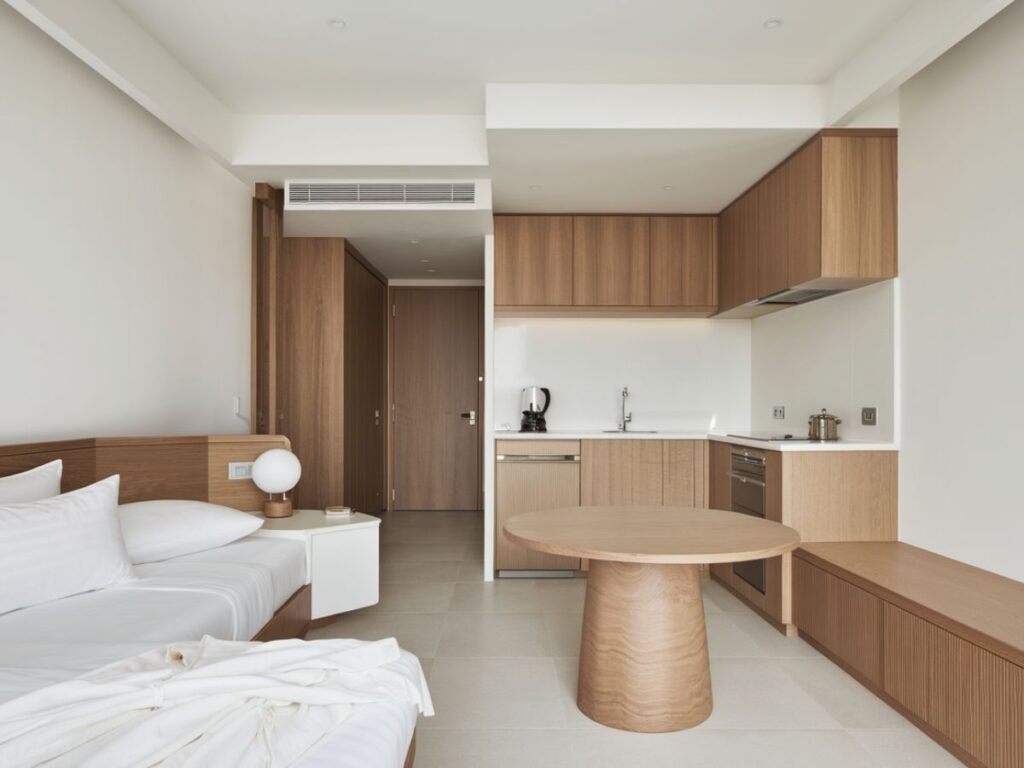
It accommodates multiple people in the kitchen without creating bottlenecks, and it integrates naturally with a dining or living area.
An L-shaped kitchen also lends itself well to the addition of an island or a small dining area in the open corner. In this way it can serve as a natural transition point between kitchen and living room.
This makes it particularly well-suited to households that cook together, entertain, or want the kitchen to feel like part of the social space rather than separate from it.
Peninsula and island: where kitchen meets living room
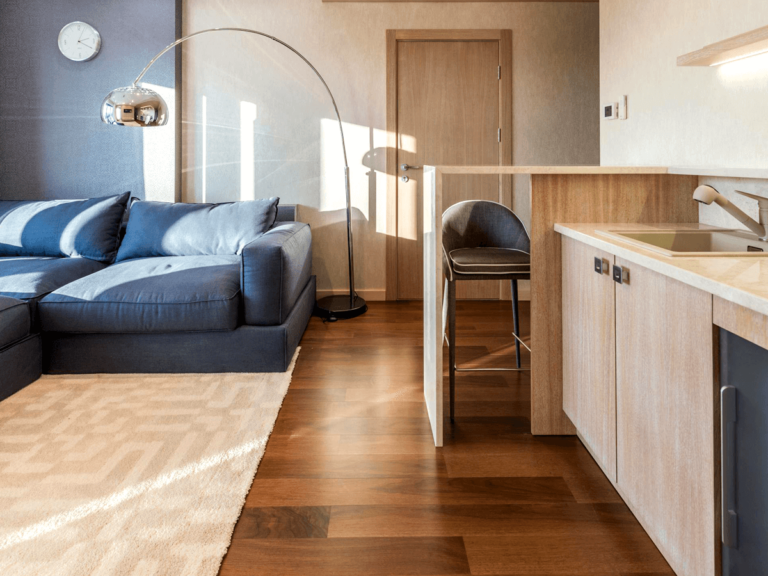
A peninsula — a counter that extends from an existing run of cabinets into the open plan — does something particularly useful. It creates a soft boundary between kitchen and living room without closing the space off.
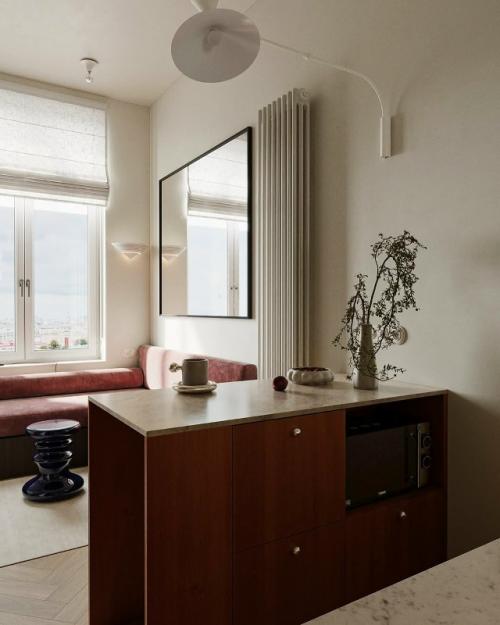
Tiny kitchen peninsula in a tiny studio home in Russia.
Found it here!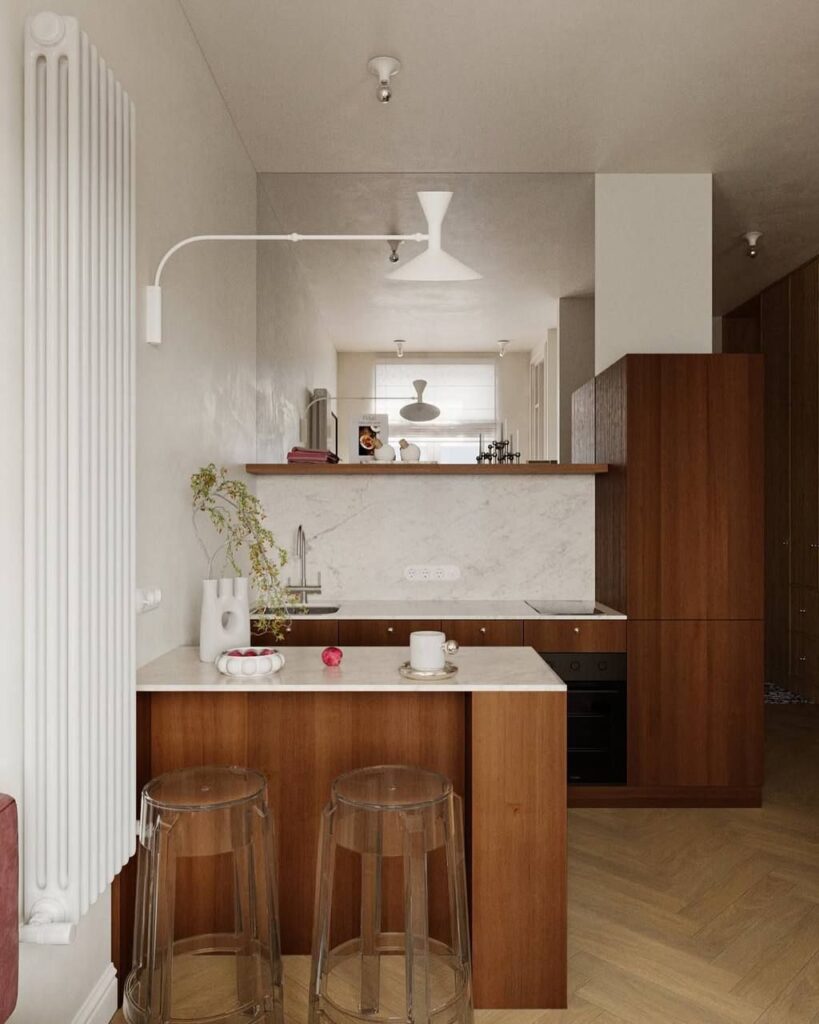
Tiny kitchen peninsula in a tiny studio home in Russia.
Found it here!
It provides extra work surface, often accommodates bar stools for casual dining. Also defines the kitchen zone in a way that feels both practical and considered.
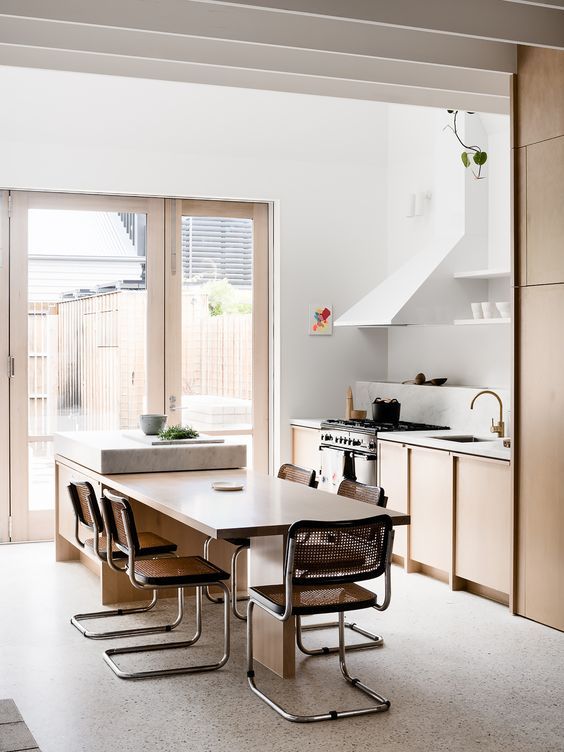
An island offers similar benefits in a more flexible form, provided the floor plan is large enough to accommodate it comfortably. The general guidance is to allow at least 90 to 100 centimetres of clear circulation space on all sides.
Both peninsula and island layouts work well in open plan spaces because they give the kitchen a clear edge. Make it clear where the kitchen ends and the living room begins — which is one of the most useful spatial tools available.
Which kitchen layout suits your life?
This is the question that should come before any other.
If you cook elaborate meals daily.
A U-shaped or galley layout will serve your workflow better than a single-wall kitchen ever could.
If you rarely cook but often have people over.
An L-shaped kitchen with a sociable island may be the most useful investment.
If you live alone in a compact studio and cook simple meals.
A well-planned one-wall kitchen frees up the remaining space for the living area, which is where you actually spend most of your time.
It is also worth thinking about what happens during cooking. Do you want to be able to see the living room — to watch a film, or keep an eye on children — while you cook? Or would you prefer the kitchen to feel slightly separate, a dedicated workspace with its own focus?
Your answer will guide both the layout choice and the orientation of the kitchen within the open plan.
The Most Common Open Plan Kitchen Living Room Mistakes
Understanding what commonly goes wrong in open plan kitchen living rooms is one of the most direct routes to getting yours right. Most of the issues are structural rather than decorative. They come from how the space is planned, not how it is styled.
No defined zones — the “church hall” effect
The most frequently cited problem in open plan design is the absence of clear zones.
Without them, a space can quickly begin to feel like one large, undefined hall — spacious, perhaps, but without warmth or purpose.
This happens when furniture is pushed against the walls, when there is no visual anchor in the living area, and when the floor plan is treated as a single open field rather than a collection of distinct areas.
The fix is not complicated, but it does require commitment. Pulling the sofa away from the wall and positioning it to face into the living zone — rather than pressed against the perimeter — immediately creates a sense of enclosure and intention. A rug placed under the seating group reinforces this further.
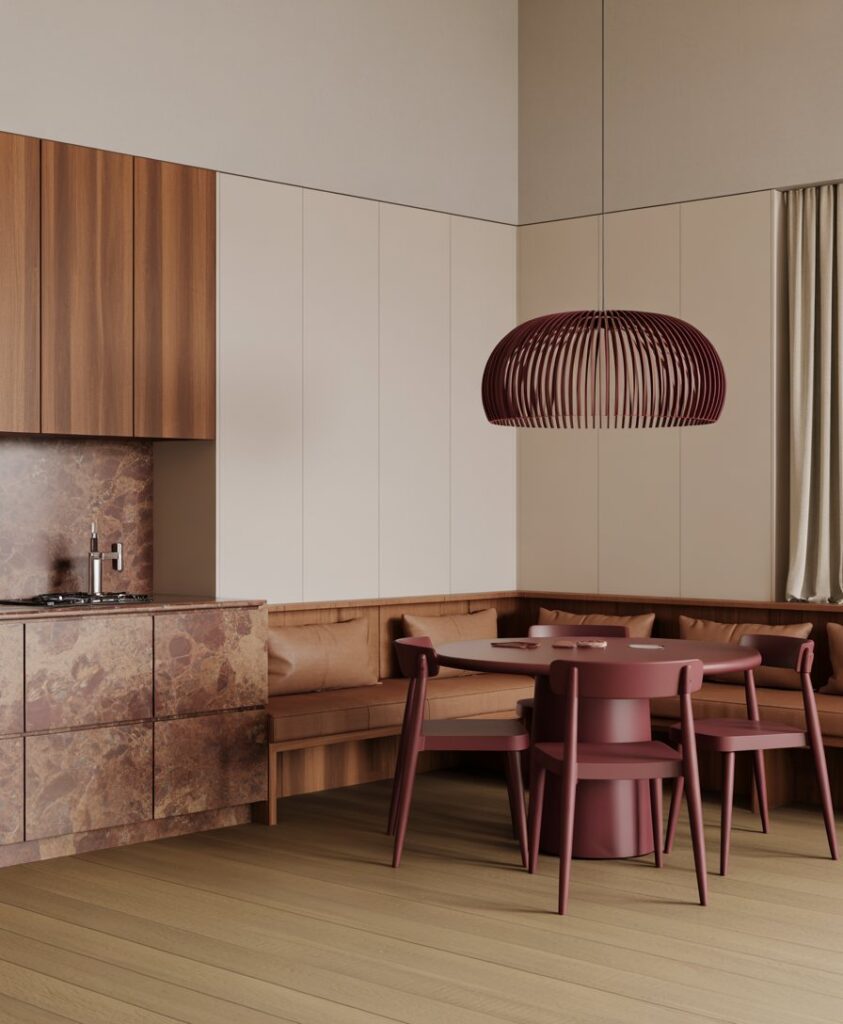
Mismatched or competing colour schemes across the space
It is a natural instinct, when moving from a home with separate rooms, to carry the décor approach from each room into the new open plan.
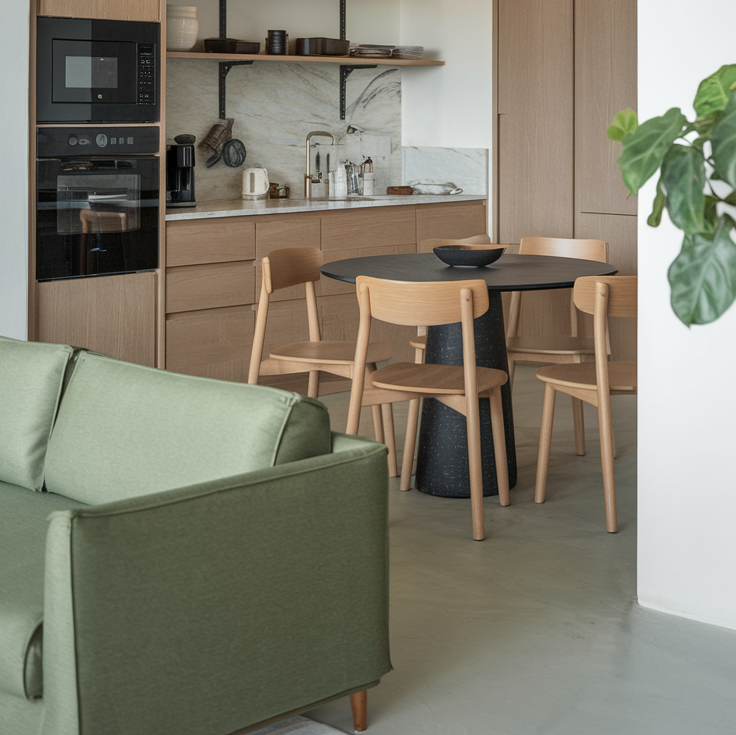
The problem is that colour schemes and material palettes that worked in separate spaces can clash when they share one continuous environment. The eye moves across the whole space at once.
Competing palettes — a warm terracotta kitchen alongside a cool grey living room, for example — can create visual fatigue rather than visual interest.
The most dependable approach is to establish a unified base: a consistent wall colour, or at least a closely related palette, that runs across the entire open plan.
From there, differentiate the zones through texture, furniture style, and soft furnishings rather than through competing colours. This creates cohesion without making the space feel monotonous.
Ignoring Lighting Until It Is Too Late
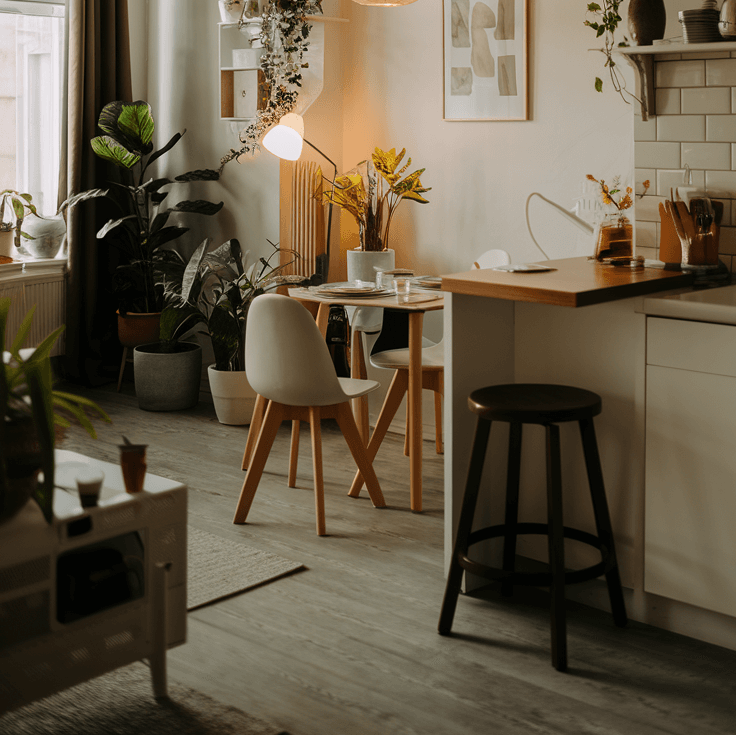
Lighting is one of the most consequential decisions in an open plan kitchen living room, and one of the most commonly deferred.
The mistake is to leave the lighting to an electrician who installs a grid of recessed downlights across the ceiling — functional, evenly spread, and almost entirely lacking in atmosphere.
A lighting plan should be designed around the furniture and zones, not viewed from an empty ceiling. It should include pendant lights over the kitchen or dining area, task lighting within the kitchen, and layered ambient lighting in the living zone.
Each zone benefits from its own lighting character: brighter and more practical in the kitchen, warmer and softer in the sitting area. Getting this right after the walls are finished and the ceiling is plastered is costly and disruptive. It is one of the few decisions in an open plan that is genuinely worth making early.
Furniture That Blocks Circulation And Breaks The Flow
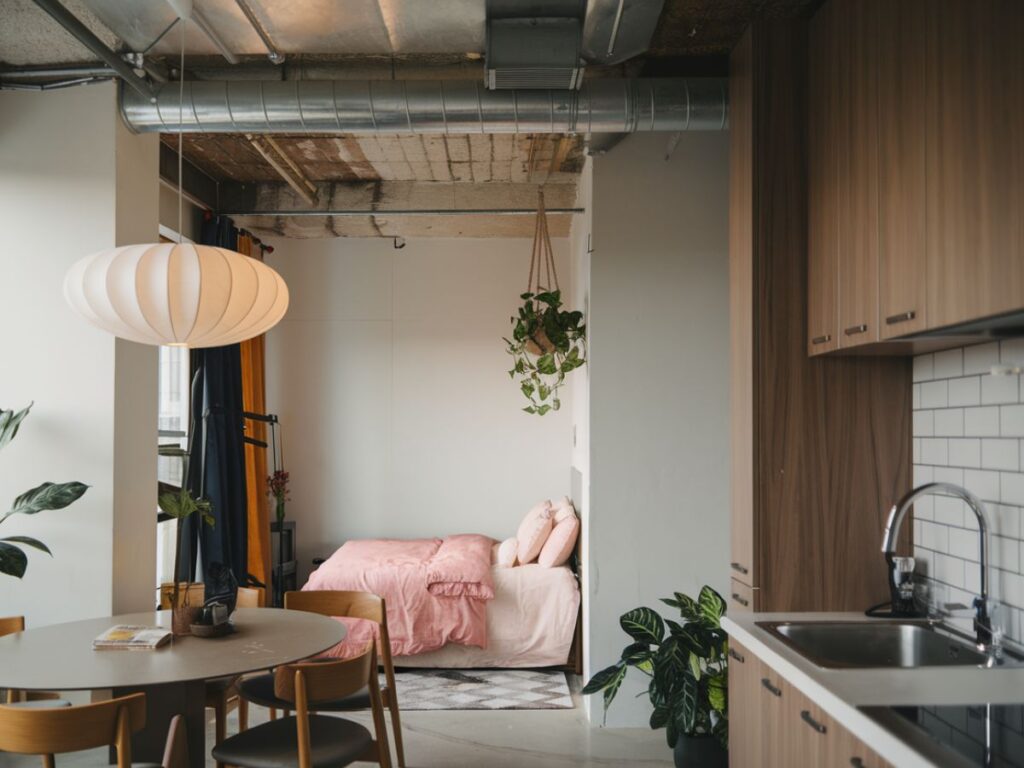
In a room with walls, large furniture can lean against them without affecting how the space functions. In an open plan, furniture acts more like architecture — it defines pathways, creates boundaries, and either supports or interrupts the natural movement through the space.
Oversized sofas that block the route between kitchen and living area, dining chairs that extend into a walkway, or an island placed too close to a run of cabinets can all make a generous space feel strangely difficult to move through.
The work triangle in the kitchen — the efficient path between hob, sink and fridge — should never be crossed by a main circulation route, and walkways generally should be at least 90 centimeters wide to feel comfortable. Planning these paths before selecting or arranging furniture is one of the most practical steps you can take.
How to Zone an Open Plan Kitchen and Living Room Without Building Walls
Zoning is the art of giving each area of an open plan space its own identity and function — without reinstating the physical boundaries that were removed.
It is, in many ways, the central design challenge of this kind of room, and it can be approached in several complementary ways.
Rugs As Zone Anchors
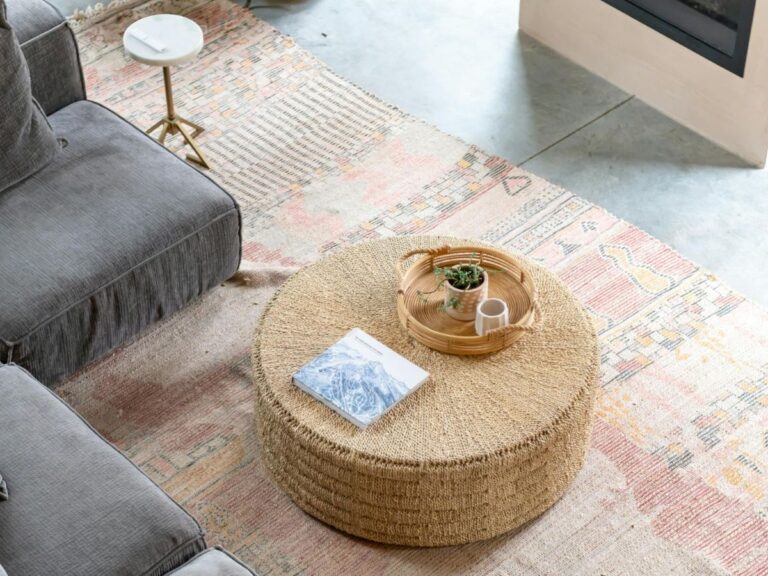
A rug is one of the most reliable tools for defining a living area within an open plan. Placed under the main seating group so that it extends beneath the front legs of the sofa and chairs, a substantial rug creates a clear visual boundary for the living zone without any physical barrier.
It also introduces texture and sound absorption — a practical benefit in a space full of hard surfaces. The key is scale: a rug that is too small will look like an afterthought. It should be large enough to anchor the furniture group, with the seating sitting on or at the edge of it.
The Sofa As a Spatial Divider
Positioning the sofa with its back towards the kitchen — facing into the living area — does something quietly significant.
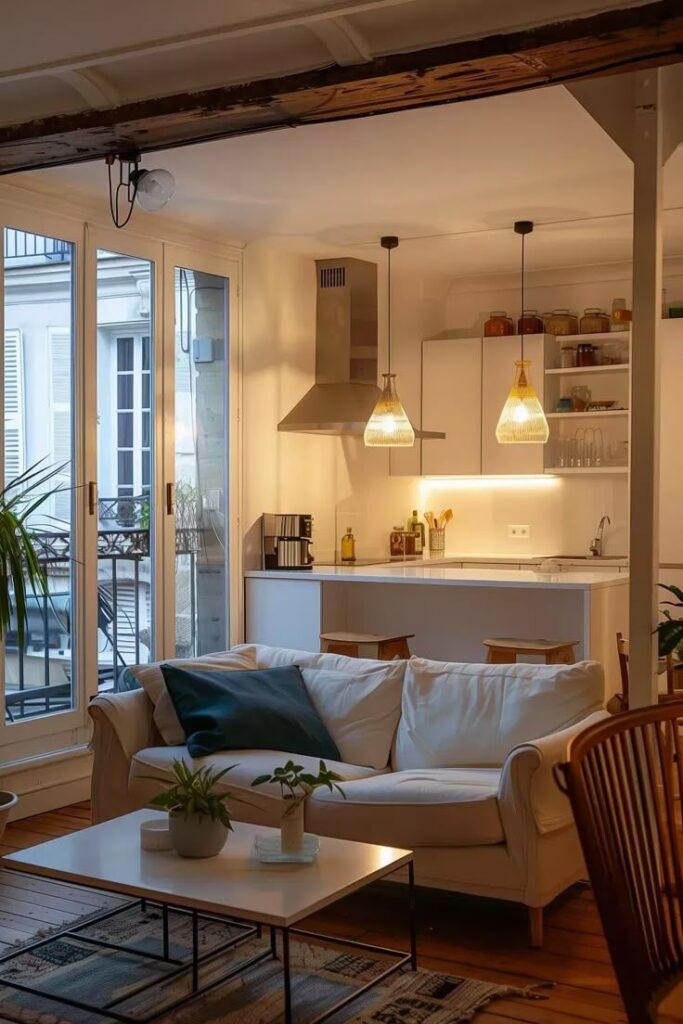
It turns a piece of furniture into a spatial boundary, creating a sense that the living zone has a back wall even when there is no wall there.
This arrangement also directs attention towards the living area rather than across the open plan, which makes the space feel more intimate and settled. Multifunctional living room furniture choices matter here too: pieces that do double duty as storage reduce visual clutter across the whole open plan.
Open Shelving, Islands, And Storage Units as Soft Boundaries
Taller furniture — open shelving units, a bookcase, or a sideboard — can create a sense of separation between zones without blocking light or views.
Positioned along the line between kitchen and living room, these pieces act as a permeable partition: you can see through or around them, but they give the space a clear sense of transition.
An island or peninsula, as discussed earlier, serves a similar purpose with the added benefit of practical work surface. A well-placed kitchen island acts as a transitional element, giving the kitchen a defined edge while keeping the living area connected.
The Sensory Details That Make or Break the Space
Good zoning addresses how an open plan kitchen living room looks and functions.
But there are two further dimensions — sound and air — that determine how the space actually feels to live in. These are often overlooked in the visual enthusiasm of planning a new layout.
What is the best way to manage noise in an open plan kitchen and living room?
Acoustic comfort is one of the most underappreciated aspects of open plan living.
Hard surfaces — polished concrete, stone countertops, ceramic tiles — are visually appealing and practical in a kitchen context, but they reflect sound rather than absorbing it. This means that the clatter of cooking, the hum of appliances, and everyday conversation all bounce around the space more freely than they would in a room with softer finishes.
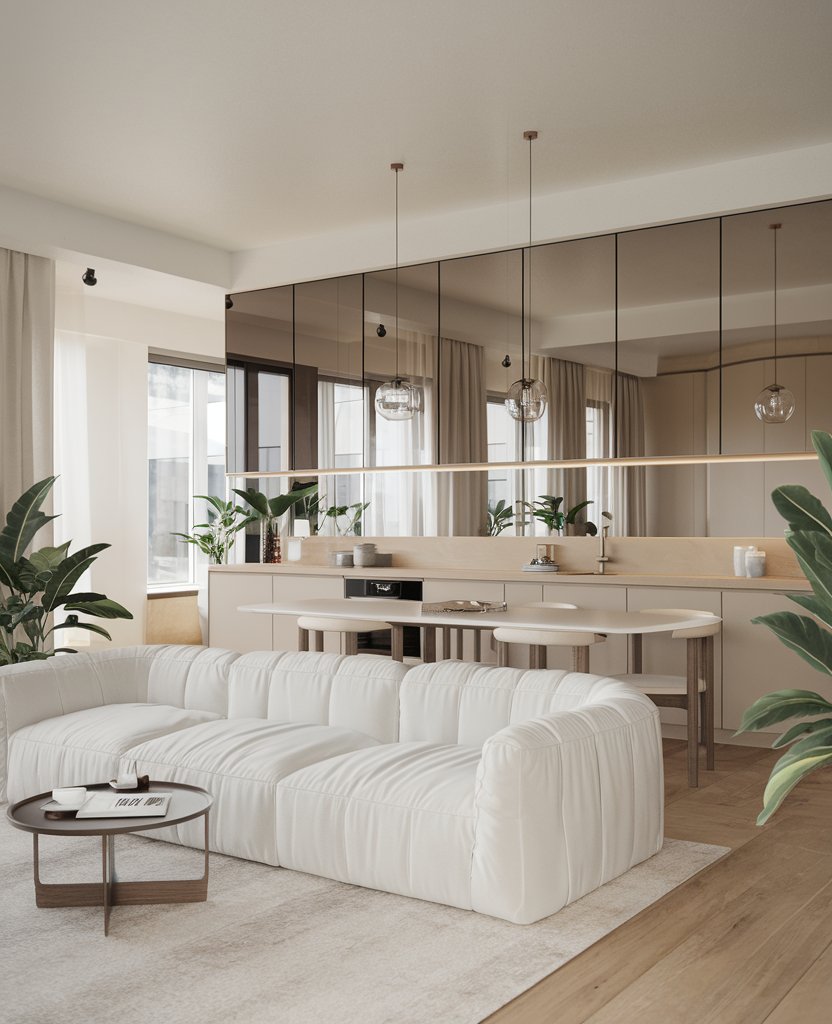
The most effective approach is layered: introduce sound-absorbing materials across multiple surfaces rather than relying on a single fix.
Thick rugs, upholstered furniture, and fabric window treatments all help to absorb sound in the living zone, while timber finishes, cork panels, or acoustic wall slats can address the kitchen side without looking clinical.
Positioning the cooking and cleaning appliances — hob, dishwasher, sink — as far as possible from the main seating area reduces the impact of their noise on the resting zone. These are decisions that are most effective when made during the planning stage, but many of them can also be introduced into an existing space.
Ventilation and cooking smells — why extraction is non-negotiable
In a closed kitchen, a modest extractor fan is often sufficient. In an open plan kitchen living room, ventilation requires more deliberate attention.
Cooking smells travel freely in a connected space. Without proper extraction, they settle into upholstery, curtains, and cushions — and linger long after the dishes are done.
A powerful range hood positioned directly above the cooking hob is the single most effective fix. Size it for the hob, not for the aesthetic. A hood that looks sleek but underperforms will leave your living room smelling like last night’s dinner.
A few things worth knowing when choosing your system:
Ducted extraction (vented to outside) outperforms recirculating systems by a significant margin. If you’re renovating, prioritize getting the ducting in — it’s much harder to add later.
Recirculating hoods filter and return air to the kitchen. They’re better than nothing, but they require regular filter maintenance to stay effective.
Induction over gas — induction hobs produce less heat, smoke, and airborne grease than gas, which takes some pressure off the ventilation system overall.
Flooring continuity and visual coherence
The flooring choice across an open plan kitchen living room has a significant effect on how unified the space feels.
Using the same flooring throughout — timber, stone-effect tile, or quality vinyl — creates a sense of continuity that makes the whole space read as a single, considered environment.
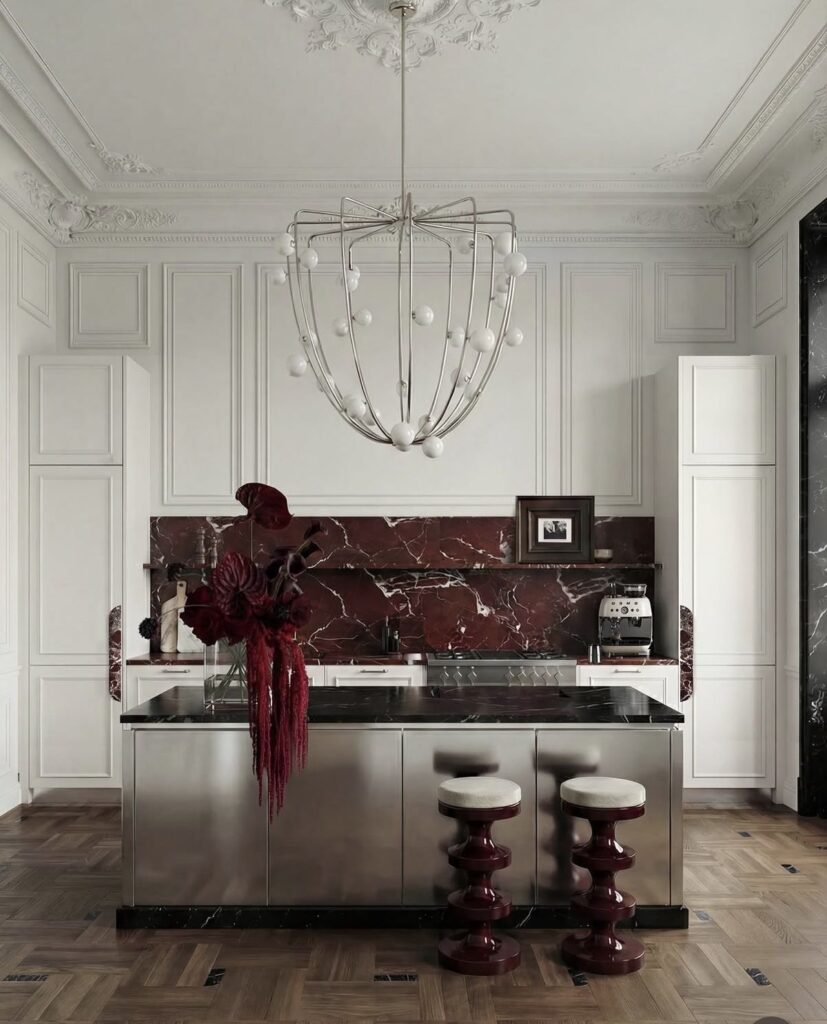
Found it here, credit: @nuova_home
A change in flooring can also be used deliberately to mark the boundary between kitchen and living areas, provided it is planned with care. The change should feel intentional and harmonious, not accidental — a shift from hardwood to a coordinating stone tile, for example, rather than a jarring contrast.
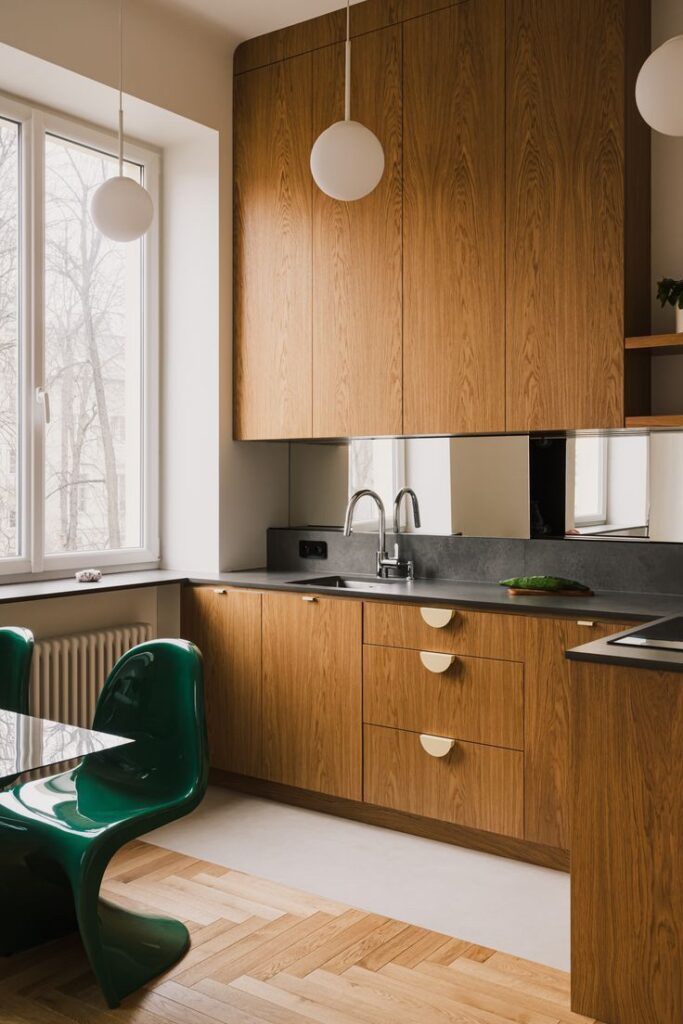
What tends not to work is wall-to-wall carpet that extends into a kitchen zone, or a material transition placed at an awkward point in the room rather than at a natural threshold.
What a Well-Designed Open Plan Kitchen Living Room Actually Feels Like
I remember standing in our studio apartment on the day the wall came down during the demolition phase of the renovation.
The space was suddenly larger — and, unexpectedly, more daunting.
It was not the neat, effortless openness of the magazine photographs. It was a raw, undifferentiated volume that needed clear thinking to become a home.
What became clear in that moment, and throughout the layout planning process that followed, was that an open plan does not simplify the design decisions — it concentrates them.
A well-designed open plan kitchen living room is recognisable not by its size or the number of beautiful objects within it, but by how settled it feels.
Each zone has a clear identity.
The kitchen is efficient and unobtrusive when not in use.
The living area feels genuinely separate — calm and unhurried — even though there is no door between them.
Light moves through the space evenly.
The air is fresh.
Noise is absorbed rather than amplified.
And the whole environment supports the way you actually live, not just the way you imagine you might.
That quality of settledness — the sense that a space has been thought through rather than assembled — comes from the decisions described throughout this post. None of them are complicated in isolation. Together, they are what separates an open plan kitchen living room that photographs well from one that genuinely works.
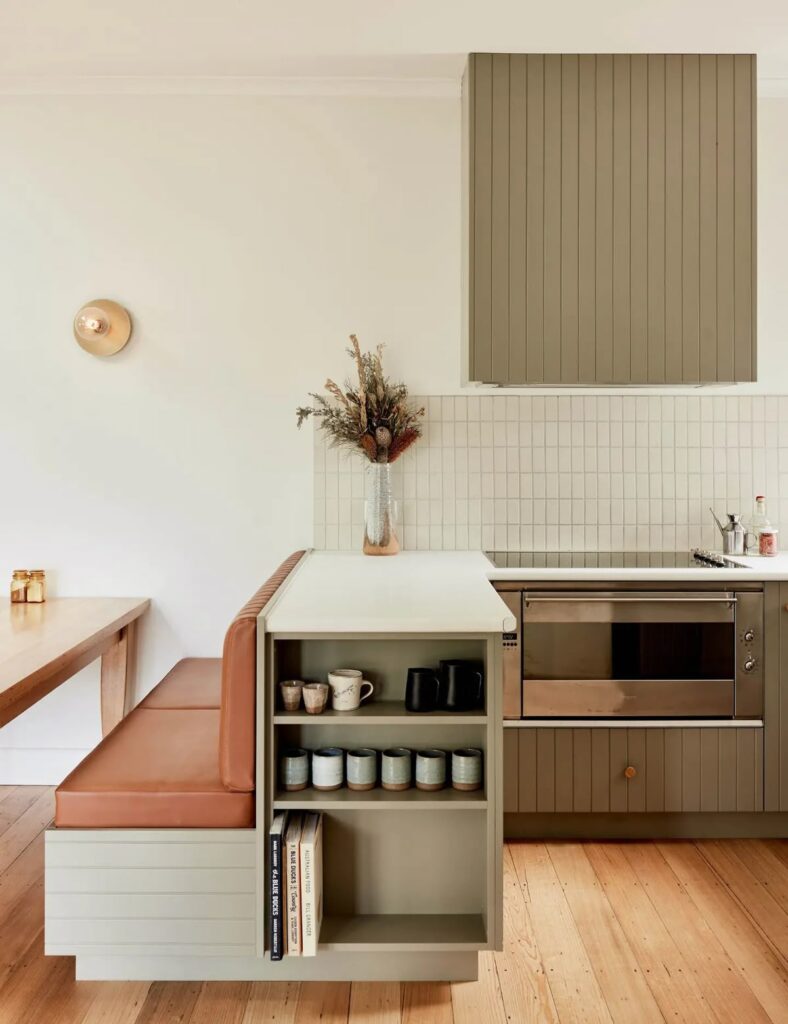
Bringing It All Together
An open plan kitchen living room is one of the most rewarding spaces to get right — and one of the more unforgiving ones to get wrong. But the path forward is clearer than it might feel when you’re standing in a room that just isn’t working.
The decisions that matter most are structural.
- Which kitchen layout actually suits the way you cook.
- How you anchor each zone so the space stops feeling like a hall.
- How you address light, acoustics, and ventilation before you fall in love with a paint colour.
Get these right, and everything else has something solid to sit on.
The space doesn’t need to be large. It needs to be honest — planned around how you actually live, not how you imagine you might.
- How many people cook at once.
- Whether you entertain or mostly nest.
- Whether you need the kitchen to feel like part of the conversation, or slightly apart from it.
That clarity is what makes an open plan kitchen living room feel genuinely good to come home to.
If you’re working through these questions for your own space, I’d love to hear what you’re navigating — drop it in the comments below.
And if you’re at the beginning of a renovation, don’t skip the planning stage. The renovation budget template I put together walks you through the financial side before the walls come down — because that’s exactly when it matters most.