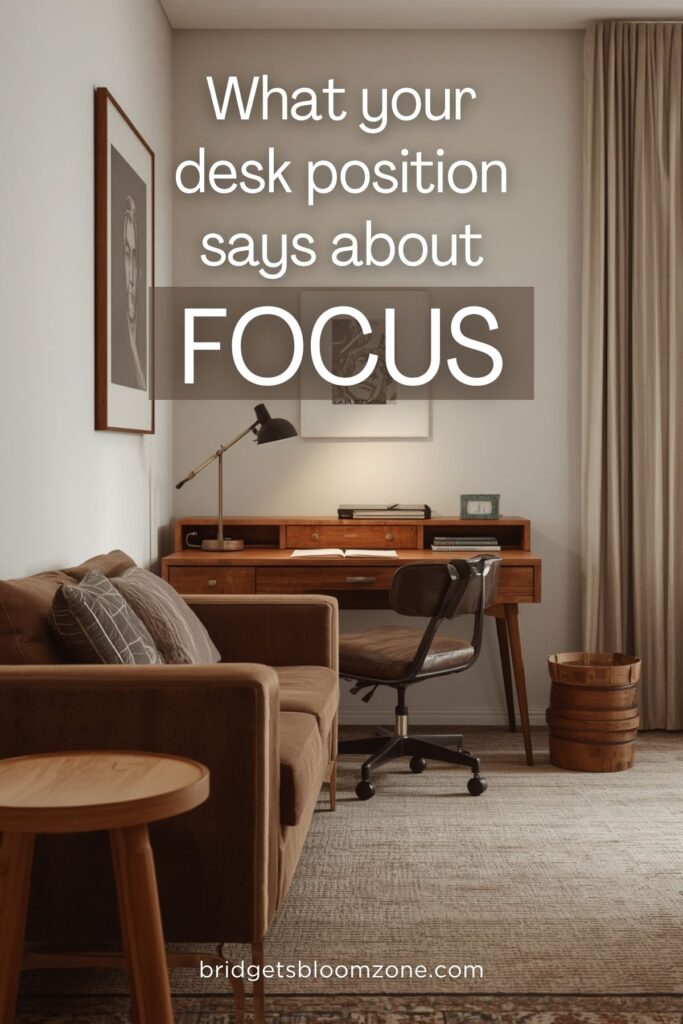
Living Room Office Combo Ideas That Actually Work — And the Psychology Behind Why
Pinterest is full of living room office combo ideas and cozy home office setups. Beautiful desks, warm light, a plant in the corner.
But a desk that photographs well and a desk that supports real, sustained work are not always the same thing. The difference often comes down to a detail that never shows up in the image: which way the desk faces.
I have been working from home for most of my adult life — not because a global event made it necessary. After long days at the architecture office, colleagues and I would stay on to work our own projects: competition entries, personal briefs, ideas that needed a real desk.
Alongside the professional work, there were always creative side projects too. Regulalry, a sewing corner has to find its place in a studio apartment never designed for it.
I have solved this problem many times, in many small apartments. Not as a decorator — as an architect.
A workspace that supports real focus has less to do with aesthetics and more to do with spatial logic. How enclosed do you feel? What are you facing? These are environmental psychology questions — and they have answers.
This post is about how to set up a living room office combo that actually works: where the desk should go, which way it should face, and how to make the space feel cohesive. Before you choose a desk or think about storage, ask yourself one question: when I sit down to work, what do I want to be facing?
That single decision shapes everything else.
Bedroom, Living Room, or One Room — Where Should Your Home Office Go?
Why the bedroom is a harder choice than it looks
The bedroom feels like the obvious answer. It has a door. It’s quieter. But working where you sleep creates a persistent problem: the brain builds associations between spaces and states.
Research published in the Journal of Occupational and Organizational Psychology found that keeping work in a physically separate area from rest spaces was one of the most effective strategies for maintaining both productivity and work-life balance when working from home.
When your desk is three feet from your bed, it becomes harder to switch off in the evening — and harder to switch on in the morning.
The practical downsides of a bedroom workspace:
- Work equipment stays visible during personal time
- The room loses its psychological association with rest
- Evening wind-down is harder without a physical transition
- Natural light is often less generous than in a living room
Why the living room works
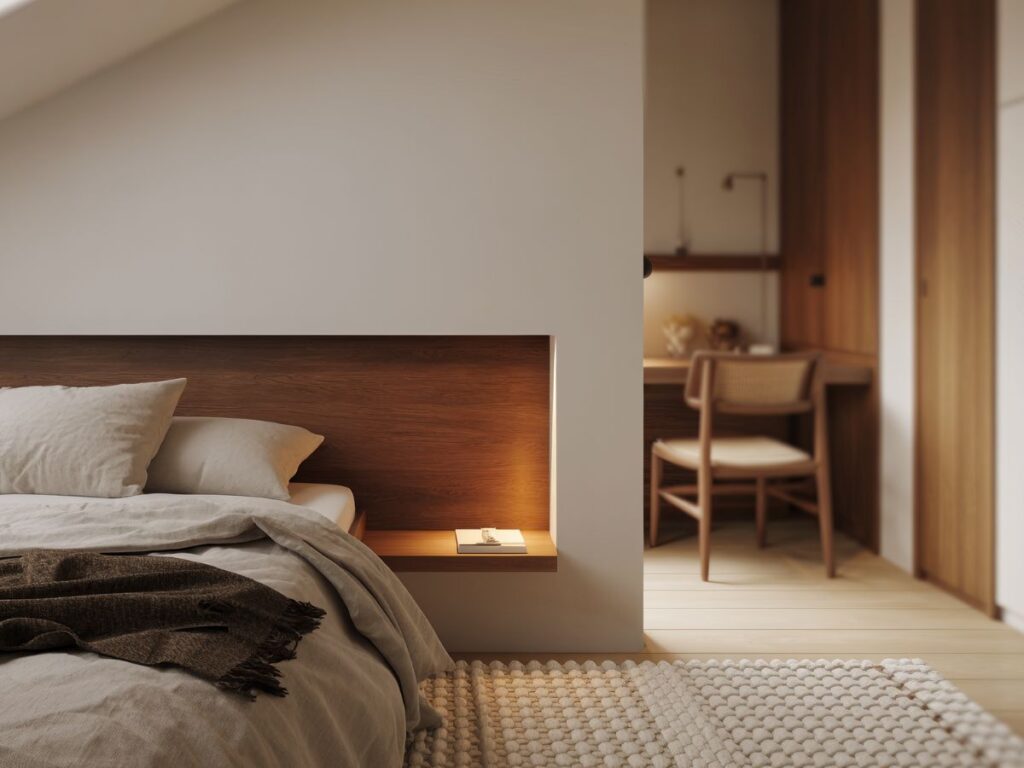
The living room is already a multi-function space. Adding a work zone is a smaller conceptual shift than it seems. Being able to walk away from your desk at the end of the day — even if it stays visible — creates a real psychological transition the bedroom rarely allows.
What the living room tends to offer:
- More wall options and usually the best natural light in the apartment
- The ability to physically leave the workspace at the end of the day
- A clearer separation between working and resting areas
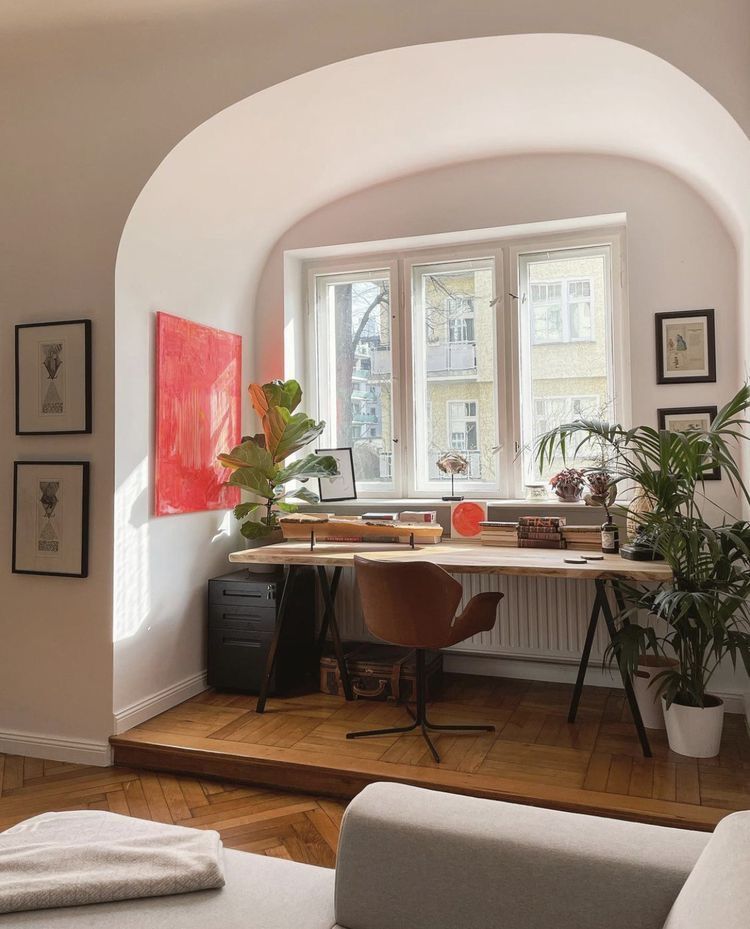
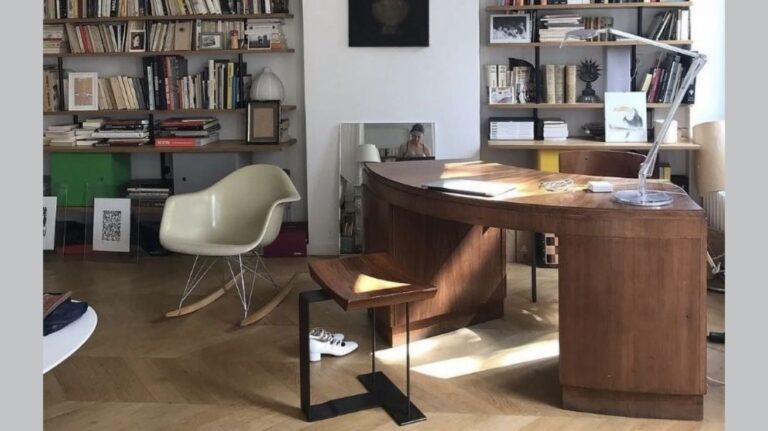
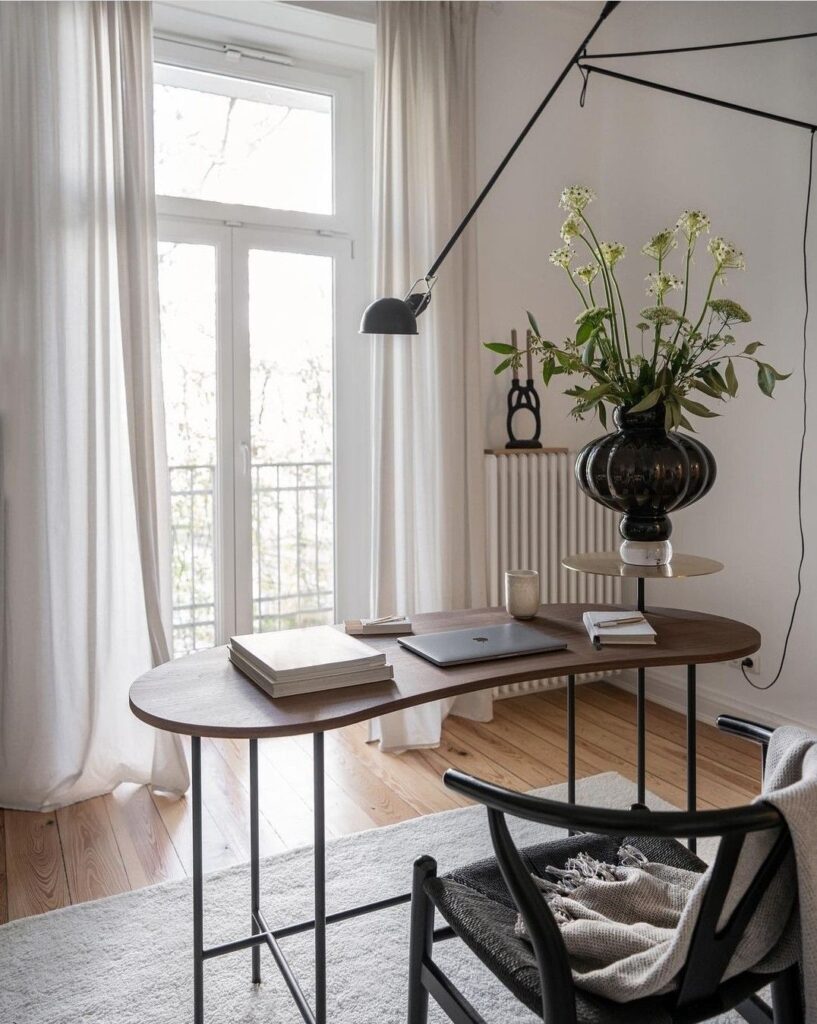
Source: Pinterest. Probably an apartment from Berlin – If you know the owner, tell me!
What to do if you only have one room
If sleeping, living, and working share the same footprint, the challenge is real — but it is a design problem with practical solutions. More detail on studio apartment layout strategies, but the core principles for a one-room setup are these:
- Face the desk away from the bed.
The less the bed is in your sightline while working, the easier it is to stay focused. - Use orientation, not walls, to create zones.
A 45-degree angle between the desk and sofa signals a different zone without any furniture division. - Treat the desk lamp as a zone marker.
On when you’re working. Off when you’re not. - Keep the desk surface clear when you finish.
In a single room, a clear desk is the strongest visual cue that the working day has ended. - Avoid placing the desk between the bed and the living area. A corner or wall position is more contained — and feels less like the room revolves around work.
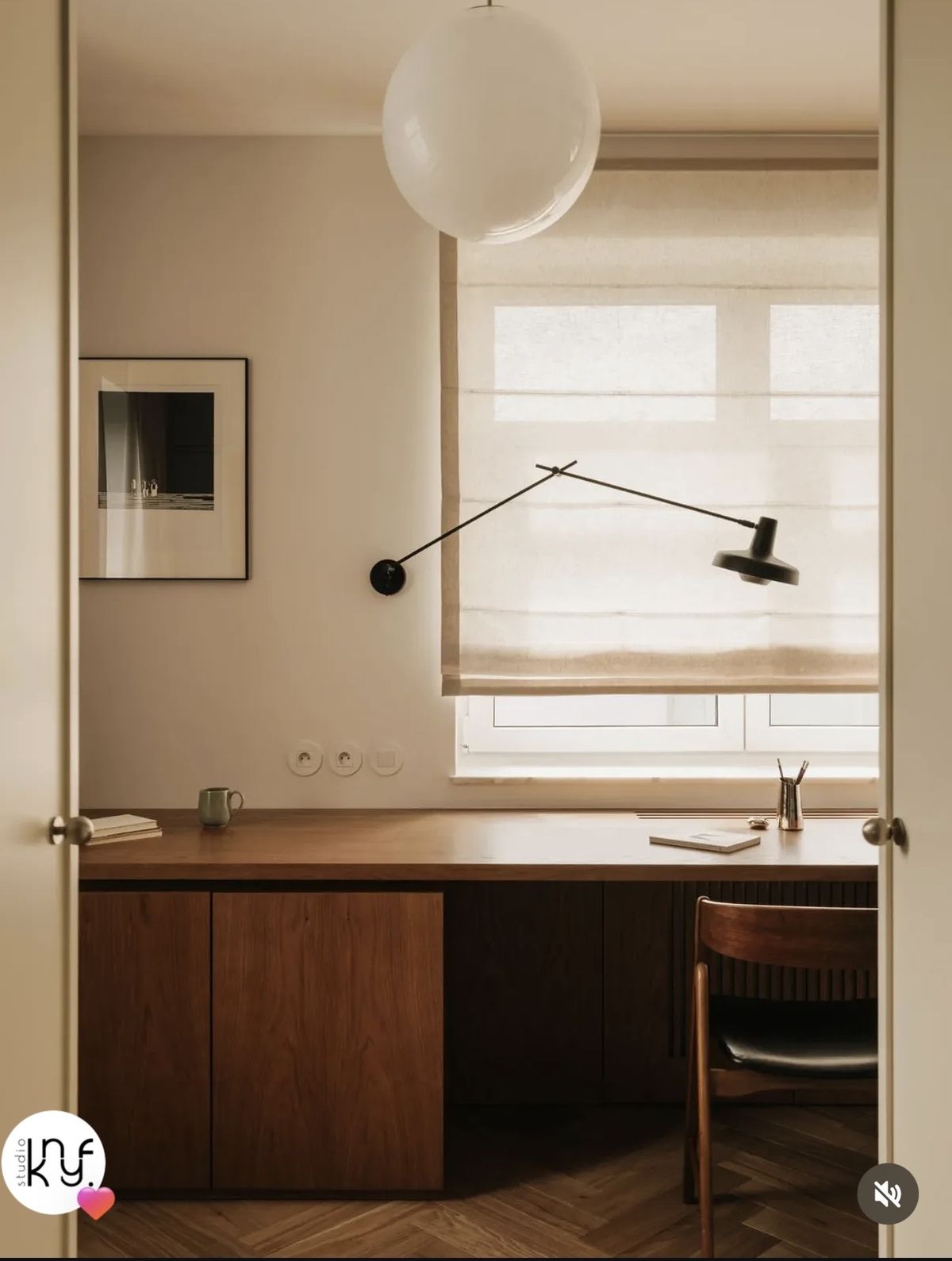
Projekt: @uklonstudio Foto: @migdal.studio
The Psychology of Which Way Your Desk Faces
This is the part most living room office combo posts skip entirely. It is also the most useful.
Where you sit relative to the room — what is in front of you, what is behind you, what you can and cannot see — affects your sense of safety, your ability to concentrate, and your baseline comfort throughout the working day.
Facing the window — light, view, and the risk of distraction
A window desk is the most popular position. It is also the most nuanced.
The benefits are real: natural light that falls on your face supports alertness and mood. A UCL study published in PLOS ONE found that workers at window desks consistently reported feeling more focused and productive.
Research from Northwestern University linked daytime daylight exposure to significantly better sleep quality — which in turn affects cognitive performance.
The trade-offs are equally real:
- Direct sunlight at certain times creates screen glare
- Movement outside — people, traffic, birds — can interrupt concentration
- For deep-focus work, the view competes with the task
The window desk works best when light falls from the side rather than straight ahead.
A sheer blind can soften direct light without losing the benefit of the window.
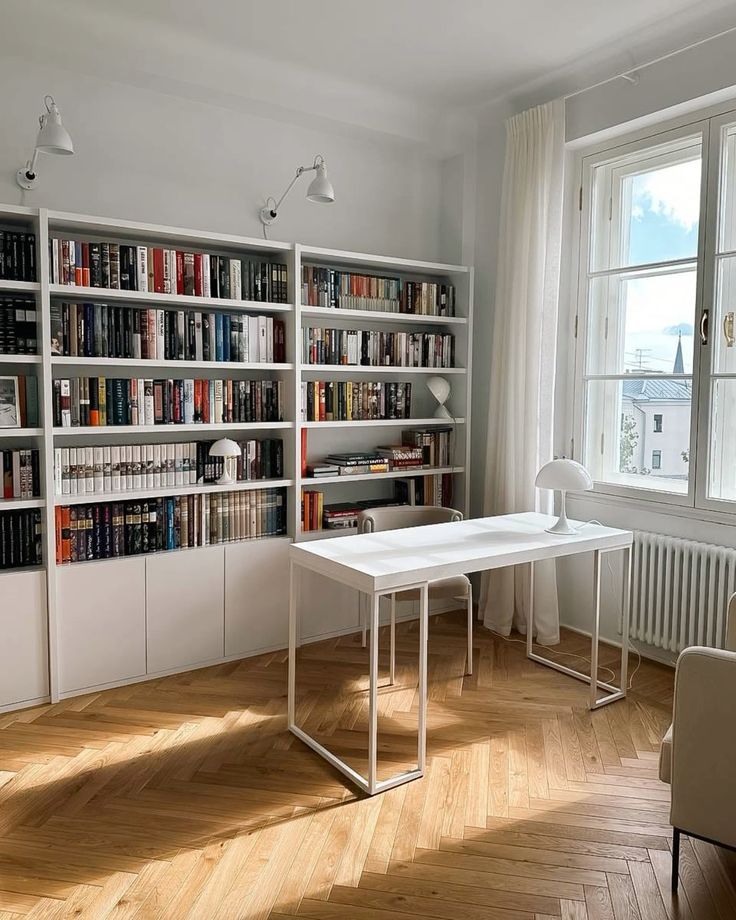
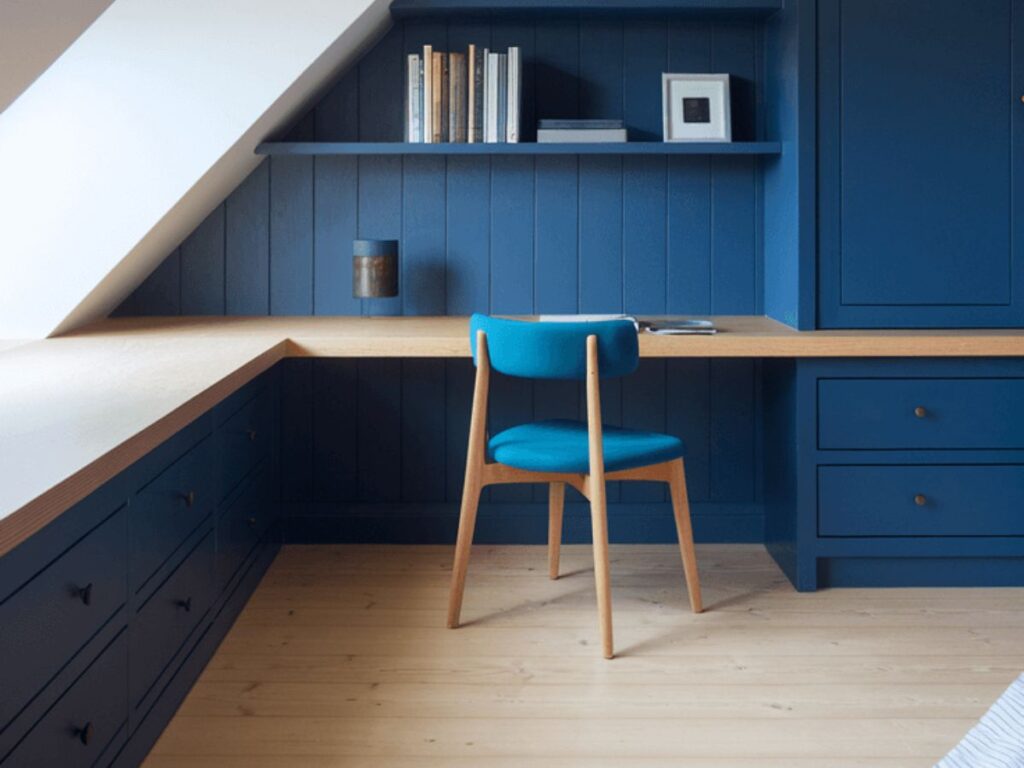
Facing the wall — containment and focus
Facing a wall reduces visual distraction. Environmental psychologist Lily Bernheimer, in The Shaping of Us, writes that people demonstrate better cognitive performance in what she calls ‘ninja-proof seats’ — positions with their back against a wall and a clear view ahead.
We concentrate better when we are not processing what might be approaching from behind.
A wall-facing desk offers:
- Minimal visual distraction
- A sense of privacy and containment
- A clear surface for shelving, a pinboard, or an inspiration arrangement
The risk: without careful lighting, a wall-facing position can feel oppressive over time.
A task lamp, a shelf at eye level, and one or two personally meaningful objects make a significant difference to how this position holds across a full day.
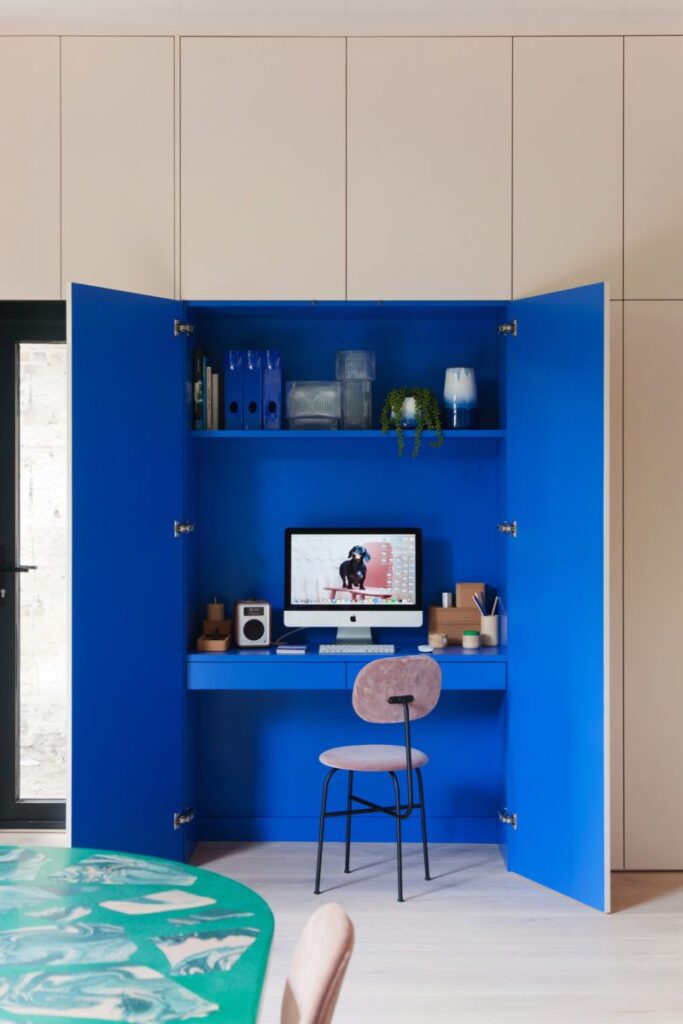
Facing the room — the command position
The third option is to face into the room itself, back to a solid wall. This is sometimes called the command position.
In architecture and environmental psychology, it maps to Jay Appleton’s prospect-refuge theory (1975): humans are instinctively drawn to positions that offer both a clear view ahead and protected enclosure behind.
The preference is evolutionary — encoded deeply enough that it still shapes how we feel in a space today.
A position facing the room tends to produce a baseline sense of control and settledness. It works particularly well in a living room because:
- You can see the door without being startled
- The living area is in your peripheral vision, not your direct sightline
- The desk reads as a considered element of the room, not an afterthought
What Don Draper’s desk tells us
There is a reason Don Draper’s desk in Mad Men faces the door. The show’s production designers — Amy Wells and Dan Bishop — were meticulous about period accuracy.
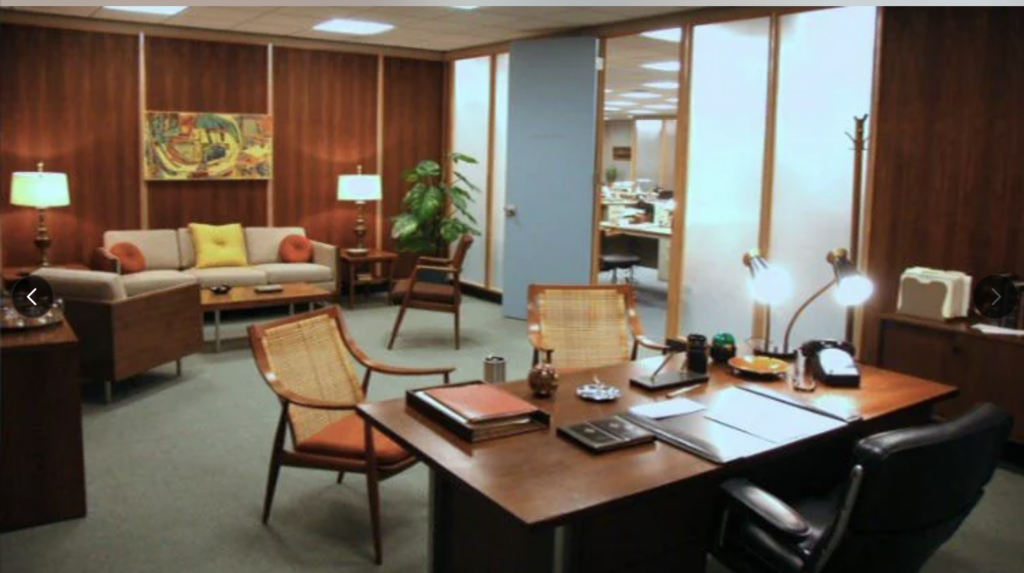
The Sterling Cooper layout encoded the hierarchy of the early 1960s in spatial form: executive offices on the perimeter with natural light, the typing pool inside without windows, and Don’s desk positioned to see every person who entered the room.
The ability to face the door without being surprised was not set dressing. It was a mark of authority — and a spatial principle documented across environmental psychology, feng shui traditions, and decades of executive office design.
For a living room office combo, the implication is practical: if your layout allows it, facing into the room is often the position that feels most naturally settled for long working days.
Finding Your Position — and the Right Desk for the Space
Read the room before placing anything
Before buying anything, observe your living room across the day. Notice:
- Where the light falls in the morning, at noon, and in the afternoon
- Which corners or walls feel naturally enclosed
- Where the main circulation path runs — and which spots sit outside it
- What you would be facing from each potential desk position
A few placement principles hold regardless of room size:
- keep the desk out of the main circulation path
- allow at least 90 cm behind the chair
- prefer a corner or wall position over a central one.
For a deeper look at spatial planning, the small living room layout guide covers the architectural thinking in full.
Desk types for a living room with office space
The right desk depends on how you work and how much room you have.
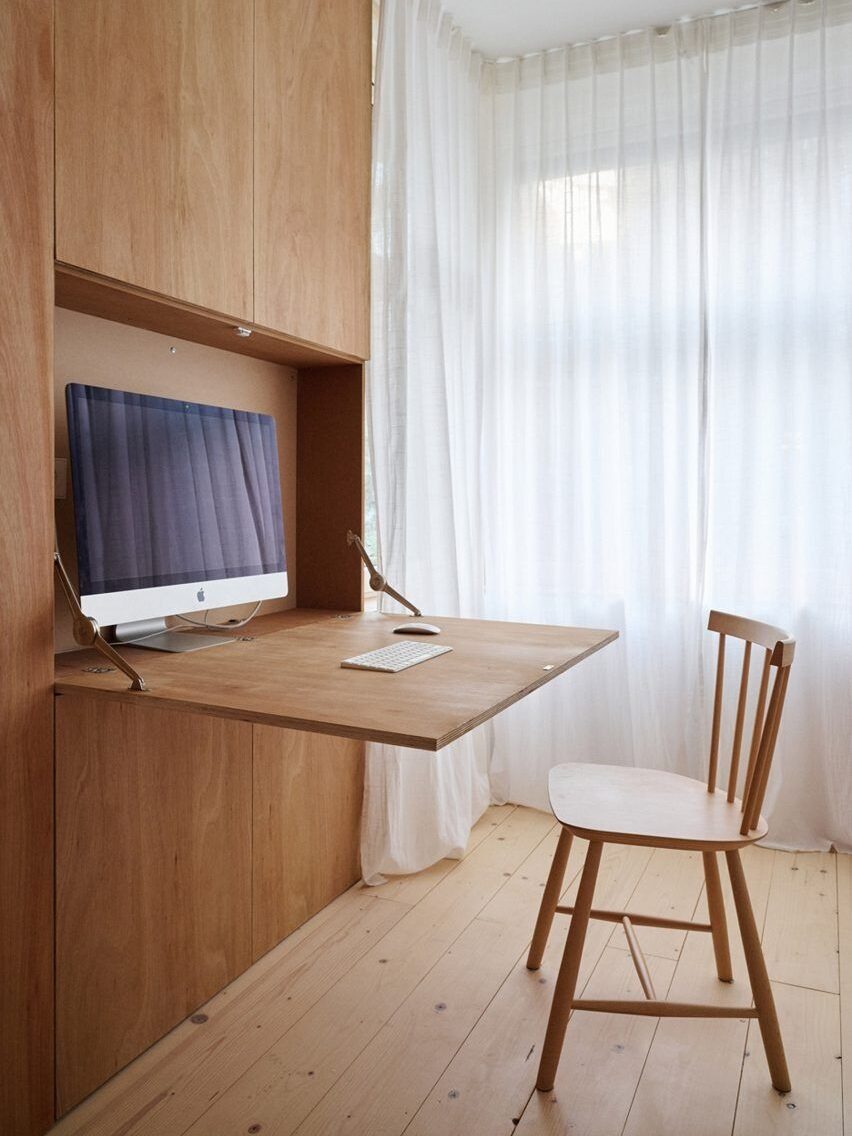
The floating wall desk has the smallest footprint. The surface folds away when not in use, leaving the floor clear. It suits laptop-based work and anyone who wants the desk to disappear outside working hours.
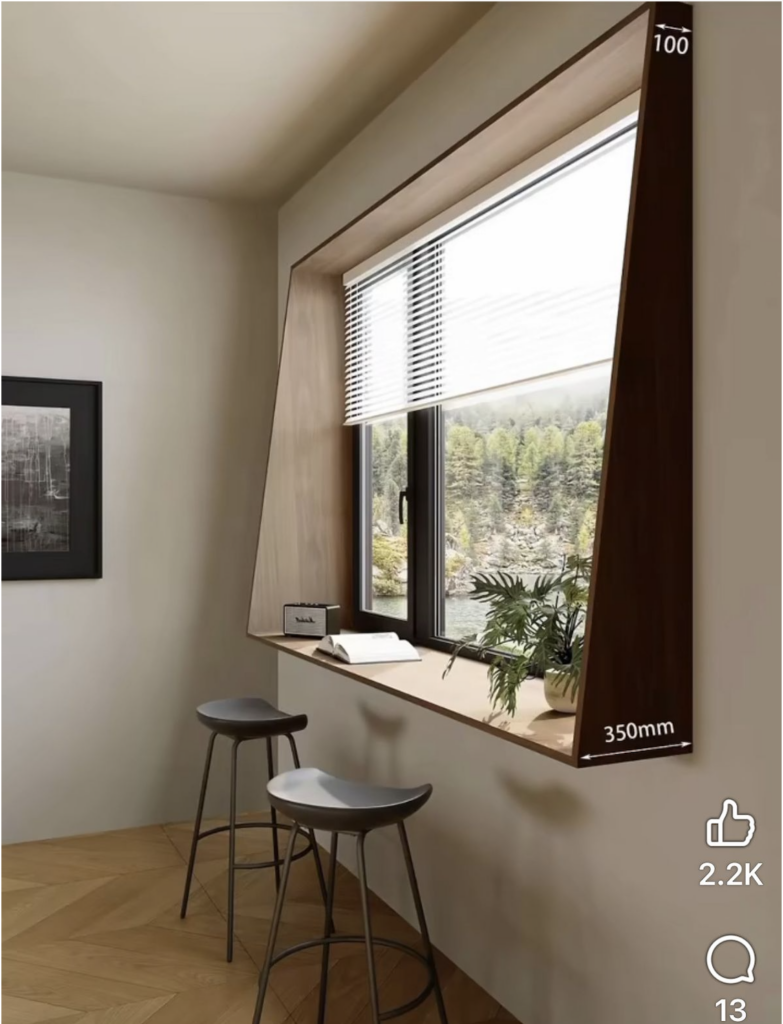
The console or window desk — typically 30 to 40 cm deep — reads like furniture rather than office equipment. It sits naturally against a wall, in front of a window, or behind a sofa. Allow 55 to 60 cm if you work with a monitor. It pairs well with multifunctional living room furniture — the desk joins a room that is already working harder than it looks.
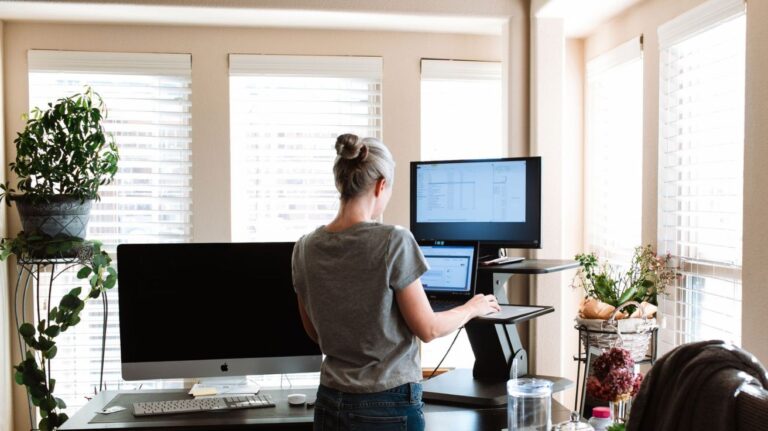
The height-adjustable desk is a personal conviction as much as a practical recommendation. Alternating between sitting and standing makes a real difference to energy and focus, especially across long sessions.
A UK-based review found that 87% of workers who stood for at least one hour during their working day reported feeling more energized.
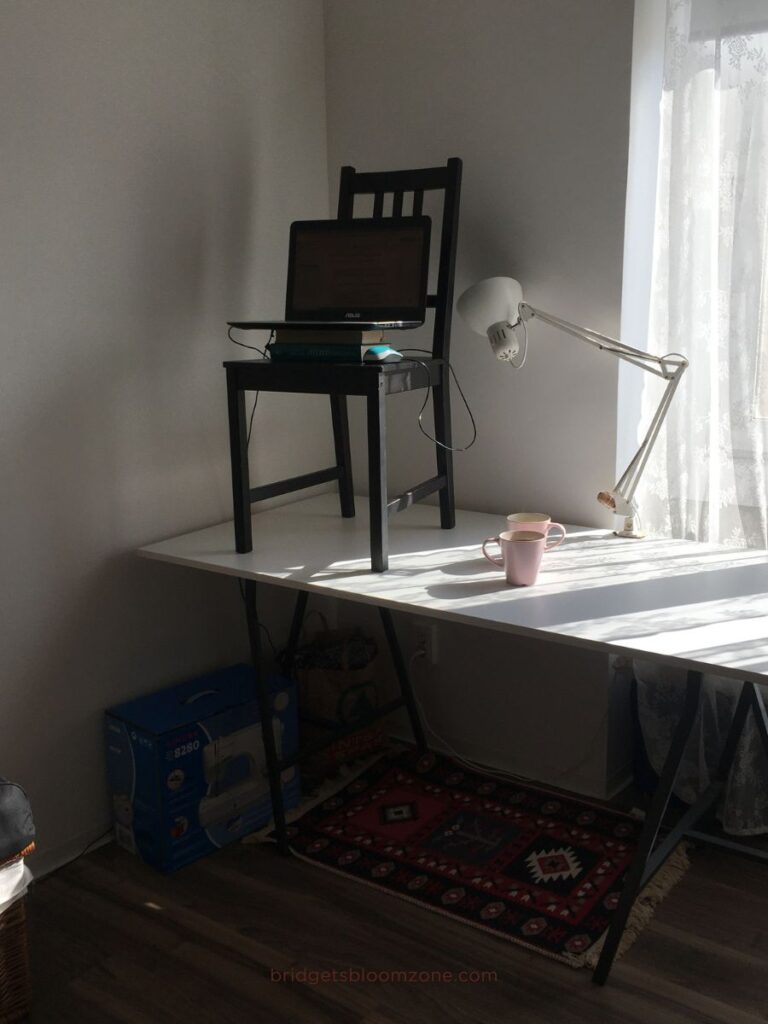
My own experience with standing desks started at architecture school — the solution then was a cardboard box placed on top of a regular desk. The principle was right; the execution had room for improvement. A slim height-adjustable model or a desk converter offers the same benefit without the cardboard. The treadmill desk remains a future ambition for me — space does not allow it yet.
How Do You Make a Home Office Feel Cohesive in a Living Room?
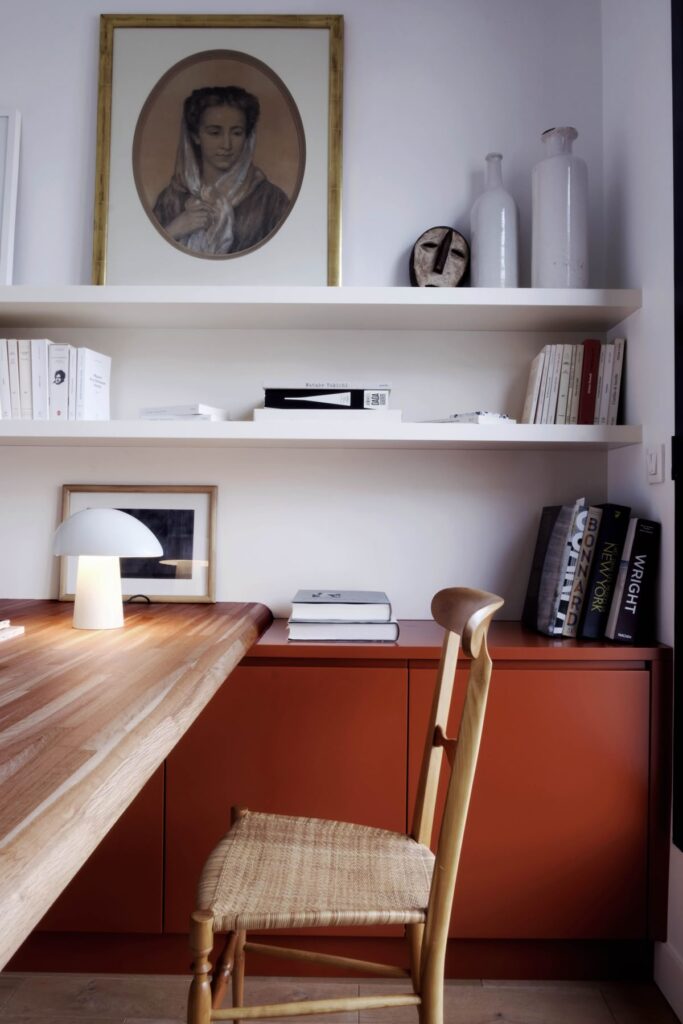
The instinct is often to hide the desk. In practice, concealment strategies create more visual complexity than they resolve. A more dependable approach is coherence: choose a desk and chair that speak the same design language as the rest of your furniture.
Quick coherence checklist:
- Desk finish echoes the wood tones or material palette in the room
- Chair style sits closer to a dining or accent chair than a traditional office chair
- Storage above the desk is styled as décor, not filing
- Cable management is sorted — loose cables make any setup feel unfinished
Lighting is one of the most dependable tools for zoning a small space. A focused desk lamp marks the workspace. When it is off and the ambient lighting takes over — a floor lamp, a wall light — the room reads as a living space again.
This layered approach to lighting in small spaces does more spatial work than most people realise. For the desk lamp: position it to the side of the screen to avoid glare, and choose a warm tone that reads as domestic rather than clinical.
What Is the Best Desk Position for Working From Home?
It depends on how you work. Here is a practical framework:
- Need deep, uninterrupted concentration?
Face the wall. Minimal distraction, strong containment. Add side lighting and something at eye level so it does not feel like a dead end. - Want natural light and a sense of openness?
Face the window — but position it so light falls from the side, not directly onto the screen. A sheer blind manages glare. - Work best when you feel oriented and in control?
Face into the room. Back to the wall, view of the door. This is the command position — and in a living room, it integrates the desk most naturally. - Working in a single room?
Face away from the bed. Use the lamp as a zone marker. Keep the surface clear when you’re done.
In a living room office combo, the command position is often the most settled long-term choice. It gives you visual control of your space and allows the desk to feel like a natural part of the room.
When the Workday Ends — The Physical Cues That Help
The act of leaving an office — putting on a coat, walking out the door — signals to the brain that the day is over. When that transition disappears, it needs to be designed deliberately.
In a living room with a workspace, the transition can be as simple as:
- Turning off the desk lamp
- Clearing the desk surface
- Closing notebooks or putting materials away
- Making a drink and moving to the sofa, OR better
- Having a short exercise or going for a walk
The specific ritual matters less than its consistency. Over time, the brain associates these small actions with the shift from work mode to home mode. A clear desk surface at the end of the day is also the most effective visual signal that the room belongs to you again — not to work.
This connects to a broader principle: how a considered home environment supports the ease slow living is built on — which holds whether you have a dedicated living room, a single room, or something in between.
A Space That Holds Both
A living room office combo that works is not just a matter of the right desk or the right colour palette. It is about understanding why certain positions feel better — and making deliberate choices based on that.
The three things that matter most:
- Where the desk goes.
The living room is usually the better choice over the bedroom. If you only have one room, orientation and ritual do the work that a door cannot. - Which way it faces.
Window, wall, or room — each has a distinct psychological character. Choose based on how you actually work, not how the setup photographs. - What happens when the day ends.
A consistent closing ritual and a clear desk surface allow the room to shift back to being a home.
If you are working through a bigger spatial question, the posts on studio apartment layout ideas and furniture for small spaces are worth reading alongside this one.
I would love to hear how you are approaching your own setup — which direction your desk faces, what room it is in, and whether any of this changed how you think about it.
Leave a comment below, or join the newsletter to follow the renovation diary and more posts on small-space living.