Ambient Lighting Ideas for a Small Living Room (No Design Talent Required)
This post may contain affiliate links. If you buy through them, I may earn a small commission — at no extra cost to you. I only recommend products I’d genuinely specify as an architect.
I have a friend with a strange kind of talent. He moves into rented apartments all the time, always a different shape, style, always a different landlord.
Within a week every single one somehow feels like his. It is never the furniture, since most of it stays behind when he moves again. The real work comes from small fairy lights he tapes along the corners of the room.
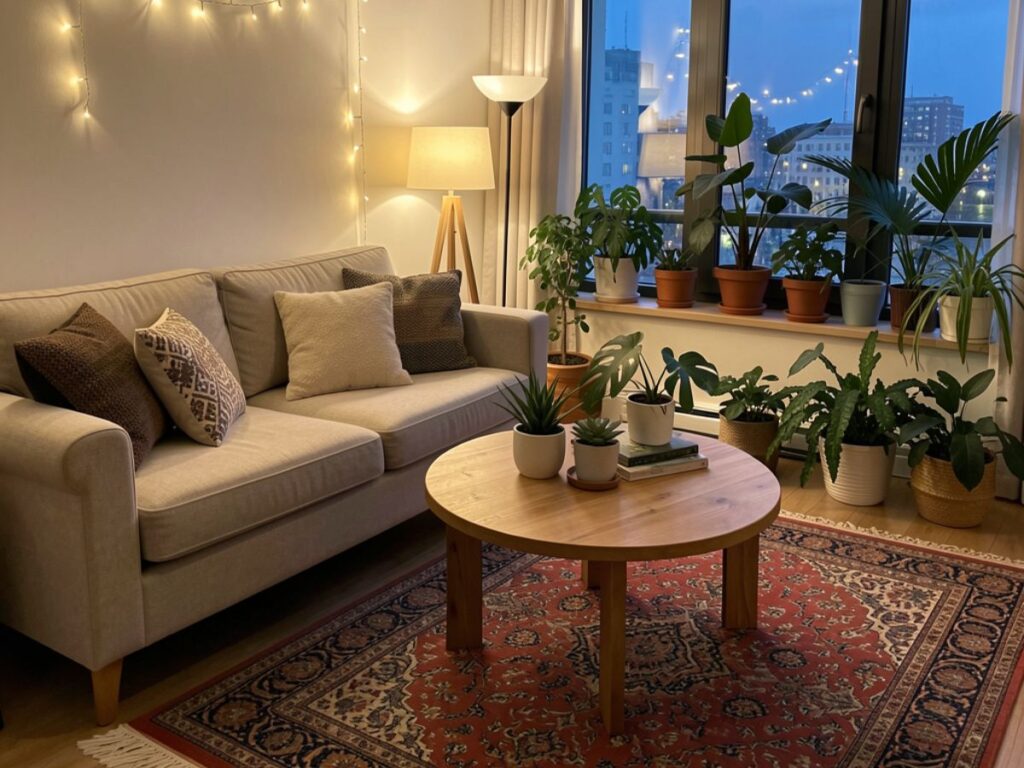
He winds them around the pot of a climbing plant and traces them along its vines up the wall. Ambient lighting ideas like his look like a gift some people are just born with.
That is not really true. They come down to four simple rules, and this guide walks through all of them, room by room, so you can borrow the effect without needing his eye for it.
Why Ambient Lighting Ideas Matter More Than the Furniture
People spend hours choosing a sofa and five minutes choosing a bulb. That ratio is backwards for a small living room.
A sofa fills space. Light decides how that space feels once the sun goes down.
This is the piece most guides skip. It is also the piece my friend understood without ever calling himself a designer or a lighting specialist.
He never mentions lighting when he talks about a room he loves. Instead, he just switches it on, and the room does the talking for him.
The Feeling You’re Actually After
Good lighting is not about brightness. It is about warmth, depth, and a room that feels lived in rather than lit.
A single bulb overhead does neither. Layered light does both, and that difference is the entire point of this guide.
The Four Rules Behind Good Ambient Lighting
None of this requires an eye for design. It requires four layers, used together, in a fairly specific order, alongside the broader lighting rules for small spaces that guide every room in a compact home.
Rule One — Task Light
Task light is bright and focused. Think table lamps, floor lamps, or wall lamps positioned near a chair or desk.
It exists for reading, working, or anything that needs real clarity. Without it, every other layer in the room is just decoration with nothing practical behind it.
Rule Two — Accent Light
Accent light highlights what you already love: plants, artwork, a favorite shelf.
This is where my friend’s fairy lights do their quiet work, wound around a pot or traced along a leaf. The source barely matters here. What matters is what it points at.
A hidden LED strip inside open shelving does the same job with a completely different look.
Rule Three — Decorative Light
Decorative light is a light source that doubles as art: an antique lamp, a sculptural floor lamp, a string of fairy lights along a windowsill. Or a mushroom shaped little lamp. Lava lamps. This is the light showing your personality, add something to remember to your small living room.
Its glow is secondary to how it looks in the room, which is exactly why it earns a spot even in a very small space.
An antique lamp that scatters a specific pattern across the wall does this well. So does one dramatic floor lamp that nobody else in the room competes with.
Rule Four — Ambient Light
Ambient light is the soft, even base that fills a room without calling attention to itself.
When the first three layers are placed well, ambient light often takes care of itself. It is the layer people usually mean when they talk about a room feeling cozy.
Even so, it rarely does the most visible work.
What can be an ambient light here as fourth layer? Maybe nothing, maybe it just appears when the other three lights are on. Maybe you dim the main headlight to low light. For larger rooms, maybe there is an other extra lightsource.
Key takeaway: A small living room does not need fewer lights. It needs these four layers working together instead of one bulb working alone.
Start With the Ceiling — The Foundation Layer of Ambient Lighting Ideas
The ceiling light is usually the first fixture anyone thinks about, and for good reason. It is the one light that can fill the whole room at once, the way daylight does outdoors.
Think of it as a base coat. Everything else in this guide builds on top of it, the same way makeup builds on a good foundation.
Remove the ceiling light entirely and you often lose something useful: the one light source that lets you simply clean, organize, or find your keys.
Choosing a Ceiling Light for a Small Room
Flush mounts work well when ceiling height is limited, especially in apartments built around 2.5 to 2.7 meters.
Recessed LED spotlights suit attic rooms with slanted ceilings particularly well. They sit neatly inside the ceiling instead of hanging down into the room.
A dimmer turns this single fixture into two different lights: bright and practical by afternoon, soft and quiet once evening comes.
Skipping the dimmer is one of the easiest upgrades to add later. It is worth planning for even if the budget is tight now.
Is a Profile Light Ceiling Worth It in a Small Room?
Profile light ceiling systems use slim LED strips built into the ceiling instead of a hanging fixture. The result is a soft glow across the ceiling and walls.
That look can be genuinely elegant in a very clean, modern apartment where the ceiling itself is meant to read as part of the design.
In a small living room, though, it often adds construction complexity for very little practical gain.
If the ceiling is meant to function as art, a profile system earns its place. If the goal is simply a warm room, a traditional layered setup usually gets there with less effort.
(No secret – I hate these profile lights. It is not cozy at all, complicated to build, and in my oppinion should not be used at home. Industrial or commercial use is a different topic, but this is not for this blog.)
Floor, Table, and Wall Lamps — Where Ambient Lighting Ideas Come Alive
The ceiling gives a room its base. These three fixtures are what give it a personality.
Floor Lamps and Where to Put Them
A floor lamp tucked into a corner bounces light off the walls instead of shining straight into your eyes.
Arc lamps work particularly well over a reading chair or coffee table. They reach across the surface without taking up floor space of their own.
Height matters more than most people expect. A lamp placed too low throws harsh shadows, while one placed too high spreads the light too thin.
A floor lamp is also the easiest fixture in this guide to move, test, and move again until the corner finally feels right.
Hiding the cord is the only real downside. Running it along a baseboard or behind the sofa usually solves it without calling an electrician.
Hanging Lamps in a Small Living Room
A pendant over a coffee table or a small desk can double as a task light. It also adds some visual interest overhead, which a floor lamp alone cannot do.
Keep the drop somewhere around 60 to 75 centimeters above the surface, so it lights the table without sitting at eye level.
In a low-ceilinged room, a few small pendants read as lighter than one large statement fixture. A pendant should never sit directly in the path between the sofa and the rest of the room, the same circulation logic behind any good small living room layout.
An other important thing: addd pendant lamps as task lights. If you need a surface or a task to be lit more, a hanging lamp is a good choice. Think of the dining table and the light above it.
Table Lamps and Wall Lamps
A table lamp on a console or sideboard adds task light and a bit of personality in one object.
Because it is not easily moved once placed, its spot deserves a little more thought than a floor lamp’s does.
A wall-mounted lamp becomes the better choice once floor and ceiling space both run out. It works at eye level without taking up a surface at all.
Some wall lamps swing or adjust, which brings back a little of the flexibility a fixed fixture usually gives up. Together, these two fixtures round out a small living room without adding clutter.
Small Details That Make Ambient Lighting Ideas Feel Intentional
This is the second layer that turns function into feeling, the one my friend has quietly mastered without ever naming it that way.
Let the Room Help You
Light-colored, matte walls diffuse light instead of bouncing it back harshly.
Warm bulbs, somewhere between 2700 and 3000 Kelvin, feel settled in a way cool white almost never does. A single overhead bulb flattens a room. A few smaller sources at different heights do the opposite.
Mirrors, glossy ceramics, and even a stack of books with pale covers reflect whatever light is already there. Curtains and a rug help too, since soft textiles absorb glare instead of bouncing it back into the room.
Paint color plays a part here as well, and it’s worth reading alongside how to choose the best paint colors for small living rooms.
Fairy Lights and Other Low-Effort Ambient Lighting Ideas
This is exactly where my friend’s rented rooms come alive, apartment after apartment.
He tapes fairy lights along the walls, corners of furniture and around the pot of a plant. The same lights get traced up the vines of anything in the room that climbs.
None of it needs an electrician, a landlord’s permission, or a single new fixture drilled into the ceiling.
A candle earns its place here too, for evenings that call for something a little more special than a plug.
What makes his rooms recognizable is not any single object. It is that the same handful of small lights show up again in every new apartment, in a slightly different shape each time.
The Ambient Lighting Ideas Formula for a Small Living Room
Here is the shortest version of everything above, built as a simple starting recipe rather than a strict rulebook.
Tip: Add each layer one at a time and live with it for a few days before adding the next.
The Ambient Lighting Ideas Recipe
- One ceiling light with a dimmer, for the base layer that lets you see the whole room clearly
- One or two floor lamps, placed behind the sofa or in a corner, for task and accent light together
- One or two table lamps, each with its own dedicated spot rather than a random surface
- Fairy lights, a profile LED strip, or a few candles for the final layer, the one that makes a rented room feel like yours
Common Ambient Lighting Mistakes to Avoid
- A single central ceiling light with nothing else,
which creates flat shadows and a cold feeling after dark - Cool white bulbs,
which read as harsh, especially bouncing off light-colored walls near a window - Skipping a dimmer,
which means losing the shift between daytime brightness and a quieter evening mood - Placing a floor lamp or pendant in the wrong spot,
which throws shadows exactly where you need to see - Mixing warm and cool bulbs across different lamps,
which makes the whole room feel mismatched
Final Thoughts
None of this asks for a natural eye for design, only four layers and a bit of patience while you place them.
Start with the ceiling, add a floor lamp or two, and let a few fairy lights do the rest. The room does not need more light. It needs the right four kinds of it, used together, better than any furniture arrangement alone, the way my friend has been doing it in a different rented apartment every year.
Frequently Asked Questions About Ambient Lighting Ideas
What is ambient lighting in a living room?
Ambient lighting is the soft, even light that fills a room as a base layer. It is separate from task lighting used for reading or accent lighting used to highlight objects like plants and artwork.
How many lights does a small living room actually need?
Most small living rooms work well with one ceiling light, one or two floor lamps, and one or two table lamps. A single overhead bulb rarely does the job alone.
What color temperature works best for a small room?
Warm white, roughly 2700 to 3000 Kelvin, reads as cozy rather than clinical. This matters most against light-colored walls that reflect the light back into the room.
Do fairy lights count as real lighting, or just decoration?
Fairy lights work well as an accent or decorative layer, tracing furniture, plants, or windows. They usually support the room’s base light rather than replace it.
Is a dimmer really necessary?
A dimmer lets one ceiling fixture serve two purposes: bright for daytime tasks, soft for evening. That matters most in a room with only one overhead light.
Should I choose a ceiling light or floor lamps first?
Start with the ceiling light as the base layer. Add floor and table lamps to shape the mood once that foundation is in place.
Does paint color actually affect how lighting looks?
Yes. Light-colored, matte walls bounce and diffuse light, which changes how warm or harsh the exact same bulb feels in the room.
What is the biggest ambient lighting mistake in a small living room?
Relying on a single central ceiling light. It flattens the room and leaves every corner in shadow once it gets dark.