Bedroom Storage Ideas: What Actually Works in a Small Room
This post contains affiliate links. If you buy through them, I may earn a small commission — at no extra cost to you. I only recommend products I’d genuinely specify as an architect.
Good bedroom storage ideas are not about adding more storage. They’re about reducing the effort required to use what you already have.
That distinction matters more in a small room than anywhere else. When a bedroom is compact, every extra step between you and putting something away increases the chance that it won’t get put away at all. The rooms that stay tidy aren’t the most organized — they’re the most frictionless.
Why Small Bedroom Storage Ideas Start with Behavior, Not Products
During my time at university, I moved through roughly ten different rooms over several years.
The ones that stayed tidy weren’t the largest or the best-equipped. They were the ones where every common task — hanging a coat, charging a phone, leaving a book — had a place that required almost no extra step. Storage has to work with how you actually move through a space, not how you intend to.
Bedroom Storage Ideas by Zone
The most practical way to approach bedroom storage ideas is to map the room by behavior zone, not by furniture category.
Where do you get dressed? Where do you drop things when you come in? Where do you charge devices and set things before sleep? Each zone has different storage requirements. Treating the bedroom as one undifferentiated storage problem leads to solutions that look organized but function poorly.
The Wardrobe Zone
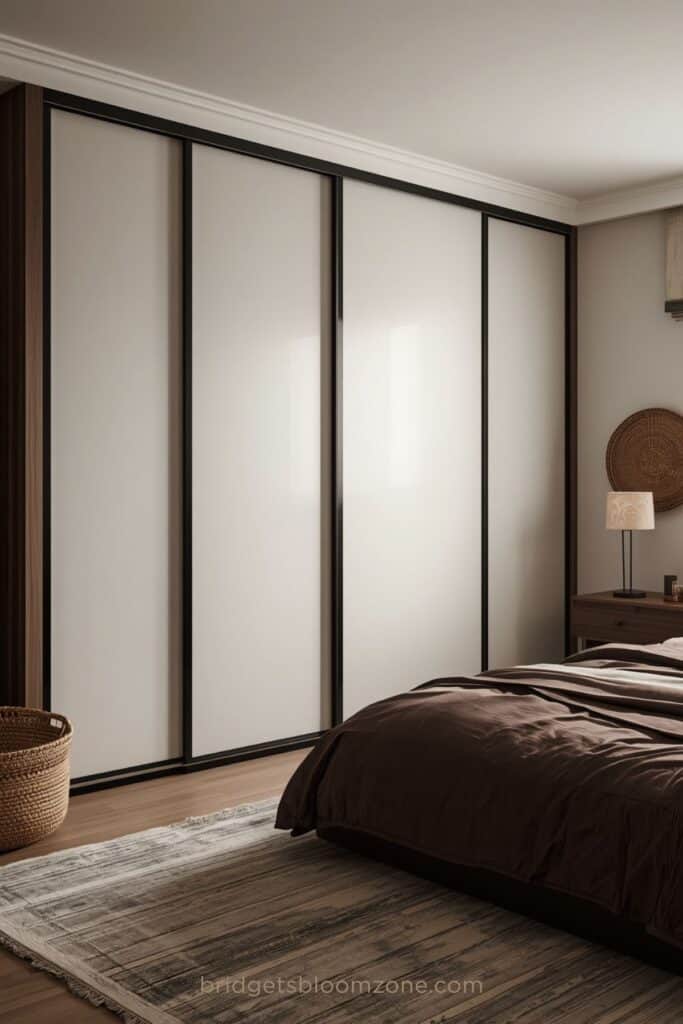
The built-in wardrobe is the most significant storage decision in a small bedroom, and the one that most affects the room’s proportions.
A floor-to-ceiling wardrobe that runs the full width of one wall removes the visual noise of a freestanding piece and recovers the ceiling height as usable volume. In a room under 12 square meters, that matters. The wardrobe design for bedroom guide covers the full decision framework — internal layout, door type, and how depth interacts with floor area.
- Hinged doors need clearance in front of the wardrobe — factor this into the layout before specifying
- Sliding doors save floor clearance but mean you can only access half the wardrobe at a time
- Open shelving requires consistent folding discipline to look good — it suits people who are naturally tidy, not people hoping to become tidy
For general architectural principles that apply to wardrobe and storage decisions alike, you can find more to read in the post about furniture principles for small spaces. This also covers the spatial logic behind built-in vs freestanding choices.
The Bedside Zone
The space beside the bed is one of the highest-use storage zones in a bedroom — and the one most often handled with a piece of furniture that doesn’t quite work.
In my opinion, this area is the least suitable for storage. Less clutter, less dust next to a bed for a better sleep.
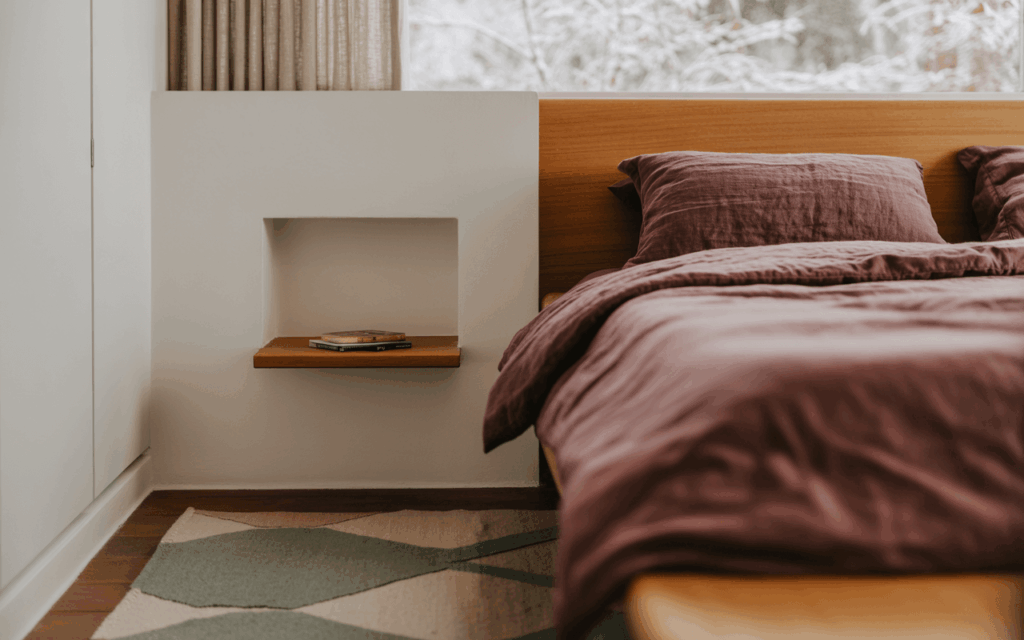
A standard bedside table takes up floor area, often has a surface too small to be genuinely useful, and adds a furniture leg to a zone that’s already visually busy. When we were designing the studio renovation, I decided to build a small closet organization solution directly into the partition wall beside the bed instead.
The result was a recessed niche about 20cm deep and 60cm wide — enough for a lamp, a book, a phone charging cable, and one small object. It was a design decision. This space was not dedicated for storage, but only for storing things temporary.
The full process is documented in the DIY bedside table wall niche guide.
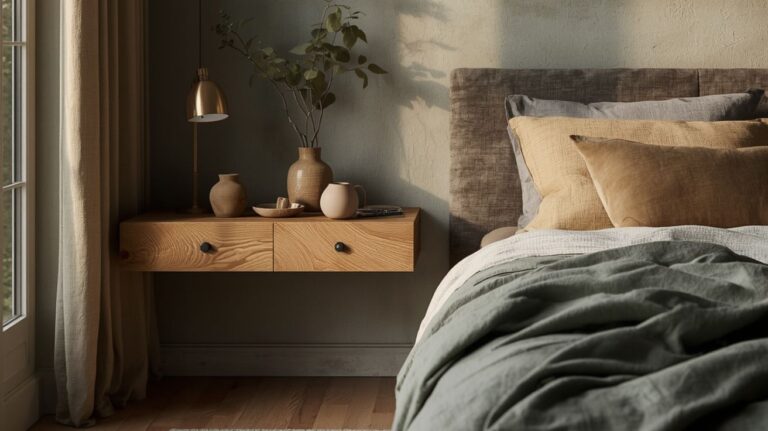
If building into the wall isn’t possible, a wall-mounted shelf with a floating appearance achieves a similar effect. The minimalist bedside table ideas guide covers both shelf and surface options for keeping the beside zone functional without using floor area.
Tip: Whatever bedside solution you choose, run the charging cable through or behind the wall if possible. A cable draped across a bedside table or down a wall is the most persistent source of visual noise in an otherwise calm bedroom.
The Under-Bed Zone
Under-bed storage is one of the most used — and most misused — small bedroom storage ideas.
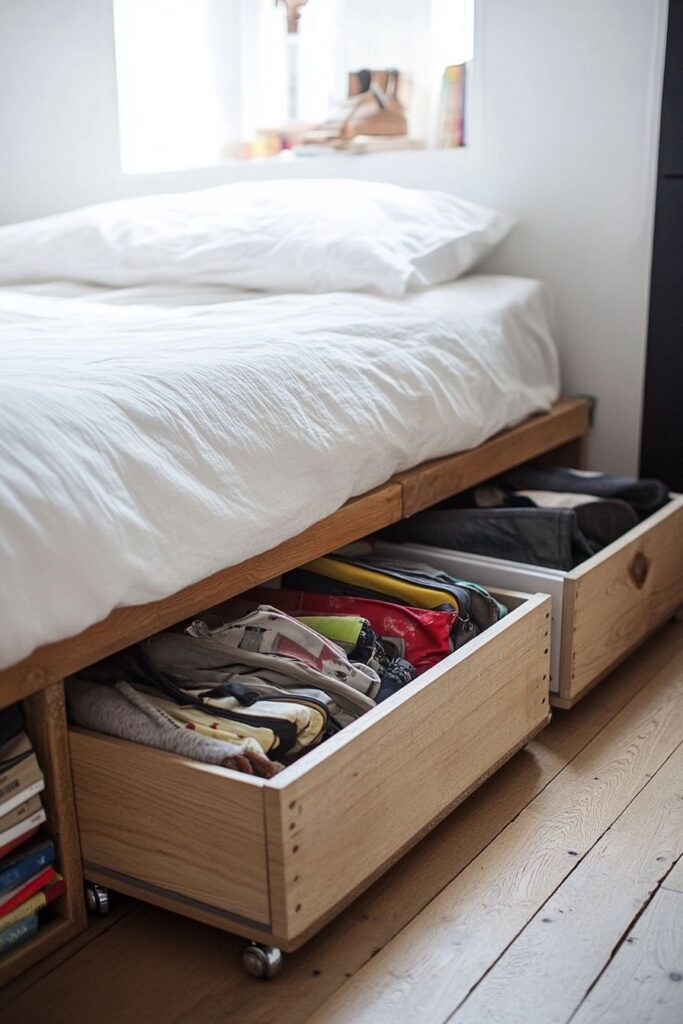
The volume under a standard bed is considerable, but it only works as storage if it’s accessible without significant effort. Cardboard boxes shoved under the frame become invisible and forgotten. Flat drawer units on castors or purpose-built under-bed containers with lids are genuinely retrievable.
In terms of what to store there: seasonal items, extra bedding, and luggage are the right candidates. Things that we need quarterly or less. Daily-use items stored under the bed won’t consistently be put back. The retrieval effort is too high to sustain.
Tiny Bedroom Storage Ideas — Vertical Space
In a compact bedroom, vertical space is a tricky storage option.
The zone between the top of a wardrobe and the ceiling, the wall above the door, maybe the area above the bed — these are genuinely useful storage locations for items accessed infrequently. The key constraint is visual: storage in these zones should have consistent, closed-face containers so that the upper portion of the room reads as calm rather than cluttered.
High Shelving Above the Door
A shelf running above the bedroom door at ceiling height is one of the most overlooked bedroom organization ideas small rooms strategy. But we have to be careful with this idea.
It works for things you rarely need: archive boxes, spare pillows, seasonal decorative items. The shelf itself should be deep enough to hold a standard storage box (at least 35cm). About color, it is best if you find one the same color as the wall and ceiling, so it visually recedes.
If it contrasts, it becomes a feature — which defeats the purpose.
And if many small objects are stored on shelves, they will just collect dust and clutter. In my oppinion, shelves are not for storage, but for display. The only exception is in really small rooms, and with uniform boxes in the color of the walls.
Wall-Mounted Hooks and Rails
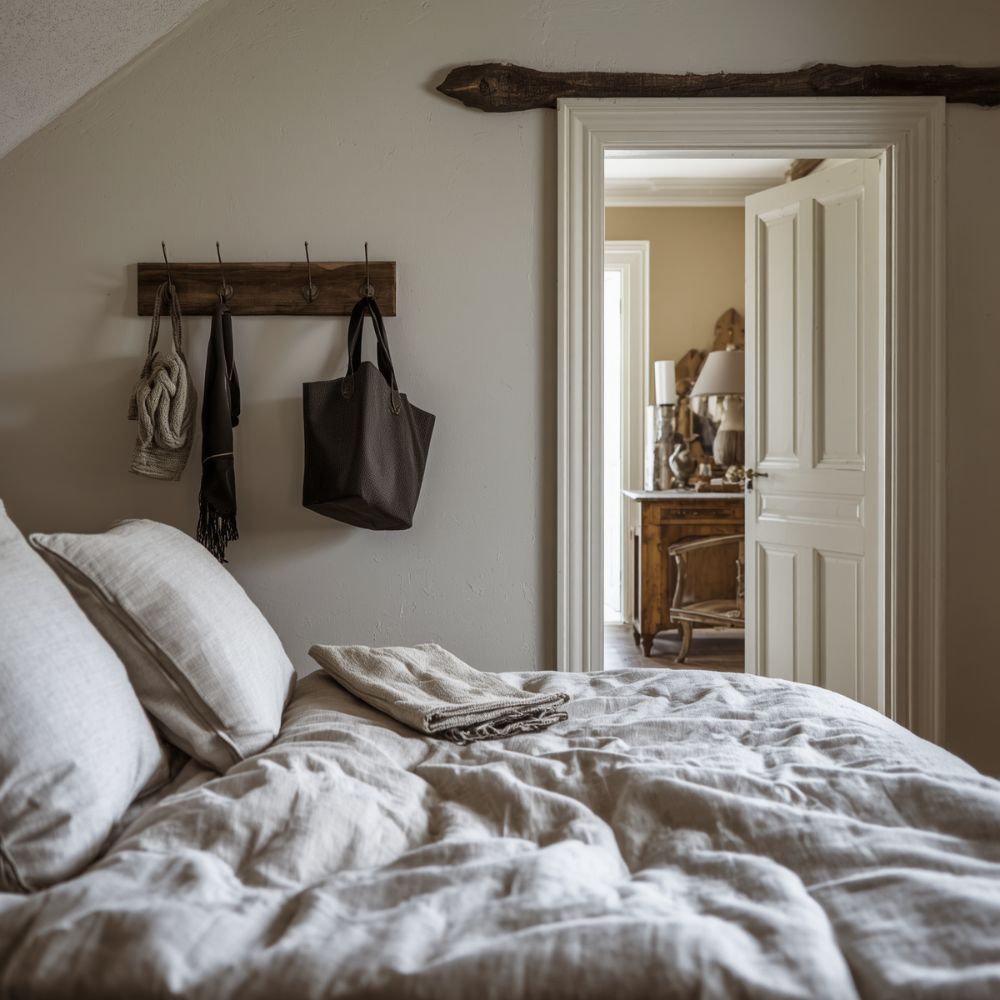
A hook or peg rail mounted at shoulder height beside the door handles the items that are hardest to put away: the jacket you wore today, the bag you’ll use again tomorrow, the scarf that doesn’t belong in the wardrobe.
The friction with these items is that they’re actively in-use and storing them formally (in the wardrobe) feels like putting them away when you haven’t finished with them. A hook removes that friction completely. Mounting it beside the door ensures it intercepts the item before it lands on a chair or the floor.
Note: The number of hooks matters. Three to four is the right number for daily rotation. More than six hooks tends to become a dumping point. And will be never fully cleared.
Small Closet Organization Bedroom Strategies
The inside of a wardrobe rewards as much design attention as the outside.
A standard wardrobe interior — one hanging rail and a shelf above — wastes most of the vertical volume available. Short items (jackets, folded shirts, folded trousers) hang to about 100cm. Below that, there’s typically 40–60cm of unused space. That space should be used for shelving, drawers, or shoe storage rather than left open.
Double-Hanging Rails
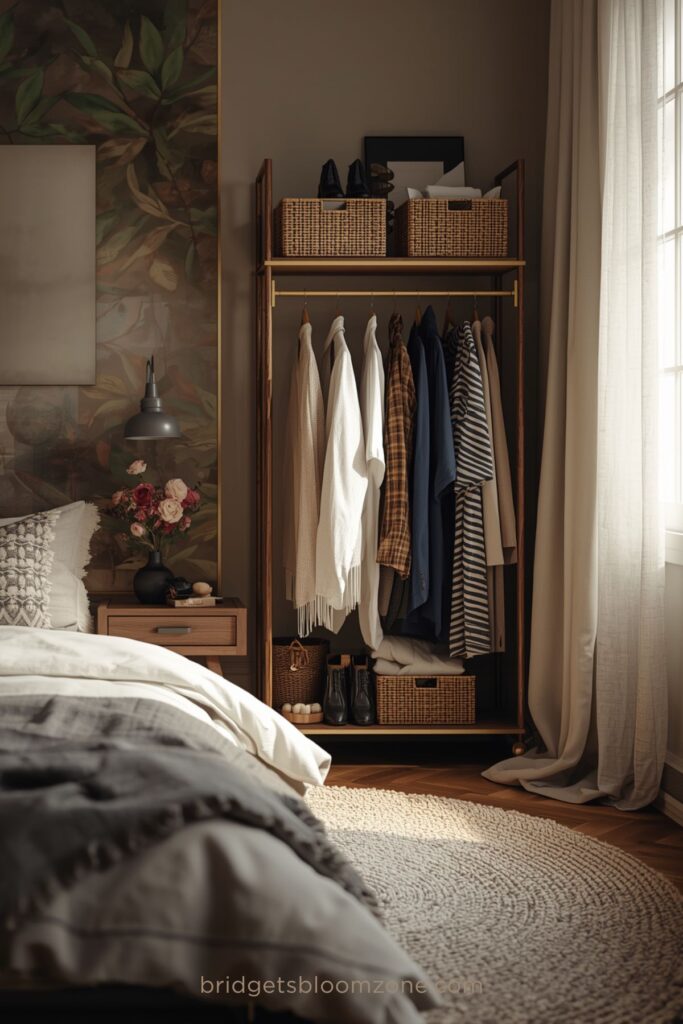
If most of your wardrobe contains short items, a double-hanging arrangement — two rails stacked, each at roughly half the full height — roughly doubles the hanging capacity in the same footprint.
Long items (dresses, coats) need their own full-height section, which can usually occupy one quarter to one third of the total wardrobe width. Everything else can double-hang. This is one of the simplest small closet organization bedroom adjustments and requires only a second rail and brackets.
Drawer Units Inside the Wardrobe
Freestanding drawer units placed inside a wardrobe work better than built-in shelves for folded items.
Shelves require things to be stacked vertically. Items at the bottom become inaccessible over time. Not to mention the space behind the folded clothes – they usually fill up with unused pieces, clutter.
Drawers allow everything to be visible and retrievable in one motion. For a bedroom where floor-standing drawer furniture is not desirable, moving that function inside the wardrobe keeps the room clear without eliminating the storage.
The small bedroom ideas guide covers the full layout decision process — including how wardrobe position and depth affect the other furniture in the room.
Bedroom Organization Ideas Small Rooms — The Reset Habit
The most well-designed storage system still requires one habit to work: a daily reset.
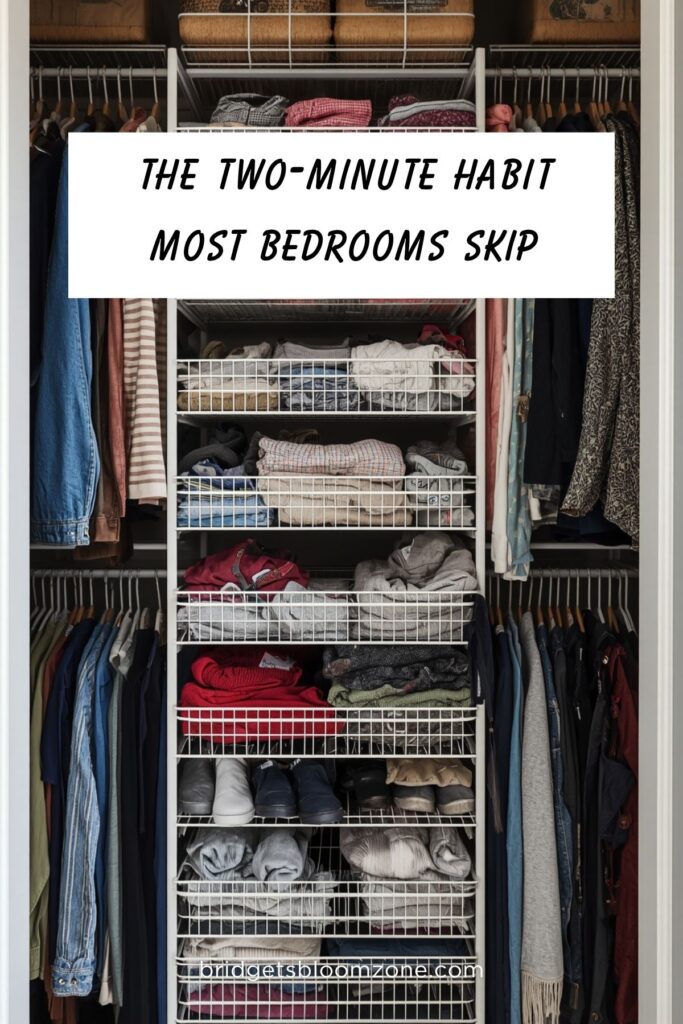
In a small bedroom, a two-minute reset before bed — putting the day’s items back in their designated places — prevents the slow accumulation that makes a small room feel chaotic. The difference between a tidy room and a cluttered one in a compact space is often less than ten items.
The reset works when each item has a specific place that’s genuinely easy to reach. If putting something away requires opening a container, unlabeling, climbing, or searching — it won’t happen consistently. The effort to store something should be roughly equal to the effort to leave it out.
Bedroom Hacks That Don’t Actually Work
Not every popular small bedroom hacks recommendation translates into a room that functions well over time.
- Over-the-door organizers: useful in bathrooms and kitchens, but in a bedroom they read as visual clutter and are often abandoned within weeks
- Storage ottomans at the foot of the bed: work only if the items inside are accessed regularly — otherwise they become a place things go to disappear
- Labeling everything: only necessary if the system is complex. A simple system with two or three zones rarely needs labels.
- Matching containers on open shelves: looks good in photos, but requires continuous maintenance to keep looking that way in real life. Plus, you will forget, what is in each box.
For bedroom ideas that go beyond storage into the full small-room decision set, the bedroom ideas for small rooms guide covers layout, light, and material choices alongside storage.
Final Thoughts
The best bedroom storage ideas for a small room are the ones you’ll actually use without thinking about them.
A recessed niche beside the bed. A wardrobe that uses its full interior volume. Under-bed drawers for seasonal items. A peg rail that intercepts the jacket before it hits the chair. None of these is complicated. Each one removes a decision or a detour from the daily routine. In a small bedroom, that’s exactly what good design is supposed to do.
For the wardrobe in detail, the wardrobe design for bedroom guide is the most thorough reference for getting that zone right. For bathroom storage that uses the same spatial logic, the bathroom storage ideas guide covers the small-space approach room by room.
Frequently Asked Questions About Bedroom Storage Ideas
What are the best bedroom storage ideas for a small room?
Built-in or floor-to-ceiling wardrobes, recessed niches beside the bed, under-bed drawer units on castors, and wall-mounted hooks beside the door. The best storage is the most frictionless — the kind that requires almost no deviation from how you already move through the space.
How do I organize a small bedroom with too much stuff?
Start by reducing before organizing. Storage that holds things you no longer use is still clutter — it just has doors. Once you’ve reduced to the essentials, assign each category a specific zone and make sure retrieving things from that zone requires minimal effort.
What is the best storage for under a small bedroom?
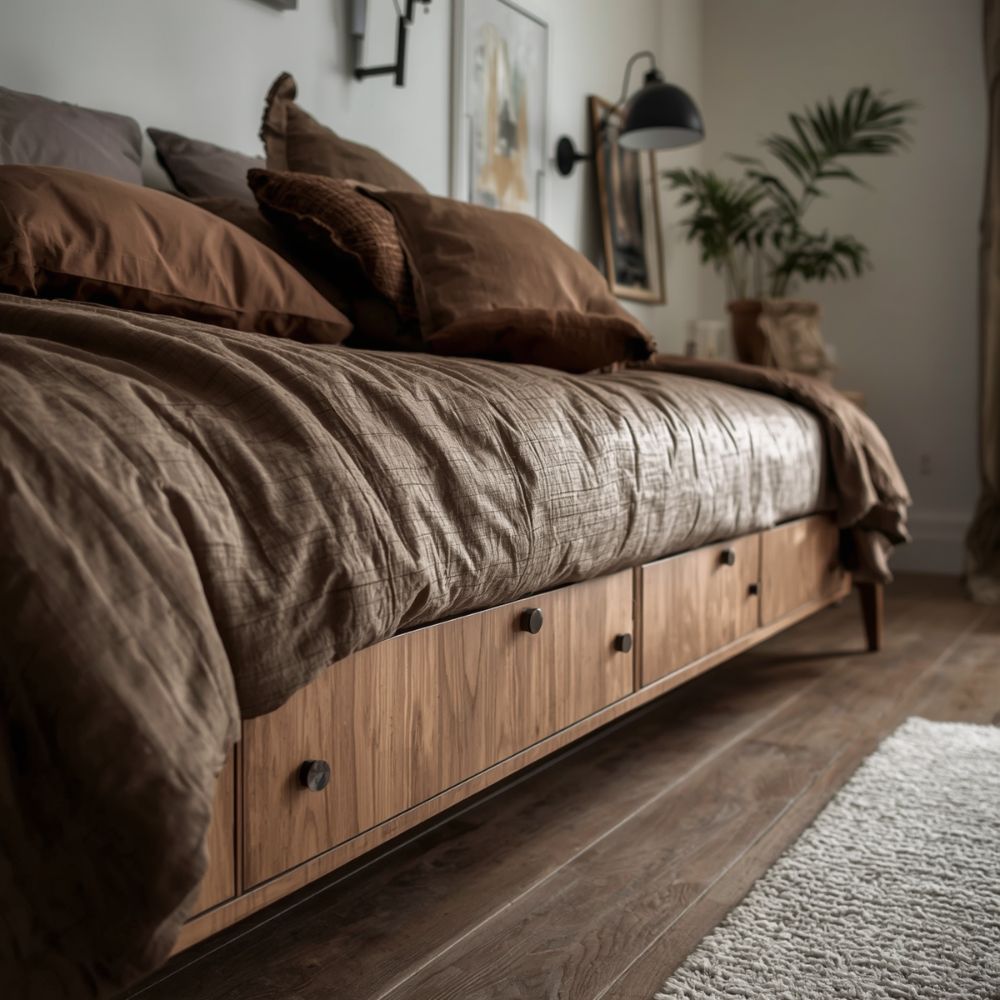
Flat drawer units on castors, or a platform bed with integrated drawers. Use the under-bed zone for seasonal items and things accessed quarterly or less. Daily-use items stored under the bed: we will not consistently put them back. The retrieval effort is too high to sustain as a habit.
How do I add storage to a bedroom without a wardrobe?
A floor-to-ceiling shelving system with doors or a freestanding wardrobe gives the most volume per square meter. Supplement with under-bed storage and a wall-mounted hook rail for daily-rotation items. Open shelving is also an option but requires maintaining consistent visual order.
What are small closet organization bedroom tips that actually work?
Double-hang short items to roughly double hanging capacity. Add a freestanding drawer unit inside the wardrobe for folded items rather than relying on shelves. Use the floor of the wardrobe for shoe storage or a small drawer unit, not as a place to accumulate items that don’t have a home.
What should I store in a bedroom vs outside the bedroom?
A bedroom should store clothing, bedding, items used before sleep, and personal documents. Anything work-related, hobby-related, or high-volume (tools, large collections, sports equipment) belongs outside the bedroom. We can rest better in a room when its storage function is focused.
Are built-in wardrobes worth it in a small bedroom?
Yes. A floor-to-ceiling built-in wardrobe uses the full volume of the room up to the ceiling, removes the visual weight of freestanding furniture, and — if it runs the full width of one wall — becomes an architectural element rather than a storage piece. The upfront cost is higher, but the spatial return justifies it in a room under 12 square meters.
How do I keep a small bedroom tidy long-term?
Make putting things away require less effort than leaving them out. A peg rail beside the door intercepts the jacket before it reaches the chair. A charging cable routed to the bedside niche means the phone goes there, not on the floor. The daily reset — two minutes before bed — handles everything else.