Floating Nightstand: How to Choose, Mount, and Get the Height Right
This post contains affiliate links. If you buy through them, I may earn a small commission — at no extra cost to you. I only recommend products I’d genuinely specify as an architect.
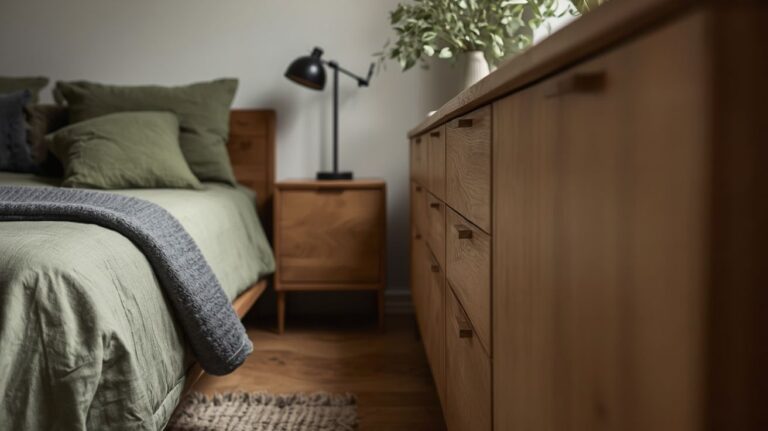
The most popular image I have ever published on Pinterest shows a floating nightstand – that does not exist. Not a surprise, with the technology we have today it is easy to design anything and get a visualization, that seems like a photograph.
I generated that image with AI a year ago for a post about simple bedside tables. It spread across Pinterest faster than anything I had photographed in real life.
But I think I just realized, why floating nightstands got such a popularity – and in this article I would like to answer all the questions, that everyone wants to know when they decide to mount a floating nightstand.
Here is the part that matters. When I looked at that image with my architect eyes, I realized it was completely buildable. The proportions were right, the mounting was believable, and the height would actually work next to a real bed.
Most AI images like it are the opposite. They show you a serene result and hide the details behind it, which is exactly where this project succeeds or fails.
So this guide covers the three decisions the pretty pictures skip. The right height for your bed, the right mounting for your wall, and an honest answer if you rent.

Why a Floating Nightstand Works in a Small Bedroom
The floor space math
The average new American apartment now measures under 900 square feet (83,61 square meters), and it has been shrinking for a decade. A bedside table with zero footprint matters more than it did five years ago.
In a compact bedroom, the strip of visible floor beside the bed does real optical work. Keep it clear and the room reads larger, which is the same logic behind most good small bedroom decisions.
There is a practical bonus, too. Nothing stands on the floor, so a vacuum or a robot vacuum passes underneath without you moving anything. Dramatic visual change, zero structural commitment.
The advantage nobody names
Freestanding nightstands come in a standard range of roughly 24 to 28 inches tall. You shop within that range and hope it matches your bed.
A wall mounted bedside table works differently. You set the height yourself, to the centimeter, matched to your exact mattress.
To be fair, a stool or a solid block of wood also solves the bedside problem, and with charm. This piece wins when you want exact height and clear floor at the same time.
That logic holds on one side of the bed, or on both sides for a couple.
How High Should a Floating Nightstand Be?
The mattress-top rule
Mount the top surface level with the top of your mattress, or up to two inches above it. Nearly every designer guideline lands in this zone, including the detailed height breakdowns from furniture makers who measure this for a living.
The reason is your arm. From a lying position you reach sideways or slightly up, and reaching up is easier than reaching down. A surface below mattress height invites knocked-over water glasses.
Measure from the floor to the top of your mattress. Include the topper and the mattress pad, because they add real height that catalogs ignore.
Height targets by bed type
Your bed type sets the number. As a starting point:
- Low platform bed or floor bed,
mattress top around 18 to 24 inches. Mount level with the mattress.
Standard-height furniture looks like a tower next to these beds, which is why wall mounting suits a low bed frame so well. - Standard bed,
mattress top around 24 to 26 inches. Mount level to two inches above. - Tall bed with a box spring,
mattress top 28 inches or more. Mount level to two inches above, and expect the unit to sit surprisingly high on the wall.
If you are still deciding between bed heights, my comparison of a floor bed and a low bed frame covers how bed height changes everything around it.
Tip: Tape the outline of the nightstand on the wall with painter’s tape, then lie in bed and reach for it before you drill anything.
Your bed type sets the number. As a starting point, match the mounting height to your mattress top.
| Bed type | Mattress top sits at | Mount the top surface at |
|---|---|---|
| Floor bed or low platform | 18–24″ (46–61 cm) | Level with mattress |
| Standard frame | 24–26″ (61–66 cm) | Level to +2″ above (+5 cm) |
| Bed with box spring | 28″+ (66+ cm) | Level to +2″ above (+5 cm) |
How to Mount a Floating Nightstand
This is the part almost every guide skips, and it is the part readers are actually nervous about. The good news is that the whole decision comes down to one question.
What is behind your wall where the nightstand needs to go?
For anything that carries daily weight, screwing into a wood stud beats every anchor. When there is no stud where you need one, a metal toggle-style anchor is the best second place.
- Stud where you need it — long screws straight into the stud. The strongest option; the unit’s own weight rating becomes the real limit. Screws need to reach about 1.5 inches (3.8 cm) into the wood.
- Stud in the wrong spot — a cleat or backer board screwed to the stud, with the unit mounted onto that. Nearly stud-strength across the full width, at the cost of a little extra depth off the wall.
- No stud, drywall or plaster — metal toggle anchors, two minimum. Rated 75 to 150 lb (34 to 68 kg) each in ideal conditions, so plan for roughly half that in practice.
- Cannot drill at all — adhesive systems, honestly assessed below. Around 20 lb (9 kg) at absolute best, which is decor duty, not nightstand duty.
The anchor ratings come from published drywall anchor load data, which also explains why you halve the number. Ratings assume a straight downward pull, and a floating unit pulls outward too.
Important: The plastic anchors included in most flat-pack boxes will not hold a loaded unit long term. You should always choose the achors that fits best to your wall.
Why deep units sag forward
A wall-hung unit is a lever, and your wall is the pivot. Every centimeter of depth multiplies how hard the front edge pries on the mounting.
Woodworkers see this constantly. Weight near the wall is almost free, while weight at the front edge makes the whole shelf lean over time.
The practical rule is simple. Choose a unit around 10 to 12 inches deep, and keep the heavy things pushed toward the back. But the best is, if you don’t keep heavy things on it.
How much weight can a floating nightstand hold?
Here is the number that surprises people. Most retail models are rated for only 25 to 30 pounds (11-13 kg) , so with a proper stud mount the box fails before the wall does.
Now run your real bedside inventory. A lamp, two books, a water glass, and a phone come to maybe 10 pounds (4,5 kg), and what you keep within reach is usually lighter than you think.
The real load is your hand. A half-asleep press on the front edge at 5 a.m. alarm clock is a sharp, concentrated force, so mount for the slap, never just the stack.
Buy one or build one?
Buying wins for most people. A ready-made floating bedside table with a proven bracket system removes the hardest engineering from the project.
Building is for confident makers with tools and patience. We once went even further and built a bedside niche, which meant to build a complete drywall system, and I love it. It was also a genuinely bigger project than mounting a purchased unit.
Either way, the same mounting rules above apply. If you are weighing this piece against the rest of the room, my guide to bedroom furniture decisions puts the nightstand in context.
Can You Install One in a Rental?
The honest adhesive answer
The no-drill videos are selling more than the physics can deliver. Even the strongest adhesive strip products top out around 20 pounds under perfect conditions. The makers themselves point to real hardware for anything that could hurt someone if it falls.
Remember the 5 a.m. hand press from earlier. An adhesive-mounted unit that holds decor weight can still fail the moment you lean on it.
The renter-friendly path that actually works
Small holes are more fixable than most tenants believe. Two anchor holes take five minutes of spackle and a dab of paint at move-out.
Choose snap-style metal toggles for the job. In independent anchor testing they held the most weight of any drywall option, and the bolt comes out cleanly whenever you take the unit down.
European renters, one extra note from my Eastern European experience.
- Older plaster and masonry walls chew up plastic plugs. (or the plaster is falling out like sand.) Metal toggles or masonry anchors that reach the brick wall are the only versions of this project I would trust there.
- If you live in a concrete apartment building, don’t be surprised if this project turns out to be a bit trickier. Drilling into reinforced concrete walls is no fun, so you may have to let go of the idea of a floating bedside table—or get a little creative.
If the shelf is only meant to hold a book, your phone, or a glass of water, a strong construction adhesive might be enough. If you need something sturdier, you could try building the bedside table that is supported by the headboard instead. It’s definitely a more custom solution and takes a fair amount of DIY effort, but it can create the same clean, floating look without relying on the wall.
Key takeaway: The renter question is really an exit plan question, and two patchable holes are a better plan than furniture on adhesive.
The Two Problems to Solve After Mounting
Once the unit is on the wall, two styling problems appear that leggy furniture never has. I am covering both in depth in a separate post, and here is the short version.
The first is the cord.
A floating unit exposes the wall beneath it, so a charger cable hanging in a loop breaks the clean effect faster than any other mistake. Cord covers painted to match the wall, or a rechargeable cordless lamp, solve it.
The second is the lamp itself.
A small surface is easily overwhelmed by a full-size lamp, which is why plug-in wall sconces pair so naturally with this piece. My lighting rules for small spaces cover how to place them.
Final Thoughts
Three decisions carry this whole project. Set the height from your mattress top. Choose the mounting based on what sits behind your wall, and let your real habits decide the weight plan instead of the catalog photo.
For the bigger picture around it, my guide to bedroom ideas for small rooms has some more interesting ideas to think about. Or just some ideas to read how to better your bedroom.
Frequently Asked Questions About Floating Nightstands
How high should a floating nightstand be?
Level with the top of your mattress, or up to two inches above it. Measure from the floor to the mattress top, including any topper.
How much weight can it hold?
Most retail units are rated for 25 to 30 pounds. A proper stud mount holds more than that, so the furniture usually gives out before the wall does.
Can you hang one without studs?
Yes, with metal toggle-style anchors rather than plastic plugs. Use at least two, and plan for roughly half their rated capacity because the unit also pulls outward.
Do adhesive strips work for mounting one?
No. Adhesive systems top out around 20 pounds under ideal conditions, which suits a small decor shelf and fails the daily use a bedside surface gets.
How deep should it be?
Around 10 to 12 inches. Deeper units act as longer levers on the wall and sag forward over time.
How far should it be from the bed?
Within a relaxed arm’s reach, which usually means a gap of one to three inches from the mattress edge. Test the reach with the painter’s tape method before drilling.
Is this practical or just a passing look?
The form is practical in small rooms because it frees floor space and matches any bed height exactly. What made it fashionable is separate from what makes it work.
Can I install one in a rented apartment?
Usually yes. Two small anchor holes are a five-minute spackle repair at move-out, which most landlords accept far more readily than tenants expect.