Bedroom Rug: How to Choose the Right Size, Material, and Pattern for a Small Room
This post contains affiliate links. If you buy through them, I may earn a small commission — at no extra cost to you. I only recommend products I’d genuinely specify as an architect.
A bedroom rug decision looks simple: find something you like and place it under the bed. The result, more often than not, is a rug that looks wrong from day one — and the problem is almost never the rug. It is the size.
A few years ago I ordered a rug for one of my rented rooms where Iived, that I had sized correctly on paper. When it arrived and I placed it, it looked like 30cm too short for the room. The rug was right for the bed. It was not right for the visual weight of the room.
I had sized for furniture coverage, not for room proportion. This was a small mistake and I could live with it – but it was an interesting lesson for me. Paying attention to these kind of details is the secret for the best bedroom rug decisions.
This guide covers the decisions that produce a bedroom rug that looks right: size for the room first, material for the use, pile for the foot experience, pattern for the palette.
If you are still planning the bedroom layout, the bedroom ideas for small rooms guide covers how the rug fits into the floor plan alongside furniture positions.
What Does a Bedroom Rug Actually Do?
A bedroom rug does three things:
- it absorbs sound,
- it anchors the bed,
- and it defines the zone of the room that belongs to sleeping.
When the rug is the wrong size, all three functions are compromised simultaneously.
Acoustic softening — the function most people ignore
Sound in a bedroom with hard floors reflects off every surface — the floor, the walls, the ceiling — and creates a low-level reverberation that is often described as “feeling empty” or “not cozy”. Without the source being identified.
A bedroom rug absorbs that reflective energy at the floor level. The acoustic improvement in a room with a well-sized rug is immediately perceptible — the room feels quieter and more contained without any change to the walls or ceiling.
The acoustic function is size-dependent. A rug that covers less than 50% of the visible floor area in the bedroom has minimal acoustic impact. The rug must be large enough to be the dominant floor surface rather than an accent.
Anchoring the bed — the visual job of rugs in bedroom
Rugs in bedroom placement anchor the furniture to the floor. A bed that floats on a hard floor without a rug reads as unfinished — as though the room is missing a layer.
The rug ties the bed frame, the bedside surfaces, and the foot area into one visual unit. Without it, those elements read as separate objects occupying the same floor — rather than as a composed zone.
For how the bed anchoring works alongside other furniture decisions, the this blogpost covers the relationship between every piece in the room.
The wrong size undoes everything
A rug that is too small for the room reads as an object placed on the floor rather than as a floor treatment. The eye notices the bare floor around it rather than the rug itself.
A rug that is too large for the room — covering almost all of the floor to the walls — can read as a carpet rather than a rug, which is a different design effect. It is not a bad choice to go for a carpet, it is just different.
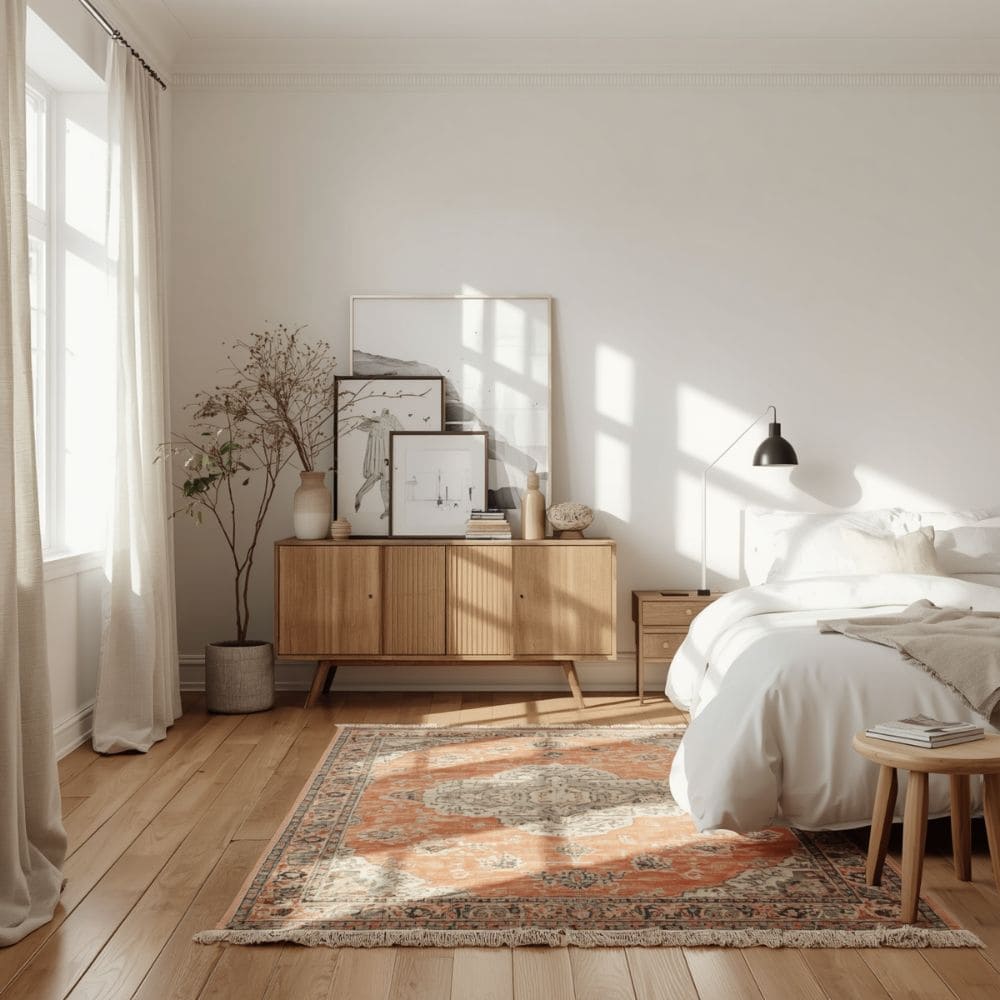
The target: the rug covers the area from below the foot of the bed to at least 60cm in front of it, and extends at least 40–50cm beyond both sides of the bed frame.
What Size Rug for a Bedroom?
Rug size for a bedroom is determined by two reference points: the bed dimensions and the room proportions. Both matter. Sizing for the bed alone — which is the most common approach — produces the result I described in the introduction.
Standard sizing rules for different bed configurations
As a starting rule, the rug should be sized so that all four legs of the bed rest on it and there is at least 40–50cm of rug visible on both sides and at the foot.
- Single bed: minimum 160cm x 230cm rug — or a 90cm runner on each side of the bed
- Double bed (135cm wide): minimum 200cm x 290cm rug
- Queen or King bed (150–180cm wide): minimum 240cm x 340cm or larger
These are minimum sizes. In a room with higher ceilings or a longer wall-to-bed distance, the rug should scale up accordingly — which is where the room proportions become the reference rather than the bed alone.
The “gap” between the edge of the rug and the wall or wardrobe next to it is also as important, as the proportions of the room. If you have a larger room, the gap can be bigger, but in smaller rooms, smaller gaps looks better.
A rug for small bedroom — when a runner works instead
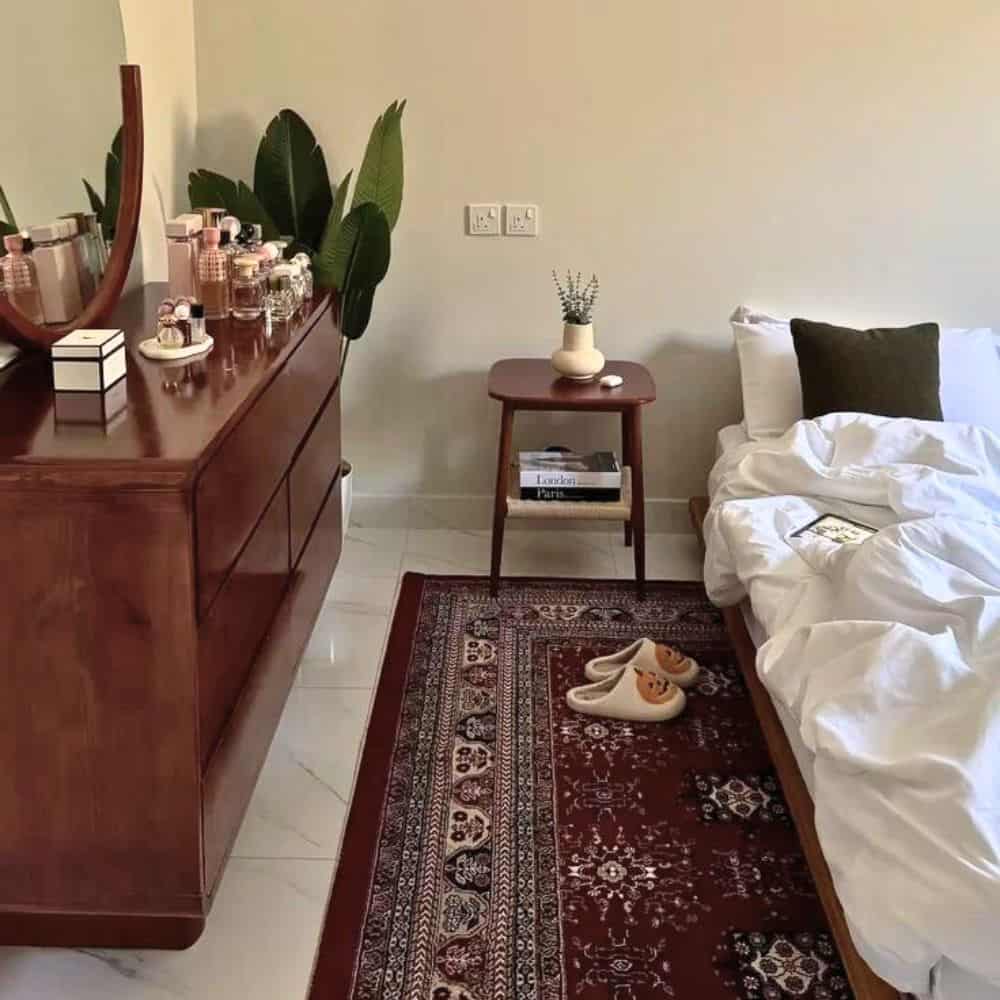
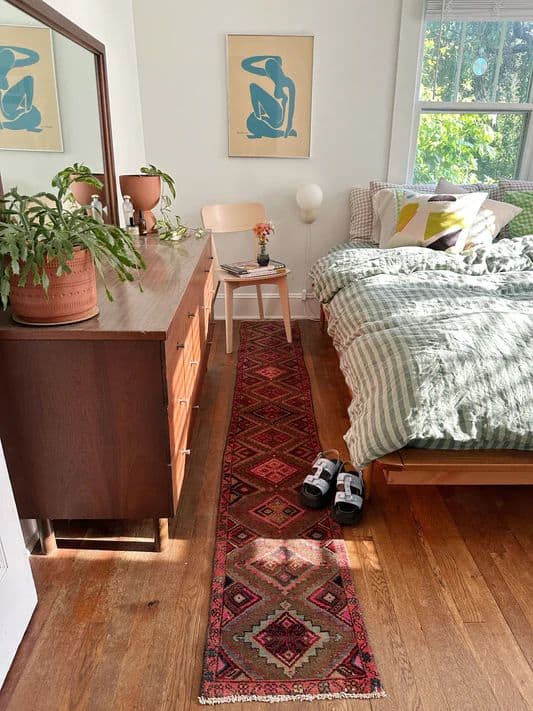
In a room where the bed is positioned against one wall — or in a very narrow room where a wide rug would cover the entire floor — two runners placed on either side of the bed are a practical alternative to one large area rug.
Each runner should be at least 60–70cm wide and extend from the headboard zone to well past the foot of the bed. Two runners read as a deliberate design decision when they share the same material and color — and as an accident when they do not match.
For how the rug position relates to the overall bedroom floor plan, the small bedroom ideas guide covers floor area planning across the full room.
Bedroom Rug Material — What to Put Your Feet On
The morning-foot experience of a bedroom rug is determined by material and pile height. Both should be chosen for how the rug feels at 7am in bare feet, not for how it photographs.
Wool versus natural fiber — the real choice
Wool rugs are the most comfortable underfoot, the most acoustically effective, and the most durable over time. They respond well to cleaning, they hold pattern and color over years, and they soften with use rather than degrading.
Natural fiber rugs — jute, seagrass, sisal — are less expensive and carry a warm earthy tone that requires no palette decision. The trade-off: they are noticeably rougher underfoot, particularly in low-pile or tight-weave constructions, and they do not clean as easily as wool.
The compromise for a small bedroom: a flat-weave wool rug in a natural tone — the softness of wool at a lower price point than a thick pile, with the easy cleaning of a flat surface.
Pile height in a bedroom — lower than you think
A high-pile rug in a bedroom looks appealing in photographs. In use, it presents two problems: it catches dust and allergens in the pile, and it creates a tripping edge at the visible foot of the rug — where the pile height meets the hard floor.
Low to medium pile — under 15mm — performs better in a bedroom for daily use. It is easier to vacuum, produces less of a visible transition edge, and holds its appearance for longer than high pile under regular foot traffic.
A flat-weave rug is the lowest-maintenance option and the one most aligned with the earthy bedroom aesthetic — for how it fits with natural materials and warm palettes, the earthy bedroom post covers rug material as part of the natural material system.
Bedroom Rug Pattern — Persian, Vintage, and Area Rug Aesthetic
I have loved Persian and Middle Eastern rugs for as long as I have thought seriously about interiors. The reason is specific: a well-made traditional rug contains a complete color palette — multiple tones that the weaver has already decided work together.
When you bring a traditional rug into a room, you are not deciding how to make colors coexist. That decision was made for you, decades or centuries earlier, by someone who spent their working life doing it.
Why a Persian or vintage rug is the most space-tolerant pattern choice
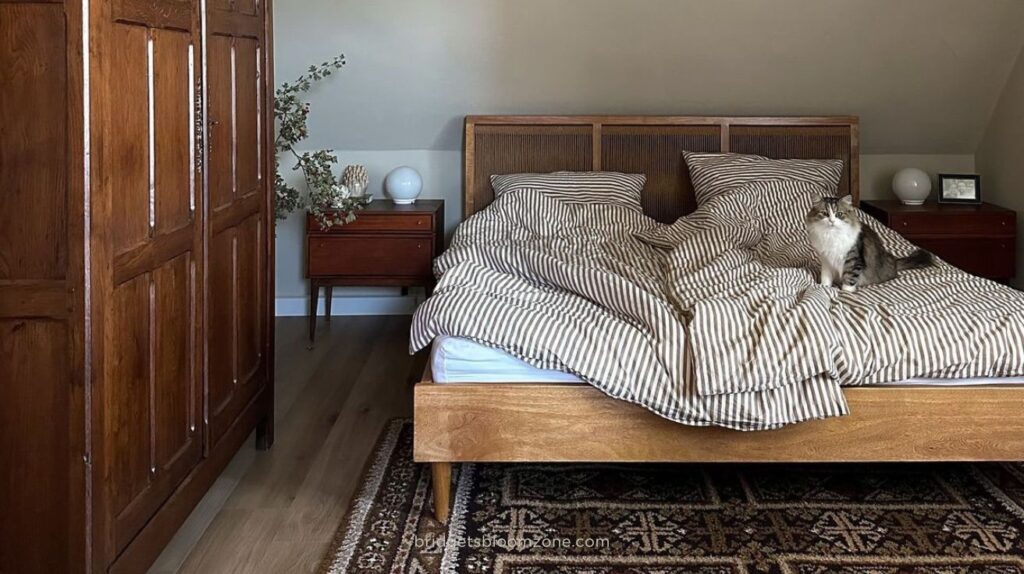
A Persian rug style — or any traditional woven rug with a repeat pattern — has a visual quality that makes it almost room-size-independent. The pattern is made up of small, repeated elements that the eye absorbs as a texture rather than as a design to decode.
This means a traditional rug in a small bedroom reads as warmth and texture, not as visual complexity. The same pattern in a large room reads the same way. A bold geometric or large-scale contemporary pattern in a small room, by contrast, can dominate the space.
Apartment Therapy’s coverage of small bedroom rug choices identifies traditional and vintage patterns as the most consistently successful in rooms under 16 square meters — specifically because of this scale-independent quality.
Solid rugs and when they are the right choice
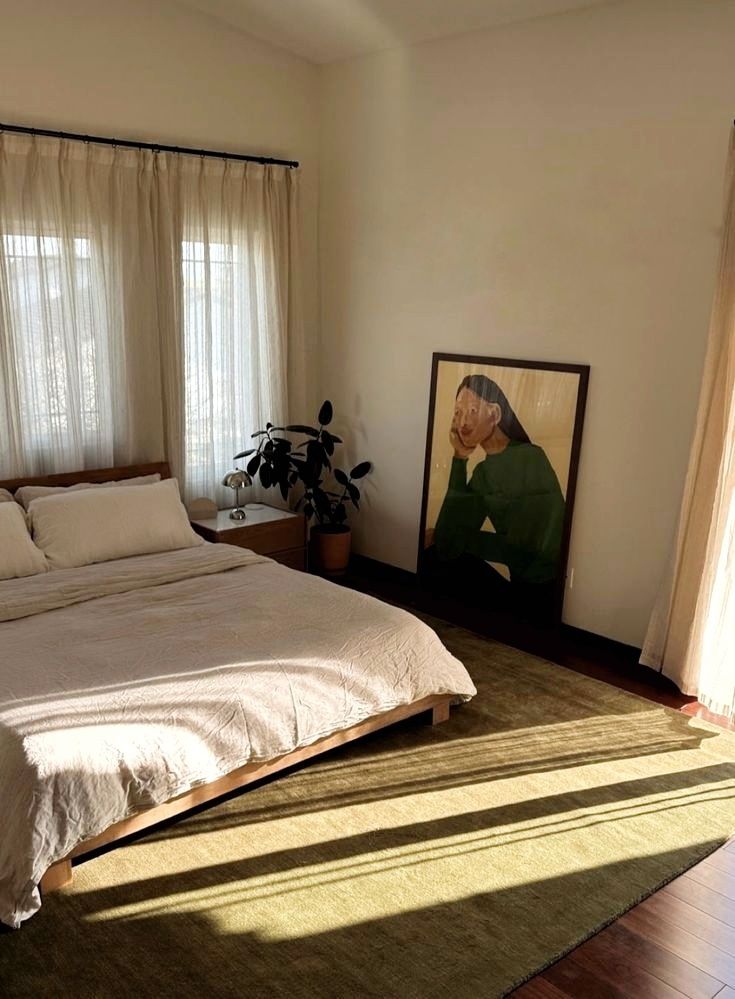
A solid-color rug is the right choice when the bedroom palette is already carrying pattern through another element — a headboard fabric, a patterned cushion, a printed wallpaper on one wall.
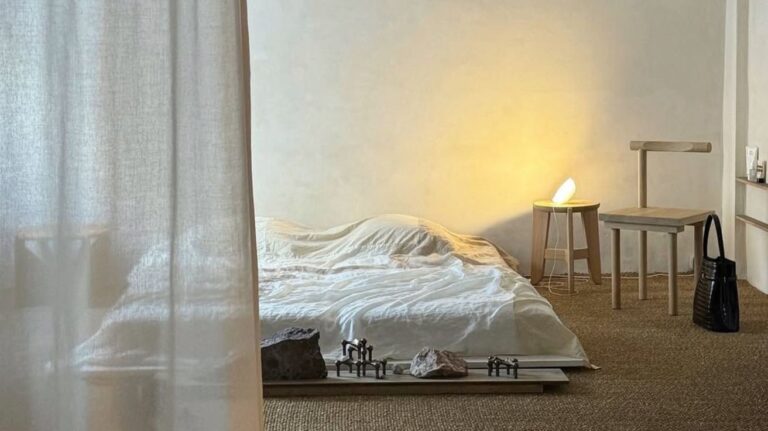
A solid bedroom rug in a warm natural tone — undyed wool, warm jute, stone-tone flat-weave — is the quietest version of the bedroom rug decision. It contributes material warmth and acoustic softening without adding any visual information to the room.
For how the rug color fits into the overall bedroom color combination, the bedroom color combination guide covers the rug as the secondary layer in the 60-30-10 framework.
Architect’s choice
If I would pick for myself, I would choose an antique (or new) traditional wool rug from the Middle East or Turkey. Supporting a small manufacturer. I think you know already, I love these colorful beauties.
This is an expensive option, but these last for more than a lifetime. I mentioned the Lost Hunt Vintage shop to buy something unique, but as a budget option you can find amazing quality products on amazon, like this one or this rug (paid links).
For something more modern, I would buy something like this from Amazon (paid link). Simple, textured and some good colors to choose from.
An other rug type I love is this type, that looks like it is woven. Very easy to clean and maintain. It is a budget option but still quality. It should always be paired with a non-slip rug pad underneath to prevent slipping. Best is when you fix that to the floor (double sided tape will do it).
Final Thoughts
Size first, every time. The rug that is correctly sized for the room is almost always the rug that works — regardless of pattern or material. The rug that is 30cm too short is almost always the rug that bothers you every morning.
Material follows from use. Wool for comfort and acoustics, natural fiber for warmth and budget, flat-weave for easy maintenance. Forget the synthetic. Pile height lower than instinct suggests in a bedroom that you will be walking through in bare feet at 6am.
Pattern is the least constrained decision in the sequence — traditional and vintage rugs carry a built-in palette relationship that most contemporary rugs have to work hard to achieve.
For the earthy bedroom context in which rugs feature most strongly, read more tips in my earthy bedroom guide, which covers rug material as part of the natural material system.

Frequently Asked Questions About the Bedroom Rug
What size rug should I get for a bedroom?
The rug should extend at least 40–50cm beyond both sides of the bed frame and at least 60cm beyond the foot of the bed. For a double bed, that means a minimum of 200cm x 290cm. For a king or queen bed, 240cm x 340cm or larger. When in doubt, size up — a rug that is too small is visible every day.
Where should a bedroom rug be placed?
Centered under the bed, with all four bed legs on the rug, and equal exposure on both sides. The foot of the rug should extend far enough to be the surface your feet land on when getting out of bed — which is the primary daily use of a bedroom rug.
What material is best for a bedroom rug?
Wool — or a wool blend — for the best combination of softness underfoot, acoustic performance, and durability. A flat-weave wool is the highest utility choice for a bedroom: easy to vacuum, comfortable on bare feet, and long-lasting. Natural fiber rugs (jute, sisal) are warmer in tone but noticeably rougher underfoot.
Can a rug be too big for a bedroom?
In most small bedrooms, the more common problem is a rug that is too small. A rug becomes too large when it covers most of the floor to within 10–15cm of the walls — at that point it functions as a carpet, not a rug, and reduces the visual contrast between the rug zone and the surrounding floor.
What is the best rug style for a small bedroom?
A traditional or vintage rug — Persian, kilim, or similar woven pattern — is the most space-tolerant style for a small bedroom. The pattern is made up of small repeated elements that the eye reads as texture from standing height, which means the design does not compete with the room. A solid rug in a warm natural tone is the quietest alternative.
Should a bedroom rug go under the bed?
Yes — at least the lower two-thirds of the bed should rest on the rug. All four legs of the bed frame on the rug is the standard approach. A rug that sits only at the foot of the bed, with the bed floating above bare floor, looks like the rug was placed as an afterthought rather than as a design decision.