Work From Home Desk Setup: The Size and Shape That Fit a Small Room
This post contains affiliate links. If you buy through them, I may earn a small commission — at no extra cost to you. I only recommend products I’d genuinely specify as an architect.
The first real work from home desk setup was a piece of furniture that closed at the end of the day.
A seventeenth-century escritoire folded shut and went back to being a cabinet in the sitting room. Pens, ink, paper, and whatever else the work needed all lived inside it.
Four hundred years later, most of us have a rectangle against a wall that never closes, carries four cables, and is somehow still too shallow.
The smallest desk that fits your wall and the smallest desk you can actually work at are two different objects. The gap between them is usually about 15 cm of depth.
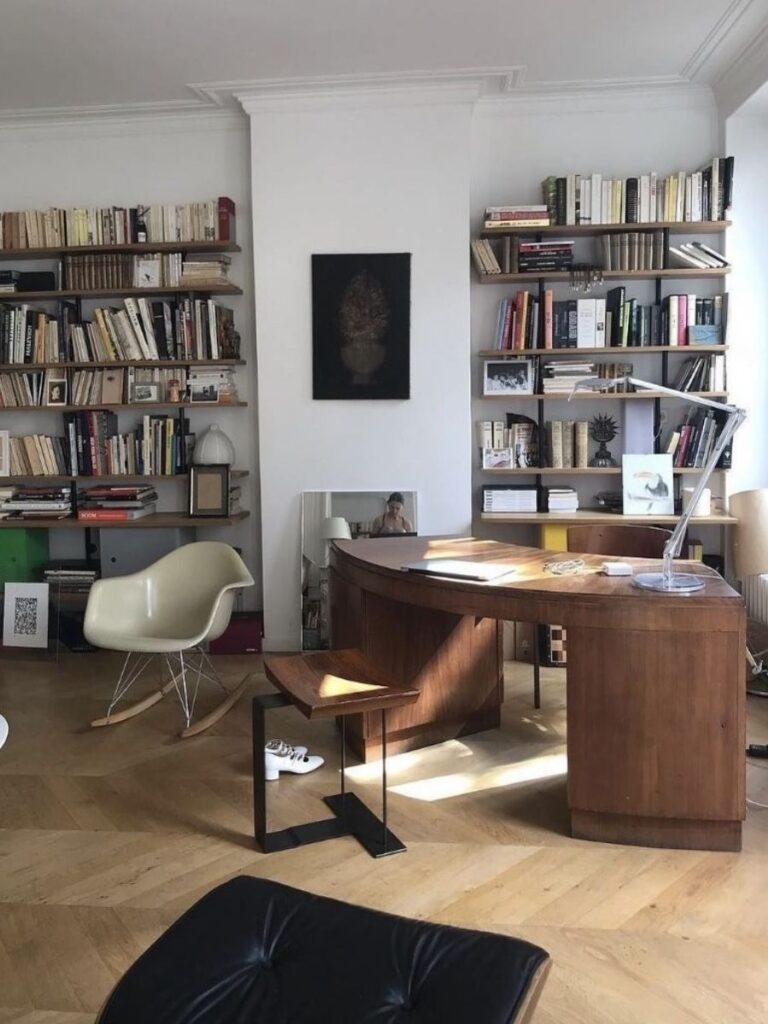
My own arrangement has stayed roughly the same through several apartments. I sit with the window on the short side to my left, so the light arrives from the side and rarely lands on the screen.
The view is there when I want it and quiet enough that it does not pull at me. Behind my chair I keep a sideboard, because sewing, drawing, and leather work all need somewhere to be set down.
That sideboard does most of the storage work, which is the same principle behind the living room storage ideas I use everywhere.
Almost any room can be persuaded into that arrangement. The pieces are small and movable, so when I need the floor back, everything shifts.
Three Desk Archetypes That Still Decide Your Options
Every desk you can buy today descends from one of three ideas. Knowing which one you are looking at tells you immediately whether it belongs in a small room.
The desk that closed
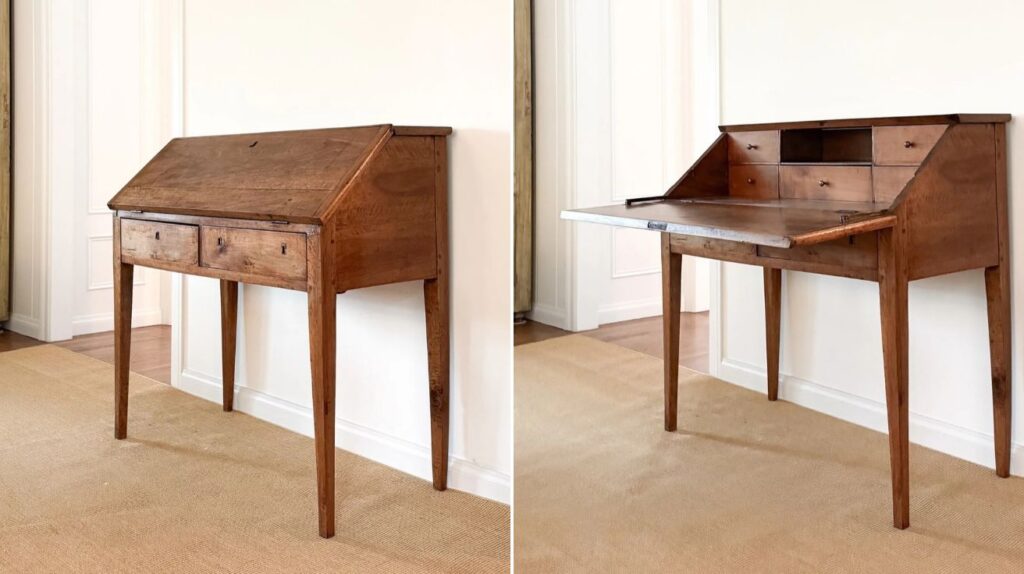
The escritoire arrived as a compact writing surface built onto a cabinet, designed to fold shut and live in a room that had other jobs to do. Small drawers and pigeon holes held everything the work required.
Its name traces back to bure, the woollen cloth used as a writing pad. That detail comes from a short history of desks that is worth reading if furniture origins interest you.
Furniture built for writing at home was designed to disappear every evening. Nobody treated that as a compromise. It was the brief.
The desk that announced you
The Bureau Mazarin, made for Cardinal Mazarin in the second half of the seventeenth century, placed drawer stacks either side of the sitter’s knees. The pedestal desk that followed ran those drawers all the way to the floor.
Storage was enormous. Presence was the real point, and these desks were finished on all four sides because they stood in the middle of a room rather than against a wall.
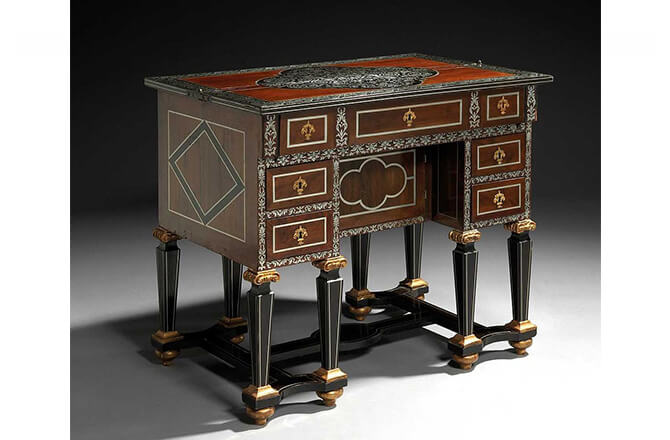
(photo via the invaluable blog and originally via Wikimedia Commons)
Two archetypes, two spatial functions. One is intimate and closable, and the other needs a room built around it.
The desk that got lighter, then met the cable
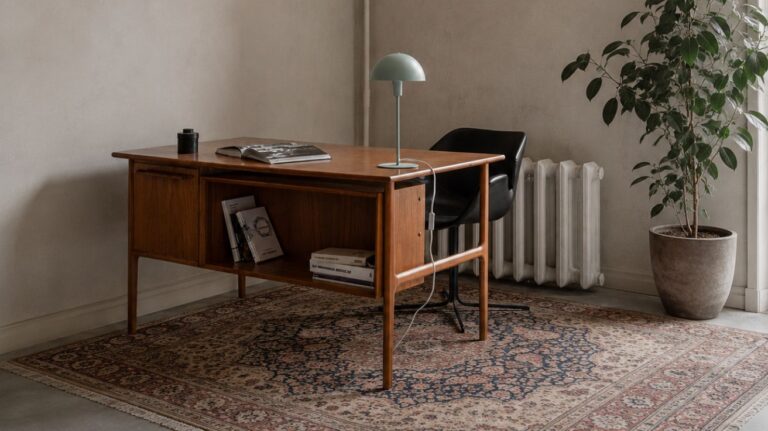
By the mid-twentieth century the pedestal had been stripped back to four slim legs and a shallow top. Mass production, material economy, and a genuine shift in taste all pushed in the same direction.
That silhouette is still the most photographed desk shape on Pinterest. It is also the least able to cope with a charger, a monitor cable, a dock, and a lamp, because it was designed to hold a fountain pen.
If you buy the mid-century shape, budget for a cable tray at the same time. The design never evolved to carry what you are about to put on it.
Depth Is the Decision in Any Work From Home Desk Setup
Width is negotiable and height is standardized. Depth decides how far your eyes sit from the screen, which is the part your body will complain about.
60 cm is the standard, and it is a laptop number
Most desks are built at around 60 cm deep. That works for a laptop, a mug, and a notebook.
Add a monitor on its own stand and the screen ends up close to the front edge. You then either slide the chair back or lean in, and neither is free across eight hours.
70 to 76 cm is where a monitor becomes comfortable
Ergonomics guidance from OSHA, ISO 9241, and optometry bodies converges on roughly 50 to 75 cm between your eye and the screen. A 27-inch monitor sits near the top of that range.
Standard desk depth runs 61 to 76 cm, and the deeper end is what makes that viewing distance achievable without a workaround.
Below 55 cm, and why a monitor arm is not the answer
A desk-clamped monitor arm does not add depth against a wall. The arm extends the screen forward from its post, and it cannot push it through the plaster.
What it genuinely does is remove the stand base, typically 20 to 25 cm deep. That returns surface to your keyboard rather than distance to your eyes.
Real depth recovery needs clear floor behind the desk, which means a freestanding one rather than an alcove.
In an alcove, take the screen off the desk and mount it on the wall. Your eye sits about 15 cm behind the front edge, so a 50 cm shelf gives roughly 65 cm of viewing distance.
That suits a 24-inch screen and is too close for a 27. Guidance on minimum desk sizes for home offices puts the absolute floor for laptop-only work at around 60 cm.
Depth decides which screen you can have, so choose it from your equipment rather than from your wall.
So my advice is: desk below 60 cm depth works only for a few hours per week laptop work.
| Depth | What fits on the surface | Where the screen goes | Largest screen | Trade-off |
|---|---|---|---|---|
| 30–40 cm | Laptop and a closed notebook | Laptop screen only | 16 in laptop | No external screen at any workable distance |
| 50–55 cm | Laptop, keyboard, mouse | Wall-mounted, off the desk entirely | 24 in | A desk-clamped arm gains you nothing here |
| 60 cm | Laptop, keyboard, mouse, mug | On its own stand, pushed to the back edge | 24 in | The stand base eats 20–25 cm of surface |
| 70–76 cm | Monitor plus laptop alongside | Stand, or an arm if the desk is free of the wall | 27 in | Takes 15 cm more floor than most small rooms have |
| 80 cm+ | Dual screens, or drawing and sewing | Two arms, both stand bases removed | Two 27 in | Occupies the footprint of a single bed |
Width, Height, and the Measurements Nobody Publishes
Once depth is settled, the rest follows quickly. Two of these numbers never appear in a product listing.
Width in the sizes that suit a small room
- 90 cm works for laptop-only sessions and fits almost any alcove
- 100 to 120 cm is the sweet spot for a small room with a monitor
- 150 cm and above is the standard office width, and it swallows a small bedroom
Width is a proportion decision as much as a fitting one. The small apartment ideas post covers how proportion changes the way a room feels.
Height, and who the standard was written for
Fixed desks land between 72 and 76 cm, which suits adults around 170 to 185 cm tall. Everyone else compensates with the chair and a footrest.
Dining tables sit inside the sitting band, so height is rarely why a dining table feels wrong. Motion capture research comparing the two found the clearest difference at the shoulders.
The chair cannot be raised, and a laptop keyboard pulls your arms in and up.
The three numbers no listing tells you
- Knee clearance width between the legs or pedestals, which needs at least 55 cm
- Apron depth under the top, since a deep rail cuts into the 65 cm of thigh height you need
- Chair clearance behind, which wants 90 to 100 cm of clear floor to push back and stand
That last one is the reason so many small-room desks feel cramped even when the desk itself fits. Circulation planning is covered properly in the small living room layout rules – if you need help, where to start, start here.
When the minimum is the wrong answer
One of my apartments was long and narrow, 260 cm wide and 560 cm long. That was the year I finally bought an adjustable standing desk.
It was on sale, it was motorized, and it was enormous. Eighty centimeters deep and 160 wide, which is roughly the footprint of a single bed.
My justification was that I sew, draw, paint, and work with leather and wood, and all of that needs surface. Whether the justification came before or after the purchase is a question I have chosen not to examine.
I still love that desk. Compromises happened everywhere else in the room, and they were worth it.
Here is one extra, old fashioned but fantastic trick to hide a monitor in a white room. I mentioned it earlier on the previous blogpost, how to clear the table after work.
Key takeaway: This post gives you the ideal numbers. If the minimum genuinely does not suit how you work, the task changes into fitting your real dimensions into a small room.
Rectangle, L-Shape, or Corner in a Small Room?
Shape is a footprint question before it is a style question. It is also the point where most people forget that a desk can stand away from the wall.
The rectangle commits to one wall
A rectangle claims a single wall run and leaves the rest of the room intact. For a small room that is usually the safest starting point.
It also gives you the widest choice of pieces, since almost every desk ever made is one.
L-shapes claim two walls, unless you free them
Pushed into a corner, an L-shape occupies two wall runs and the corner between them. In a room where wall length is your scarcest resource, that is a large ask.
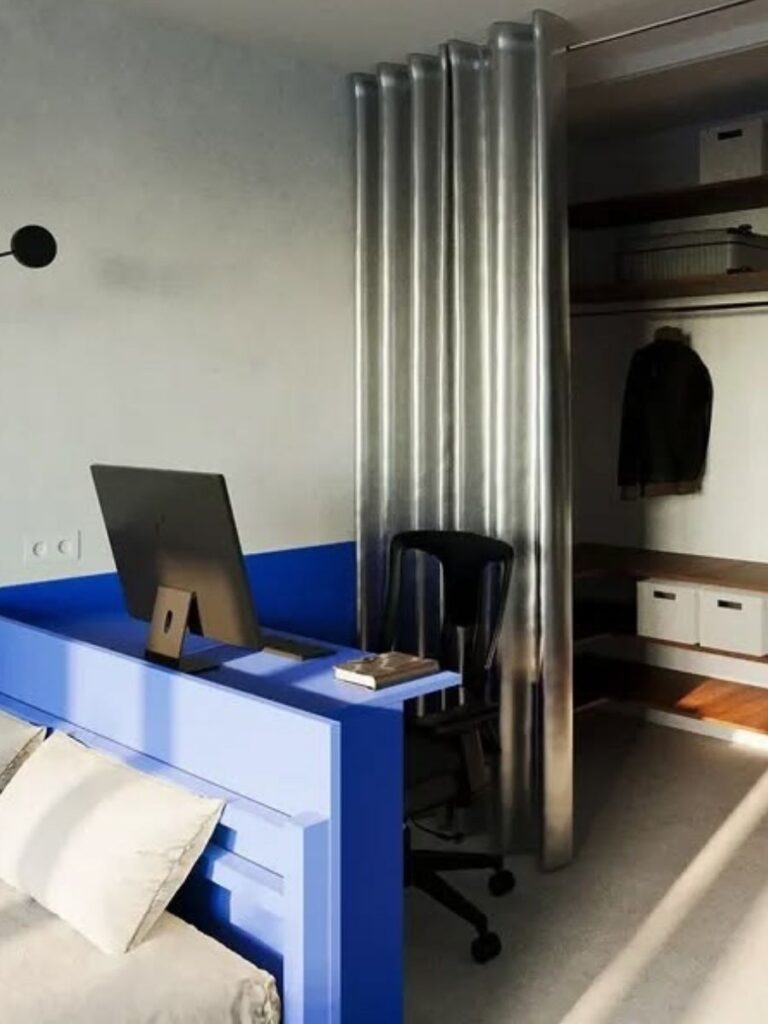
The version people rarely consider is the freestanding one. An L-shaped desk placed out in the room, with the short arm pointing into the floor area, works as a barrier between a working zone and a living zone.
You sit inside the L. The living area begins immediately on the other side of it, with no divider needed and no wall consumed.
A desk as a room divider
The pedestal desk understood this four centuries ago, which is why the backs were finished. A desk standing in the room is a piece of architecture rather than a shelf against a wall.
Two conditions have to hold. You need a finished back or a low unit behind it, and you need a plan for the cables, since the desk is no longer near a wall socket.
In a room under about 300 cm wide, a freestanding desk usually blocks the circulation path. Measure the route from door to window before you commit.
Corner desks and the dead triangle
A corner desk with a diagonal front creates a triangle of unreachable space behind it. That area is deep, dark, and where cables go to tangle.
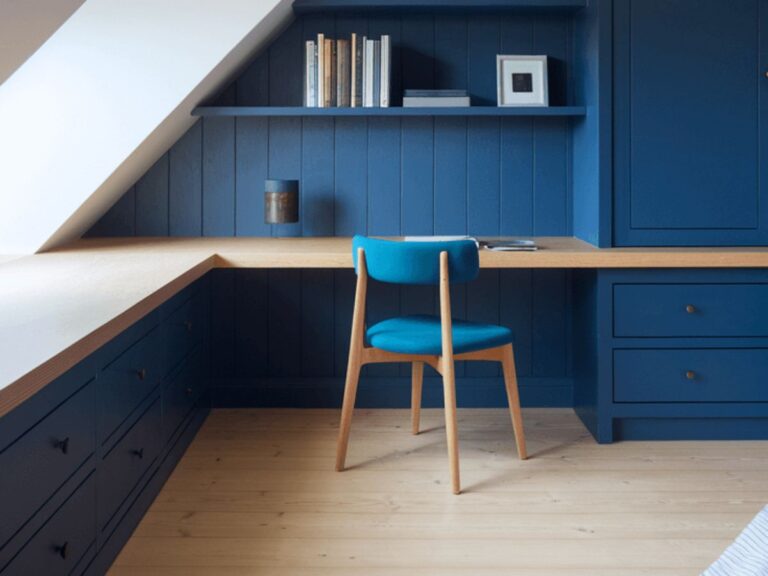
The shape earns its place when the corner is otherwise unusable, and in a room with slanted ceilings it can be genuinely clever. The attic room guide covers how to work with the low side.
Nine Work From Home Desk Setup Types, Measured
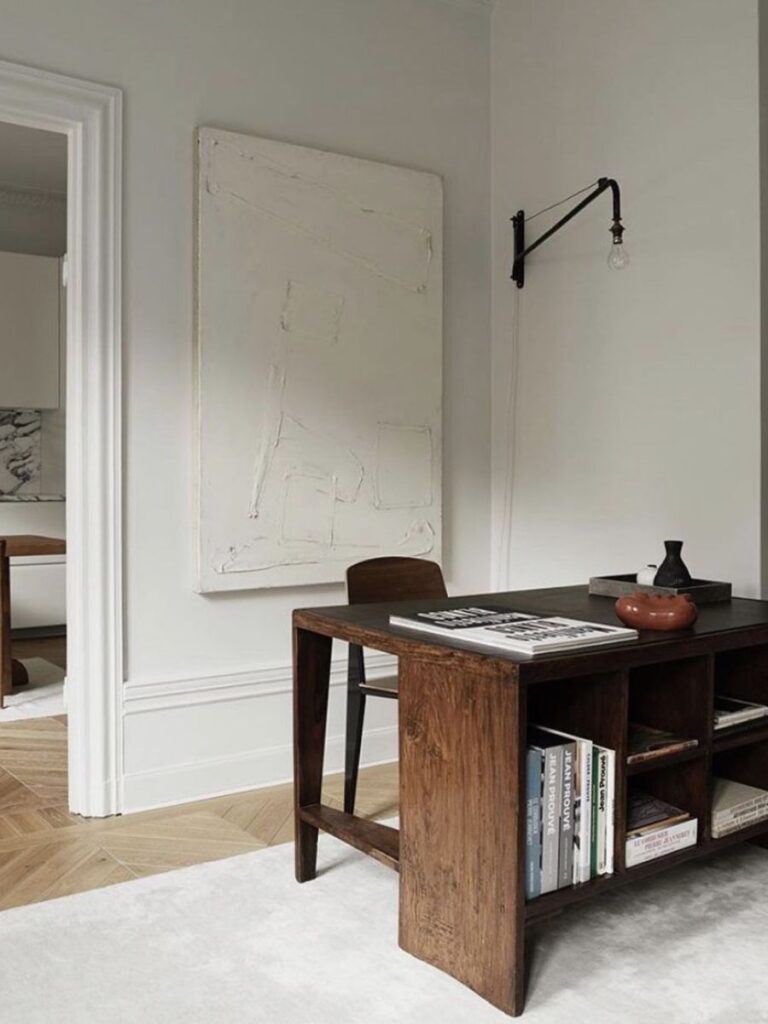
Each of these solves a different constraint in a work from home desk setup. The dimensions matter more than the styling, so they come first.
1. Wall-mounted fold-down desk
Thirty to 50 cm deep when open, and close to nothing when closed. The surface folds flat against the wall and the floor stays clear.
Best for laptop work in a room that has to do something else in the evening. The trade-off is that you cannot leave anything on it.
2. Console or narrow writing desk
Typically 30 to 40 cm deep, which reads as furniture rather than office equipment. It sits comfortably against a wall or behind a sofa.
Allow 55 to 60 cm if you work with a monitor. Below that only laptop screens work unfortunately.
A task lamp beside it does more for how the corner reads than the desk does. The lighting rules for small spaces explain the layering.
3. Modern secretary with a fall front
The escritoire logic in current production. A drop-down flap gives you 40 to 50 cm of working depth, and the flap closes over the mess.
Check the internal height before buying. Many are built for paperwork rather than for a laptop with a raised screen.
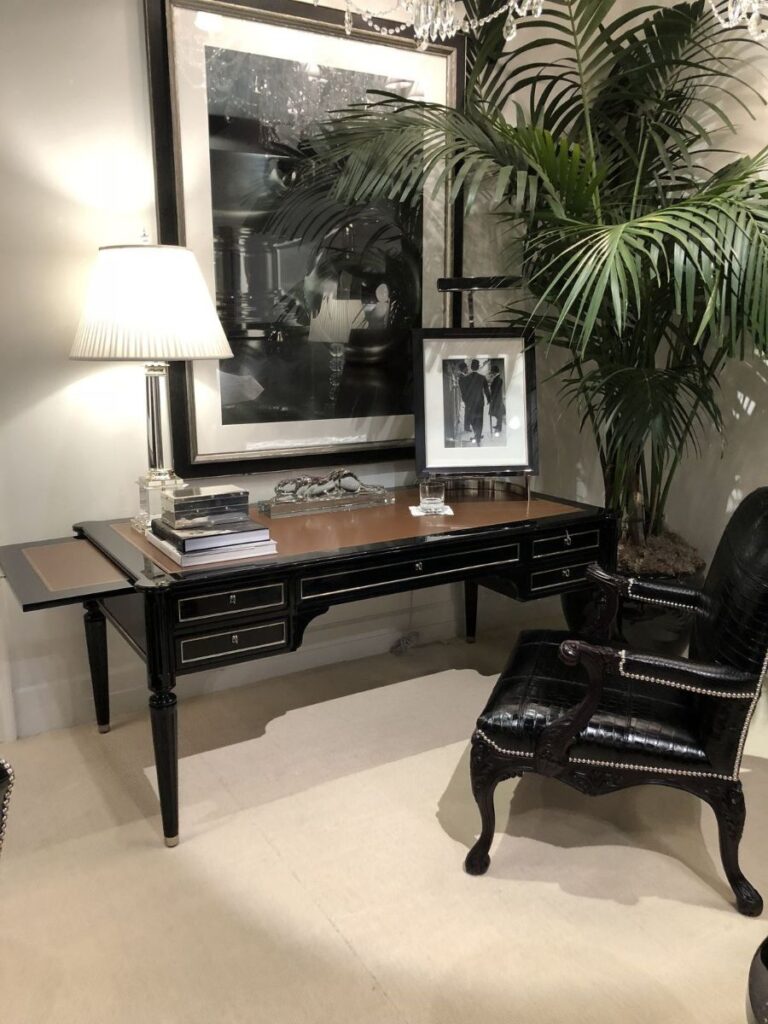
4. Antique secretary or bureau
Shallower than you expect, often 35 to 45 cm of usable surface, and almost always shorter than modern seat height suggests. Also full of character.
A piece like this brings personality into a small apartment, and people ask about it. Test the leg room with a real chair before you buy.
5. Armoire or cabinet workstation
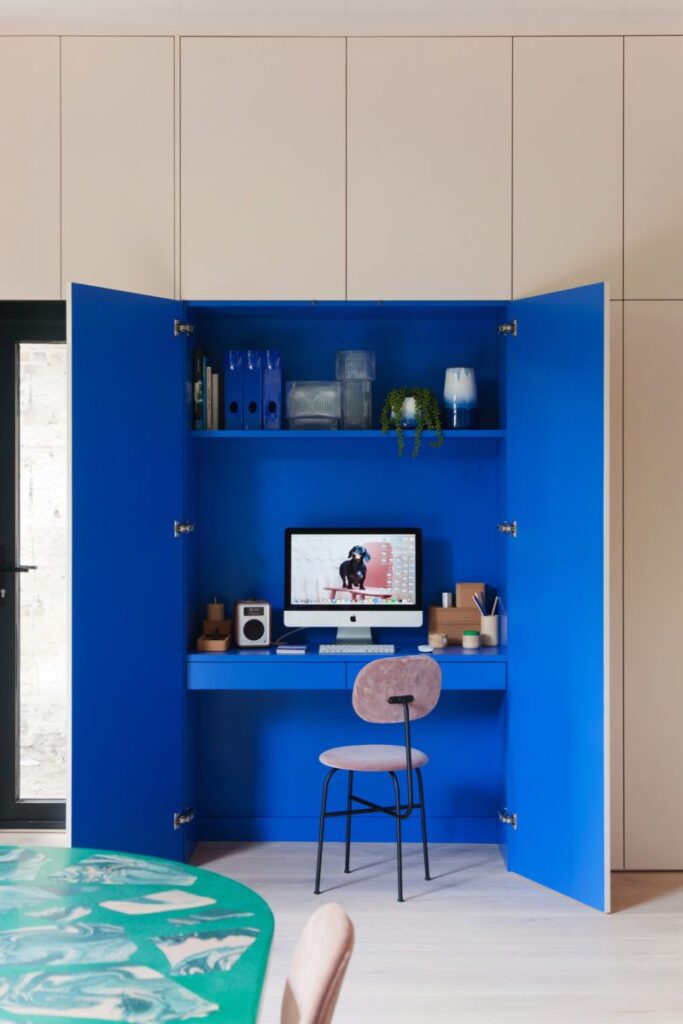
Inside a full-height cabinet, usually 1.5 to 2 m tall, a writing surface hides behind two or four doors. Everything vanishes at the end of the day.
Measure the door swing rather than the carcass. An armoire that is 90 cm wide can need 180 cm of clear space to open.
6. Closet desk
A standard reach-in closet runs around 60 cm deep, which matches the laptop number exactly. Take the doors off or hang a curtain, then fix a shelf at 74 cm.
You lose a closet and gain a workspace that closes. Heat build-up is the thing to plan for.
Deciding what leaves the closet first is covered in the wardrobe design guide.
7. Window recess or deep sill desk
A board across a deep reveal gives you a desk with no floor footprint. Depths of 30 to 50 cm are common in older buildings.
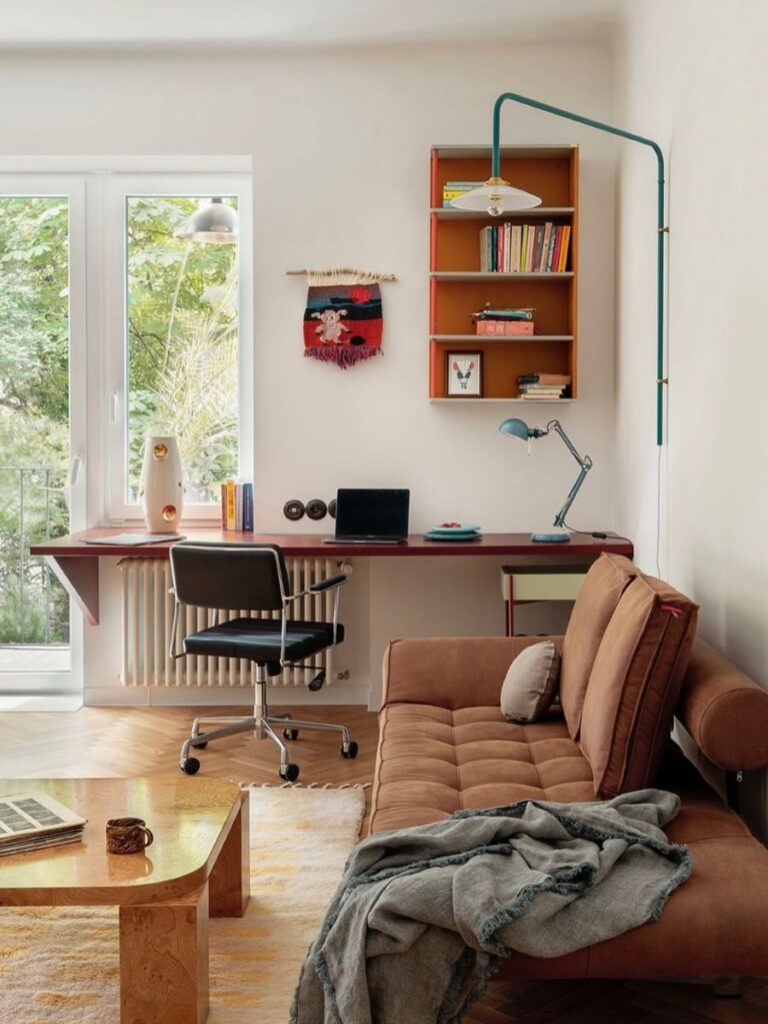
Check the window sills heights if they are correct for a table. Radiator position is the second thing that decides whether this works. Custom built-in options get a full treatment later in this series.
8. Behind-the-sofa console
Thirty to 35 cm deep, using floor that the sofa already claimed. It suits short sessions and standing work.
Pair it with a stool that tucks under. The multifunctional living room furniture guide covers how to make a piece like this earn its place.
9. Slim height-adjustable desk
Available from around 60 x 100 cm, which is small enough for a bedroom corner. The frame adds visual weight even when the top is light.
Cable slack has to cover the full travel. Whether the upgrade is worth it gets its own post in this series.
What Size Desk Does a Small Room Actually Need?
Start from your equipment and your hours, then check the wall. Four situations cover most small-room readers.
| How you work | Size | Shape and position | What to add |
|---|---|---|---|
| Laptop only, a few hours a day | 90 to 100 x 50 cm | Console against a wall or behind a sofa | Laptop riser and external keyboard |
| Full days with one monitor | 120 x 70 cm | Rectangle, back to a solid wall | Cable tray under the top |
| Room has to convert every evening | 100 x 40 cm open | Fold-down, secretary, or closet nook | One box for everything that comes off it |
| Desk doubles as a craft surface | 140 to 160 x 80 cm | Freestanding, ideally dividing two zones | Storage directly behind the chair |
If none of those rows describes you, the honest answer is the largest surface your circulation path will tolerate.
Final Thoughts
A work from home desk setup that holds up follows one order. Choose depth from your equipment, width from your wall, and shape from your circulation path.
The idea worth borrowing from four centuries ago is the one that keeps proving itself. A surface that closes, or clears completely, is still the most useful thing a small home can have.
Before you order anything, read the work from home setup guide to settle where the desk goes. The living room office combo post settles which way it faces.
If the room is also a bedroom, the living room and bedroom combo guide should come first.
For the wider furniture question, the architectural principles for small-space furniture and the room-by-room furniture decision guide both apply here. If your desk lives in a studio, start with the studio apartment layout ideas.
Tell me what you ended up with, and whether you regret the size. Leave a comment below, or join the newsletter to follow the renovation diary and more posts on small-space living.
Frequently Asked Questions About a Work From Home Desk Setup
What size desk do I need for a small room?
For laptop-only work, 100 x 60 cm is enough. Add an external monitor and you want 120 x 70 cm, or a monitor arm to compensate for shallower depth.
Is a 60 cm deep desk enough for a monitor?
It works with a monitor arm and gets tight without one. On a stand, a 27-inch screen ends up closer than the recommended 50 to 75 cm viewing distance.
Is a 100 cm wide desk too small?
No, provided the depth is right. Width mostly affects how much you can spread out, while depth affects your neck and eyes.
Are L-shaped desks a good idea in a small room?
Only when you genuinely need two work surfaces. They claim two wall runs in a corner, though a freestanding L can pay for itself as a zone divider.
What is the standard desk height?
Between 72 and 76 cm, which suits adults roughly 170 to 185 cm tall. Outside that range, adjust the chair and add a footrest, or choose a height-adjustable frame.
How much space do I need behind my desk chair?
Allow 90 to 100 cm of clear floor so you can push back and stand without hitting anything. This is the measurement most small-room setups get wrong.
Can I use a console table as a desk?
Yes for laptop work, since most consoles run 30 to 40 cm deep. Check the height, because many sit lower than 72 cm and will force your shoulders up.
Are antique secretary desks practical for computer work?
They give you 35 to 45 cm of usable surface, which suits a laptop and little else. Test the leg room with a modern chair before committing, since many were built for shorter seats.
Do corner desks save space?
A corner desk uses awkward space well and wastes the triangle behind the diagonal front. In a room with slanted ceilings or an unusable corner, the trade is often worth it.